AI-Assisted Parent Literacy: What India Is Doing That European Schools Are Missing
India’s Quiet Literacy Infrastructure — and Why It Should Concern European Administrators
European schools are racing to adopt AI — but almost entirely in one direction. AI tools for teachers, AI tools for classrooms, AI tools for student-facing learning. What is conspicuously absent from European and MENA school AI strategies is the highest-leverage use case of all: activating the home. The parent, historically the single strongest predictor of early literacy outcomes, is not in the policy frame.
This is not a minor oversight. The OECD has now named it directly. In 2026, the OECD released Reimagining Teaching in an Accelerating World, a wide-ranging background report on how technology is reshaping educator roles globally. Amid its analysis of professional development, curriculum reform, and teacher shortages, one brief section stands out for what it says about where AI is being deployed most creatively — and most consequentially.
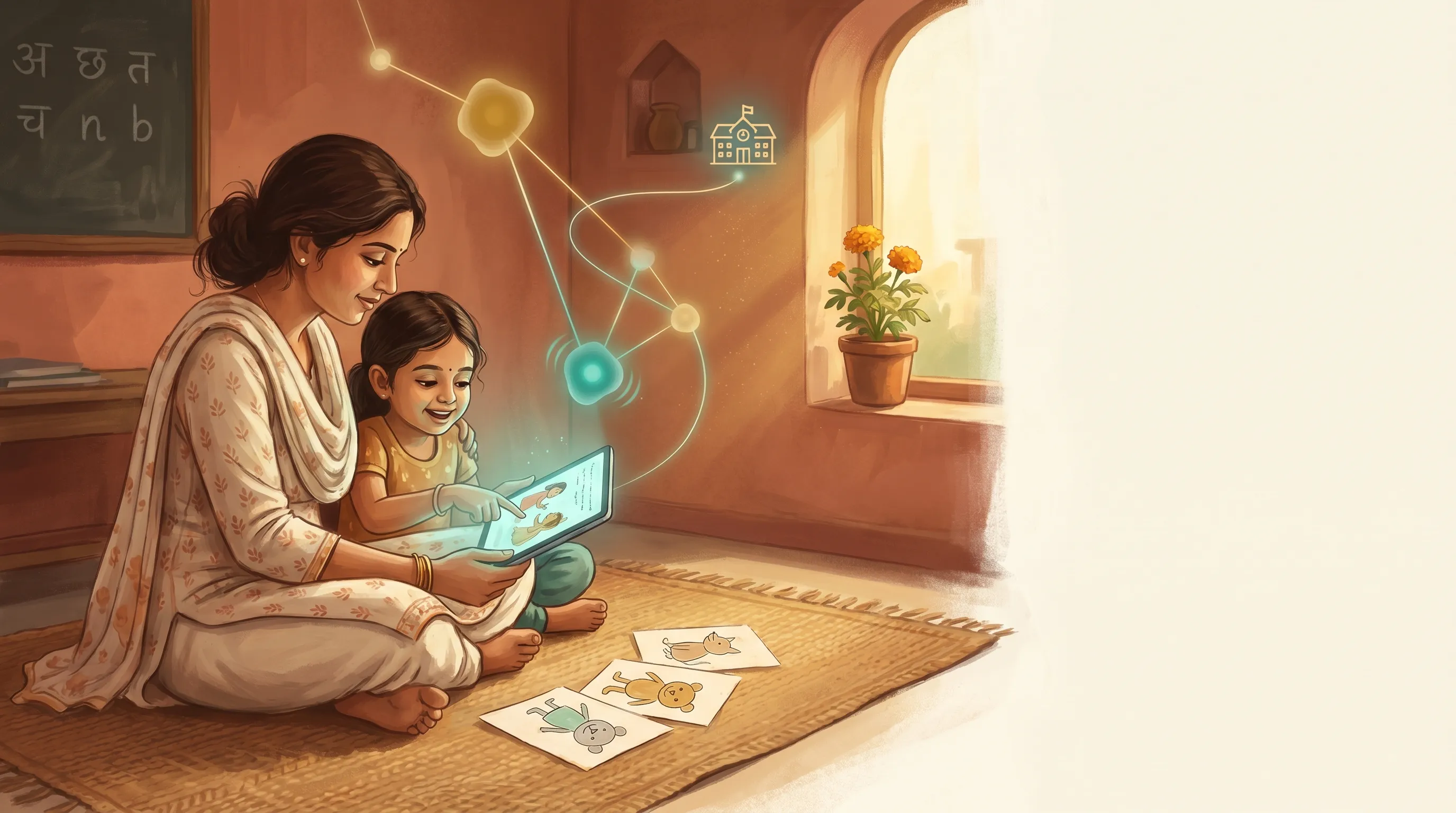
India, the report describes, is using generative AI applications to empower parents to read and invent new stories with their children. The OECD frames this not as an experimental pilot or a curiosity, but as a deliberate act of “Strategic Barrier Removal” — a systematic effort to dissolve one of the oldest and most intractable obstacles in early literacy: the gap between what happens in school and what happens at home.
According to a PolicyEdge analysis of the OECD report, this approach “shows direct correlation with improved foundational literacy skills.” The OECD stops short of a causal claim, and so should we — but the association is significant enough to warrant serious attention.
Meanwhile, European policy frameworks are accelerating AI adoption in schools. The problem is that they are pointing almost entirely in one direction: at teachers and classrooms. The family side of the literacy equation — historically the higher-leverage lever — has been left largely unaddressed.
The Five Tools India Built to Activate Families
India’s foundational literacy challenge is, by any measure, formidable. Pratham’s Annual Status of Education Report (ASER) 2024 found that just 23.4% of Class 3 students in government schools can read a simple Class 2-level story. That figure represents a recovery from a pandemic low of 16% in 2022, but it remains far below the national NIPUN Bharat target of universal Foundational Literacy and Numeracy by 2026-27.
To understand why India has moved aggressively toward AI-assisted family engagement, it helps to understand the scale of institutional response required. India’s NIPUN Bharat Mission reaches 5 crore students, 17 lakh teachers, and over 6 lakh schools. Teacher-to-student ratios and geographic spread make classroom-only solutions structurally insufficient.
Several programmes have emerged from this pressure:
PadhAI (Pratham): An AI-powered reading assessment tool developed by the Pratham Education Foundation. Rather than replacing teacher assessment, PadhAI is designed to generate actionable reading-level data that can be shared with families in accessible formats.
NIPUN Mentor App and NIPUN Samvaad (Haryana/CSF and Bihar): Developed with support from the Central Square Foundation, these tools support teacher coaching and community communication around foundational learning goals. The NIPUN Mentor App creates structured guidance channels between educators and the broader school community.
FLN Melas and NIPUN Melas (Madhya Pradesh and Odisha): Community-based learning events built around the foundational literacy mission, designed to bring parents and community members into active participation in early reading activities.
The Central Square Foundation reports a 7 percentage point improvement in both reading and subtraction skills in Grade 3 — described as the highest two-decade gain in those measures. This is observational and multi-causal data, not a controlled trial result. But the directional signal is consistent with what the OECD is highlighting about family activation.
The Science Underneath the Strategy
Why does parent involvement in early reading matter enough to build national infrastructure around it?
A 2026 arXiv preprint on ELLA (Generative AI-Powered Social Robots for Early Language Development at Home) offers one of the most controlled data points available. ELLA is a Western-context AI tool deployed for 8-day in-home trials with young children. The results were striking: children learned an average of 2.8 target words (target vocabulary introduced in the trial) during the deployment period. A Wilcoxon signed-rank test confirmed significant gains from pre- to post-deployment assessment (p = .001).
Crucially, the ELLA research also documents why home-based AI engagement works: children learn words more effectively through “interactive, socially grounded activities like parent–child co-reading” than through passive media consumption. In ELLA’s design, the AI-powered robot drives the primary instructional loop while parents serve as active co-present partners — a configuration that appears to support child learning precisely because it keeps a caregiver in the loop rather than substituting a screen for human interaction.
ELLA illustrates the same principle India’s GenAI programmes are building toward: technology that activates the home environment as a site of language learning, with the parent present and engaged rather than replaced.
AI Is Not India’s Only Literacy Lever
Any honest reading of India’s literacy situation requires acknowledging that AI-assisted parent engagement operates within a context shaped by forces that technology alone cannot address.
IMPRI’s analysis of the NIPUN Bharat Mission puts the structural challenge plainly: prior to the pandemic, learning poverty stood at 56.1% — meaning over half of ten-year-olds could not read simple texts. Post-COVID surveys revealed over 90% of students lost specific language or cognitive skills. India spends only 3.1% of GDP on education, against the recommended 6%. Teacher vacancies, inadequate pre-service training, poverty, malnutrition, caste-based access barriers, and India’s 22 official languages all bear on literacy outcomes in ways no application can resolve. The same source notes that as of a pre-pandemic data point (2019 household survey), only around 25% of households had home internet access — a significant constraint on digital tool rollout that may have shifted since but remains an important caveat.
The 7-point NIPUN improvement figure and the OECD’s family-engagement finding are real and meaningful. They are not evidence that AI is sufficient. They are evidence that family activation is an under-operationalized lever, and that AI has made it newly tractable at scale.
Where European and MENA Schools Stand
European adoption of AI in education is accelerating. The OECD Digital Education Outlook 2026 draws on TALIS 2024 survey data: 37% of lower secondary teachers reported using AI in their work — while adding a notable caution that “successfully completing tasks with GenAI does not necessarily translate into learning.” Separately, a 2025 PMC study on generative AI in secondary education — a structural equation modelling study of 500 students — found positive associations between AI use and student innovation outcomes.
What neither the OECD Outlook, the TALIS survey, nor the PMC study examines is family activation. The research focus is exclusively on teachers, classroom tools, and student-facing AI. The parent is not in the policy frame.
This is not a criticism of European educators. It reflects where institutional investment has gone. But it means that a well-evidenced lever — one the OECD has now named explicitly in its teaching policy analysis — remains absent from European and MENA school AI strategies.
What Operationalizing Family Literacy Activation Would Look Like
The structural change required is not a curriculum reform or a budget reallocation — it is an operational one.
The gap is not conceptual. Administrators in France, Belgium, Morocco, or the UAE already understand that parent involvement matters in early literacy. The gap is operational: there is no infrastructure to systematically deliver AI-assisted family activation at the school or district level.
Here is what building that infrastructure would look like in practice, adapted from the patterns India has iterated on:
AI-Generated Weekly Reading Activities
In practice, this looks like: a weekly message — sent via the school’s communication platform, in the parent’s preferred language — containing a 3-to-5 minute structured story activity. The trigger is the child’s current reading level from the school’s assessment cycle. The content is AI-generated and language-adapted: a parent in a Francophone Belgian school receives a French prompt; a parent in a UAE school with Arabic-dominant households receives an Arabic one. The activity does not require the parent to be literate — it can include voice-playback of the story scaffold.
Assessment-Triggered Phonics Nudges
In practice, this looks like: when a teacher marks a child as struggling with a specific phonics cluster — say, the “ou” sound in French or the short vowel differentiation in Arabic — an automated nudge goes to the parent within 48 hours. It contains three story-starter questions designed around words that use that sound. The message takes 90 seconds to read and requires no pedagogical knowledge to act on.
Language-Adapted Story Prompts for Low-Literacy Parents
In practice, this looks like: an AI tool that generates simple illustrated story prompts — delivered as images or audio — for parents who themselves have limited literacy. The parent is not asked to read to the child; they are asked to describe what they see, invent what happens next, ask their child questions. This is the closest European analogue to what India’s GenAI storytelling tools are doing. The parent becomes a narrative facilitator rather than a reader, and the child’s language exposure increases regardless of household literacy level.
The Infrastructure Question
None of these patterns requires a new technology category. They require a platform that connects the school’s assessment data to a parent communication channel, with AI-assisted content generation in multiple languages — and a school culture that treats this as part of the literacy programme, not a supplement to it.
The three patterns above — weekly reading activities, phonics nudges, and story prompts for low-literacy parents — share a single operational requirement.
If you’re evaluating platforms for this use case, the operational requirement is a platform that can close the loop between what teachers know about a child’s reading level and what parents are invited to do at home. Purpose-built platforms that integrate multilingual family messaging with school communication workflows already exist. BeeNet is one implementation path — built for multilingual MENA and European school contexts, with the kind of structured parent communication infrastructure this use case requires.
The Window Is Open — But Not Indefinitely
The OECD has named the model. India has demonstrated it at national scale. The underlying science — from controlled trials like ELLA and from structural work like NIPUN Bharat — points in the same direction: parent co-reading, scaffolded by AI, is associated with stronger early literacy outcomes and is now operationally feasible even in low-literacy households.
European and MENA school systems are not behind on AI. They are behind on this specific use of AI — the one that reaches into the home, activates the parent as a co-teacher, and extends the literacy window beyond the school day.
The question for administrators is not whether this matters. The OECD’s framing has settled that. The question is whether 2026 is the year their school builds the infrastructure to act on it, or whether that decision waits another cycle.
References
- OECD (2026). Reimagining Teaching in an Accelerating World.
- PolicyEdge (2026). OECD: Reimagining Teaching in an Accelerating World — Analysis.
- Pratham Education Foundation (2025). Pratham Launches PadhAI: Transforming Literacy with AI-Powered Reading Assessments.
- arXiv preprint 2603.12508v1 (2026). ELLA: Generative AI-Powered Social Robots for Early Language Development at Home.
- IMPRI Impact and Policy Research Institute (2024). Bridging Foundational Learning Gaps: Poverty, Health, Social Infrastructure, and AI Strategies in the NIPUN Bharat Mission.
- PMC/NCBI (2025). Generative AI in Secondary Education.
- Central Square Foundation (2025). India’s Progress Engine: The Groundwork Behind NIPUN Bharat Mission.
- OECD / European Commission (2026). OECD Digital Education Outlook 2026.


Ready to Transform Your School Communication?
Start saving time and increasing parent engagement with BeeNet.
Request Demo