Chronic Absenteeism Is a Communication Failure — Here Is the Research Schools Are Missing
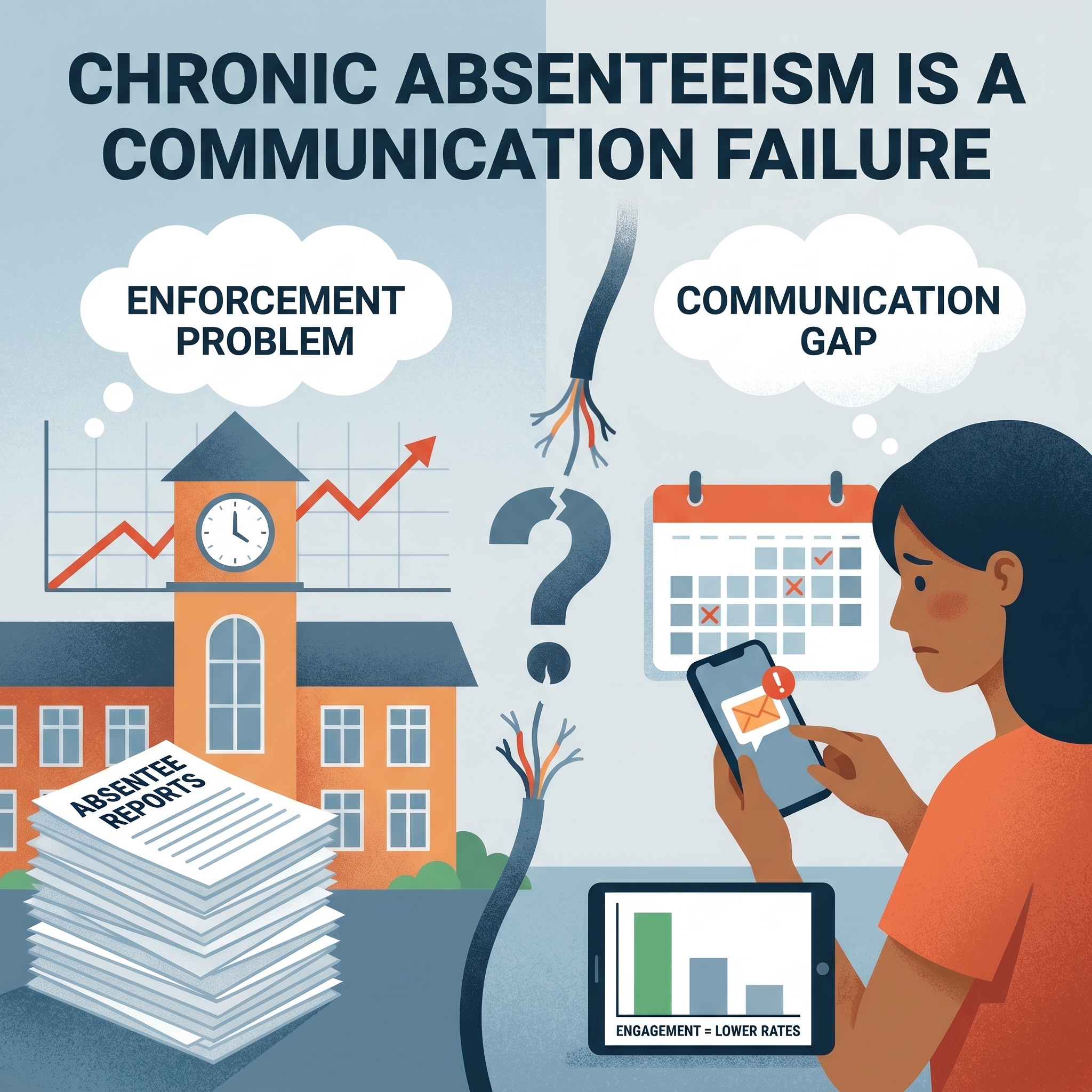
Nearly one in four U.S. students was chronically absent in 2024 — a 57% increase over pre-pandemic levels, and a crisis that is recovering far too slowly to reach pre-pandemic norms before 2029, according to American Enterprise Institute analysis of federal data. Most schools are treating this as an enforcement problem. The research says it is a communication problem first.
The research points to a six-percentage-point gap between schools that engage families and those that don’t — and to the low-cost tactics most schools aren’t using.
This article breaks down what the research actually says, what it takes to act on it, and why most schools are leaving the largest lever untouched.
The Numbers Are Bad. The Cause Is Not What You Think.
Chronic absenteeism (missing 10% or more of school days) has become one of the most tracked metrics in education. AEI’s 2025 report covering 45 states is unambiguous: “Rates are falling, but not nearly fast enough.” At the current pace, pre-pandemic levels will not return until approximately 2029.
High school is especially resistant. Industry attendance data from SchoolStatus, tracking more than one million students across 143 districts in seven states, shows high school chronic absenteeism rising 1.90% year-over-year even as younger grades show modest improvement.
The conventional response — escalating letters, referrals to attendance officers, truancy proceedings — treats absenteeism as a behavioral or disciplinary failure. The research points elsewhere.
Why Parents Are the Missing Variable
Here is the finding that should reset how administrators think about this problem: fewer than half of parents with chronically absent children are worried or concerned about their child’s absenteeism, according to a 2024 EdSource report drawing on USC research and commentary from Stanford’s Thomas S. Dee.
That is not indifference. It is a data gap.
Parents routinely undercount their children’s absences. They tally the days they know about — the sick days they called in, the appointments they scheduled — and they rarely see the full picture the school’s attendance system holds. As researchers put it: “If parents don’t know that their children are struggling in school, then they’re not going to be seeking intervention.”
This is not a new observation. An 18-month randomized controlled trial in low-income Chilean schools (Berlinski, Busso, Dinkelman, and Martínez, published as NBER Working Paper 28581) found that parents systematically underestimate their children’s absence until given timely, frequent data. When schools began sending weekly and monthly texts with attendance, grades, and behavior information, attendance-requirement compliance rose by 4.7 percentage points and math scores improved by 0.09 standard deviations. The mechanism is straightforward: closing the information gap changes parent behavior.
The lesson for administrators is direct: the problem is not that parents do not care. The problem is that they do not have the information they need to act.
What Structured Family Engagement Actually Delivers
The most important dataset on this question comes from a Harvard Graduate School of Education analysis of a 3,000-school Illinois dataset, synthesized by education writer Elaine McArdle in 2024.
The finding: “Schools with the strongest family engagement experienced six percentage points less chronic absenteeism post-pandemic than schools with the least family engagement.” Schools at the 90th percentile for family engagement had 15% chronic absenteeism; schools at the 10th percentile had 21%. The researchers note that “the effect of family engagement is as large or larger than poverty” — a comparison that should give every administrator pause.
This is not about parent nights or newsletters. The research distinguishes between passive outreach (information pushed out to parents) and structured engagement (regular, two-way, actionable communication that gives parents the data they need to respond). The gap between the two is six percentage points of your student population.
The Low-Cost Intervention Schools Are Not Using at Scale
If family engagement is the lever, text messaging is one of the most efficient ways to pull it — and the evidence base is unusually strong.
A 2021 guide published by IES — the U.S. Department of Education’s research arm — and authored by researchers at the American Institutes for Research is grounded in a randomized controlled trial covering 26,000 students across multiple districts. Its findings deserve to be read carefully:
“All four versions reduced chronic absence, lowering the expected chronic absence rate of 20.5% by 2.4 to 3.6 percentage points. For students with a prior history of high absence, messaging lowered the expected chronic absence rate of 47.1% by 3.5 to 7.3 percentage points.”
That last figure is particularly important. For the students most at risk — those who were chronically absent the prior year — targeted text messaging cut chronic absence rates by up to 7.3 percentage points. The guide also found that staff-personalized texts outperformed automated texts for high-risk students. A message that feels like it comes from a person who knows the child lands differently than a system notification.
A Pittsburgh pilot cited in the Harvard analysis translated this into concrete school-level results: weekly texts to families dropped kindergarten chronic absence from 30% to 13%. The Harvard researchers note that nudge letters of this type reduced chronic absenteeism by 10–15% “at one-fiftieth the cost of the next-best intervention.”
One-fiftieth the cost (per Harvard’s analysis of the Pittsburgh pilot data).
That ratio matters when administrators are working with constrained budgets and competing priorities. The alternative interventions — additional counselors, intensive case management, mentoring programs — have genuine value, but they are expensive and hard to scale. Structured text outreach costs almost nothing per contact and can reach every at-risk family simultaneously.
What the Research Does Not Promise
Credibility requires honesty about what the evidence does and does not establish.
A 2026 systematic review published in Frontiers in Child and Adolescent Psychiatry (Middleton, Watson, and Anderson) screened 5,527 articles on school-based attendance interventions. Its conclusion is measured: “Evidence base for interventions to improve attendance among persistently absent secondary school students remains limited.” No studies in the review achieved strong quality ratings. Family involvement in multi-component interventions showed attendance gains, but most studies failed to measure whether interventions were actually delivered as designed.
What this means practically: the text messaging evidence from large RCTs is solid. The broader claim that any family engagement program will close your absenteeism gap is not. Implementation fidelity matters enormously. A parent text program that sends inconsistent messages, at unpredictable intervals, without personalizing for high-risk students, will not replicate the RCT results. The mechanism only works when the communication is structured, regular, and actionable.
This is the gap between having a communication tool and having a communication system.
What a Communication System Actually Looks Like
The research points to three consistent features of outreach that works:
1. Frequency and regularity
The Chilean RCT used weekly and monthly cadences — not sporadic outreach after absences accumulate. Parents need information while they can still act on it, not after a problem has compounded for weeks. A student who has missed four days in the first month is recoverable. One who has missed fourteen days by December is far harder to re-engage.
2. Specificity and personalization
Generic reminders (“attendance matters!”) produce no detectable effect in the research. What works is giving parents specific, accurate data about their own child: days missed this month, current absence rate, how that compares to the threshold that triggers academic risk. The IES data shows staff-personalized messages for high-risk students outperform automated versions — the human signal matters.
3. Accessibility across channels
Families who do not see email reliably need SMS. Families with limited English need communication in their home language. A communication system that works only through the channels most convenient for the school will systematically miss the families most likely to have children at attendance risk. See how BeeNet’s messaging channels work.
Districts using proactive strategies — family engagement and positive outreach — are outperforming national averages, according to SchoolStatus data. The distinction between proactive and reactive outreach is where most schools are currently failing. Sending a letter after a student crosses the 10-day threshold is reactive. Sending a weekly attendance summary to every family from September onward is proactive.
The Monday-Morning Version
If you are an administrator reading this before a staff meeting, here is the practical translation:
- Audit your current outreach cadence. Is your school contacting families about attendance before a student becomes chronically absent, or after? If the answer is after, you are in reactive mode.
- Identify your high-risk cohort. Students who were chronically absent last year are your highest-priority group. The IES data shows text messaging cuts chronic absence for this group by 3.5 to 7.3 percentage points — but only if you target them specifically. For high schools, where recovery is slowest, segment by grade — ninth grade is the highest-risk transition year.
- Personalize for high-risk families. Automated messages work for general outreach. For the students most at risk, a staff member sending a personalized message gets materially better results.
- Make the information actionable. Give parents specific numbers: days missed, current rate, the threshold that matters. “Your child has missed 6 days this month, which puts them at 12% absence for the year” is actionable. “Attendance is important” is not.
- Remove friction. If your communication system requires parents to log into a portal, check an app, or open an email newsletter, you are adding steps that at-risk families are least likely to take. Meet parents where they already are.
If you want to see the system in practice, request a demo.
References
-
McArdle, E. (2024). Um… Where Is Everybody? Family Engagement Can Help Ease Absenteeism in Schools. Harvard Graduate School of Education. https://www.gse.harvard.edu/ideas/ed-magazine/24/05/um-where-everybody
-
Kurki, A., Heppen, J. B., & Brown, S. (2021). How to Text Message Parents to Reduce Chronic Absence Using an Evidence-Based Approach. American Institutes for Research / IES, U.S. Department of Education. https://ies.ed.gov/use-work/resource-library/report/guide/how-text-message-parents-reduce-chronic-absence-using-evidence-based-approach
-
Berlinski, S., Busso, M., Dinkelman, T., & Martínez, C. (2022). Reducing Parent-School Information Gaps and Improving Education Outcomes. NBER Working Paper 28581. https://www.nber.org/papers/w28581
-
Gallegos, E. (2024). Communication with Parents is Key to Addressing Chronic Absenteeism, Panel Says. EdSource. https://edsource.org/2024/communication-with-parents-is-key-to-addressing-chronic-absenteeism-panel-says/718238
-
Middleton, Watson, & Anderson (2026). What school-based interventions work to improve attendance? A systematic review. Frontiers in Child and Adolescent Psychiatry. https://pmc.ncbi.nlm.nih.gov/articles/PMC12832960/
-
Malkus, N. (2025). Lingering Absence in Public Schools: Tracking Post-Pandemic Chronic Absenteeism into 2024. American Enterprise Institute. https://www.aei.org/research-products/report/lingering-absence-in-public-schools-tracking-post-pandemic-chronic-absenteeism-into-2024/
-
SchoolStatus. (2025). New K-12 Student Attendance Data Shows Mid-Year Gains. https://www.schoolstatus.com/blog/new-k-12-attendance-data-2024-25
BeeNet gives school administrators the specific infrastructure the research points to: weekly attendance summaries to every family, staff-personalized outreach for at-risk students, and two-way messaging across SMS, email, and in-app — in English, French, and Arabic. If you are rethinking how your school communicates with families about attendance, see how BeeNet works.
Ready to Transform Your School Communication?
Start saving time and increasing parent engagement with BeeNet.
Request Demo