EU Early School-Leaving Hits 9.1% — The Country Gap Inside It

The European Union’s early school-leaving rate fell to 9.1% in 2025 — a record low, and just a hair above the bloc’s 2030 target of under 9.0% (Eurostat). It’s a genuine milestone: the rate has dropped steadily from 11.0% in 2015, and seventeen EU countries have already hit the target early.
But averages flatten the picture school leaders actually need to see. Look country by country and the EU splits into two groups that have barely moved relative to each other in a decade. Croatia sits at 2.1%, Greece at 3.0%, Ireland at 3.6%. Romania sits at 15.5%, Germany at 13.1%, Spain at 12.8% (Eurostat). That’s a sevenfold gap between the best- and worst-performing systems in the same union.
This piece looks at what the research literature says about how — and how early — schools and families talk to each other before a student is already gone, and what that might tell us about the gap.
The record low, and the gap hiding inside it
The 9.1% headline is real progress. Since monitoring began in 2002, the EU-wide rate has fallen from 16.9% to roughly 9.4% in 2024 and now 9.1% in 2025 (2024: 9.4%; 2025: 9.1%) (European Education Area; Eurostat).
Since 2015, nineteen countries have improved significantly. Malta leads at -7.7 percentage points, followed by Portugal (-7.4 pp) and Spain (-7.2 pp). Some countries moved the other way: Cyprus recorded the largest deterioration at +4.6 percentage points, with Germany and Austria also sliding backward (Eurostat).
Geography adds another layer school leaders shouldn’t ignore: EU-wide, cities report the lowest share of early leavers (8%), suburbs the highest (10.1%), and rural areas sit in between at 9.6%. And once a young person does leave early, re-engagement is far from automatic — only 46.2% of early leavers were employed in 2025, and second-chance education hasn’t closed the gap either: the 25-34 age cohort still shows early-leaving rates near 12-13%, meaning most young people who disengage from education never fully catch back up (Euronews; European Education Area). Prevention isn’t just the cheaper option — given how rarely early leavers fully re-engage later, it may be one of the more realistic windows schools have to intervene.
What actually separates Croatia from Romania
Croatia’s 2.1% isn’t an accident of demographics. Its national education strategy has no single dedicated dropout-prevention law, but it does bundle four explicit, proactive measures: a system for early recognition of school-leaving risk, systematic monitoring and research into causes, support measures for at-risk students built “in cooperation with other institutions,” and flexible curricula for students who need to reintegrate (Youth Wiki / Eurydice). The first two measures look, from a communication standpoint, like the building blocks of an early-warning system — identifying risk before it becomes a crisis, and tracking why students disengage — though Croatia’s own policy documentation frames them plainly as risk-recognition and monitoring measures, not explicitly as a “communication infrastructure.”
This lines up with how the EU’s own dropout-prevention framework is structured. The Council-recommended model splits interventions into three tiers: prevention measures for all students, intervention aimed at the 15-20% showing early warning signs (plus intensive support for the highest-risk 5-10%), and compensation programs to re-engage students who’ve already left (Campbell Systematic Reviews protocol). Family engagement is named explicitly as part of the prevention tier — the layer meant to reach every student before problems surface, not just the ones already flagged.
How to read the evidence in this piece: reading Croatia’s risk-recognition and monitoring measures as a “communication infrastructure” is this article’s framing, not the source’s own language. The Campbell Collaboration citation above is a protocol — a plan for a future systematic review, not a completed study with causal results — so no source in this research base proves that structured communication causes a lower national dropout rate, and none documents whether Romania, Germany, or Spain lack an equivalent structure. Croatia’s low ELET rate coinciding with a documented early-warning, continuous-monitoring structure is suggestive, not proof of a broader pattern.
The honest reckoning: communication isn’t the only variable
A systematic review of 59 studies across European contexts (2003-2023) found early school-leaving is driven by a wider set of cultural and institutional factors, not economics or communication alone: teacher attitudes and bias, rigid curricula, oversized classes, high-stakes testing, and a weak sense of school belonging all compound dropout risk. The review found migrant status combined with low socioeconomic status is “a most relevant predictor of school dropout,” and that teachers often carry unconscious bias — the idea that “foreign students achieve worse academic results” — without recognizing its effect on their own behavior toward those students (Frontiers in Education). Parental educational aspirations and family engagement are named as factors that mediate this risk, not as the sole cause of it. Any school administrator treating communication reform as a silver bullet is missing curriculum design, class sizes, assessment practices, and bias training — all of which the research says matter too.
What structured family communication actually looks like
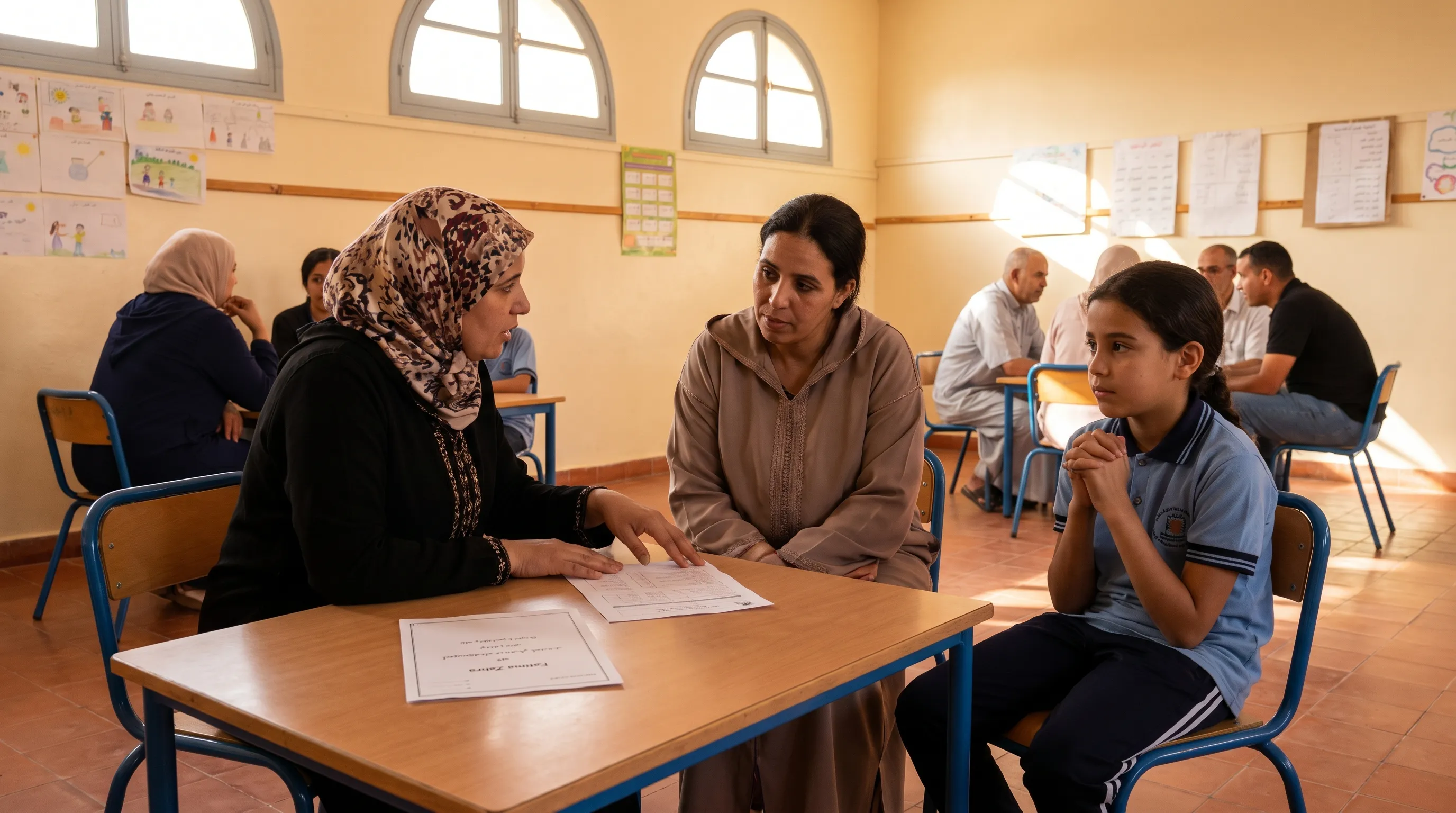
The clearest available evidence on how structured communication practices work comes from an OECD report on parent engagement in early childhood centers. OECD’s TALIS Starting Strong survey — measuring an under-6 population and predating the 2025 Eurostat data by more than a year, so treat the mechanism below as illustrative rather than proven for teens — breaks family engagement into three dimensions: communication, support for parent-child interaction at home, and parental involvement in decision-making. Settings that combine multiple types of engagement build stronger trust — and, per the source, that trust pattern carries forward into “the pattern of parental involvement in the next educational stages,” a general finding about parental involvement rather than a documented effect on early school-leaving specifically.
Translated into a secondary-school context, structured communication tends to share three traits — proactive, routine, and two-way, rather than reactive and one-way:
- A routine touchpoint, not just a crisis alert. Instead of contacting a family only after three unexplained absences, a school sends a brief weekly digest — attendance summary, upcoming assignments, one line of positive feedback when earned — so the channel is already trusted before anything goes wrong.
- An early-warning trigger tied to a specific threshold. For example: two consecutive absences (not five) could auto-generate a message to the family and a note to the counselor — a concrete way to act in the spirit of Croatia’s “early recognition of school-leaving risk” measure, rather than waiting for a formal truancy process to kick in. Croatia’s own policy documentation names that measure but doesn’t specify an absence count or any other numeric trigger — the two-absence example here is an illustration, not something drawn from the source.
- A two-way channel, not a broadcast. Parents can reply, ask a question, or flag a concern directly to the right staff member — not just receive announcements. This fits within OECD’s broader “communication” dimension of family engagement, though the source doesn’t specify two-way exchange as a defining requirement of that dimension.
The OECD report also flags a real risk: engagement tools aren’t automatically equitable. It found “no clear pattern suggesting there are systematic efforts to strengthen relationships… in situations of disadvantage” — meaning better tools tend to benefit families who were already reachable, unless a school deliberately designs outreach (translated messages, multiple channels, lower-bandwidth formats) for families who are harder to reach in the first place.
What this means for schools right now
Croatia’s case doesn’t prove causation, but it’s the clearest documented example available of what a prevention-tier communication structure looks like in practice — and the EU’s own framework says that structure belongs in every school’s prevention layer, not just Croatia’s.
For an individual school, the practical takeaway isn’t to wait for a national policy shift. It’s to audit whether your own communication model looks more like Croatia’s early-recognition structure or like a crisis-only fallback: Do you have a defined threshold that triggers an automatic family contact? Is that contact two-way, in a language and format the family can actually use? Is anyone tracking which families never respond, the way Croatia’s Measure 6.4.2 tracks causes systematically rather than anecdotally?
Getting that infrastructure in place is a matter of when, not whether — every term a school runs on reactive, crisis-only contact is a term where at-risk students go unflagged until the gap is much harder to close. A platform built for structured, continuous family communication is one implementation path toward closing that gap — not the only one, but a concrete place to start. BeeNet’s messaging and notification tools are designed around exactly this proactive, two-way model, built for schools that want to move from reactive alerts to structured, everyday family contact.
References
- Eurostat. “Early school leavers down to 9.1% in 2025.” European Commission, June 4, 2026. https://ec.europa.eu/eurostat/web/products-eurostat-news/w/ddn-20260604-1
- European Education Area. “Early school leaving in the EU: progress and challenges.” European Commission, “Chart of the month” series, 2026. https://education.ec.europa.eu/resources-and-tools/data-and-analysis-on-education-and-skills/key-trends-in-education/early-school-leaving-in-the-eu
- Pellegrini, M., Pannone, C., Fadda, D., Scalas, L. F., Vivanet, G., & Neitzel, A. “PROTOCOL: Prevention, Intervention, and Compensation Programs to Tackle School Dropout: An Evidence and Gap Map.” Campbell Systematic Reviews, 21(1):e70032, March 13, 2025. https://pmc.ncbi.nlm.nih.gov/articles/PMC11904426/
- Brown, M., Gardezi, S., O’Hara, J., McNamara, G., Cassidy, A., & McNamara, M. “Beyond economics: cultural factors affecting early school leaving—A systematic literature review.” Frontiers in Education, September 2, 2025. https://www.frontiersin.org/journals/education/articles/10.3389/feduc.2025.1657806/full
- Trindade Pereira, I. “Education: Where in the EU has the most early school dropouts?” Euronews, June 16, 2026. https://www.euronews.com/my-europe/2026/06/16/education-where-in-the-eu-has-the-most-early-school-dropouts
- National Policies Platform / Youth Wiki (Eurydice, European Commission). “Croatia — 6.3 Preventing early leaving from education and training (ELET).” Last updated March 26, 2026. https://national-policies.eacea.ec.europa.eu/youthwiki/chapters/croatia/63-preventing-early-leaving-from-education-and-training-elet
- OECD Publishing, Directorate for Education and Skills. “Engaging Parents and Guardians in Early Childhood Education and Care Centres.” OECD Education Policy Perspectives No. 110, November 12, 2024. https://eric.ed.gov/?id=ED673296


Ready to Transform Your School Communication?
Start saving time and increasing parent engagement with BeeNet.
Request Demo