France's Lycée Phone Ban: What School Administrators Must Do Before September 2026

France’s May 2026 rentrée circular hands lycée principals a mandate: consult parents and rebuild family engagement before September. The legislation behind it — voted 130 in favor on January 26, 2026 — extends the phone ban already operating in collèges to every lycée in the country. What neither the law nor the circular specifies is which communication channel should replace the informal WhatsApp threads, student-relayed messages, and ad-hoc phone contact that currently keep families informed. That gap is now your operational problem to solve — and you have roughly eleven weeks.
What the Law Actually Requires
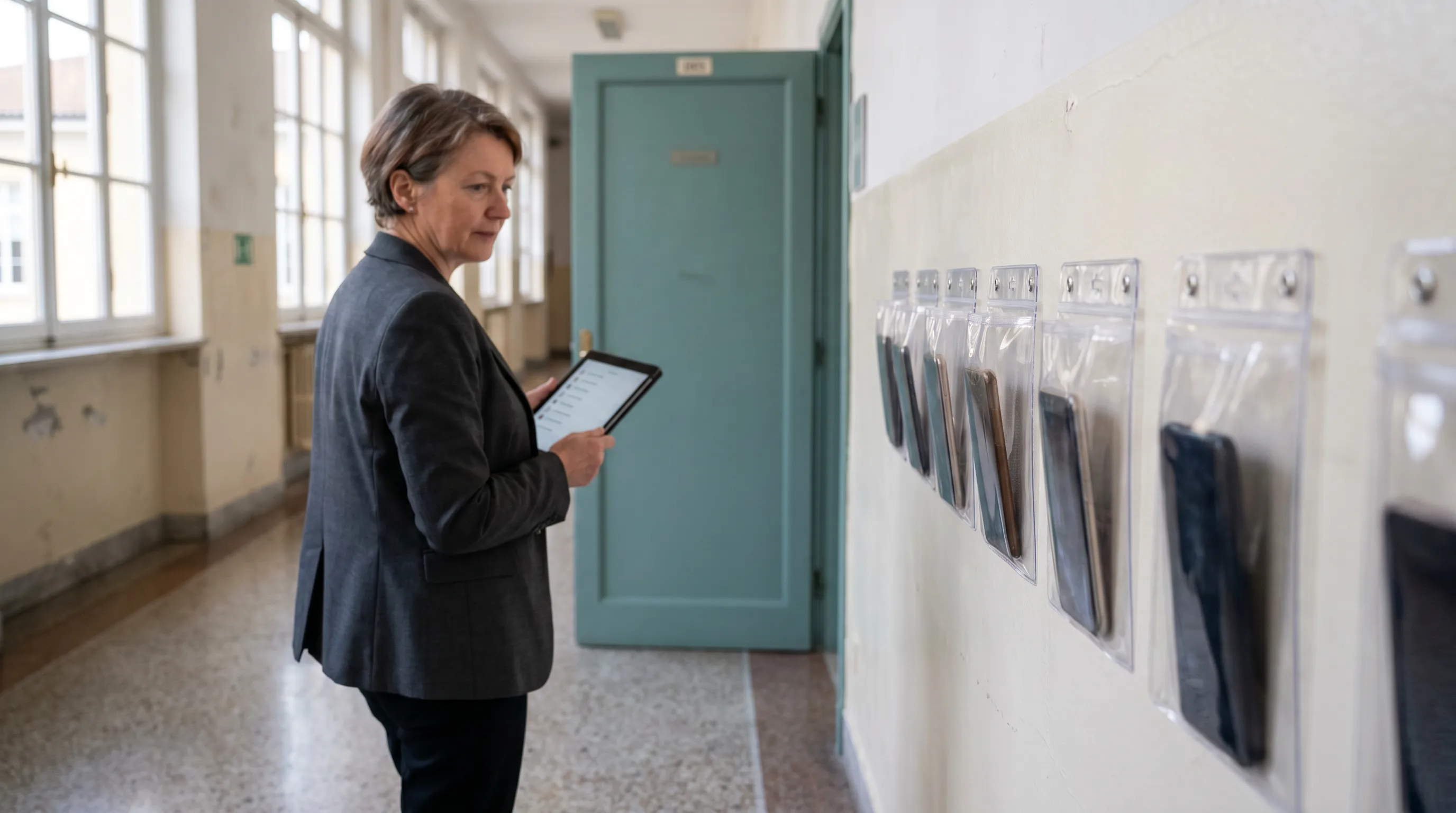
The law extends the Portable en Pause program already operational in middle schools to all lycées. From the first bell to the last, students may not use their smartphones on school premises. Principals retain narrow authority to authorize exceptions — for example, cafeteria check-in systems that currently run on student phones — but these must be documented in updated school regulations (règlement intérieur).
The January 2026 legislation and the accompanying rentrée circular require principals to do three things before September:
- Update internal regulations in consultation with teachers, the student council (CVL), and parent representatives.
- Organize early-year discussions with families about digital usage through school councils and administrative boards.
- Ensure that “success depends on family awareness and cooperation” — a direct quote from the July 2025 ministry circular that laid the groundwork for the law (Ministère de l’Éducation nationale, 2025).
Notably absent from those requirements: any specification of how to communicate with families once students can no longer relay messages through their phones.
The Implementation Gap Is Already Documented
France has been here before. When the college-level ban was extended in April 2025, a September 2025 survey found that only 8.5% of collèges fully implemented the measure, with 67% of administrators citing logistical complexity despite supporting the principle (Banque des territoires, 2025). A key logistical challenge included the absence of a workable replacement system for school-to-family communication.
That precedent matters for lycée principals now. A union leader representing school principals, Olivier Beaufrère, warned that formal prohibition becomes “nearly impossible to enforce” when students can leave campus between classes (VousNousIls, 2026). His concern was enforcement; but the underlying dynamic is the same: the moment students cannot carry phones, the informal communication infrastructure those phones sustained — text updates from students, parent-to-child direct contact during the day — disappears. Something must replace it, and that something has to be more reliable than hoping families check a portal they have never been trained to use.
Why Parent and Student Buy-In Is Higher Than Expected — And Why That’s Fragile
Concern about parent buy-in is not hypothetical. A 2026 Brookings Institution survey of nearly 1,100 adults and 400 teenagers found that 76% of teens and 93% of adults support some form of phone restrictions in schools — a higher-than-expected level of backing (Brookings / USC, 2026). Teen support in particular rose from 60% in 2024–25 to 76%, suggesting the cultural moment has shifted. Yet the same survey found that 25% of students admitted using devices when prohibited, pointing to the gap between stated support and behavioral compliance.
The implication for administrators: you have more parental goodwill to draw on than you might expect, but that goodwill will evaporate quickly if parents feel less informed once phones disappear. The communication infrastructure you build before September is the mechanism that keeps support intact.
Evidence From Outside France: What Bans Actually Produce
France’s policy is not being implemented in an evidence vacuum. A 2025 quasi-experimental study by David Figlio and Umut Özek at the National Bureau of Economic Research (NBER) analyzed an all-day cellphone ban across a Florida school district and found that estimated building-level cellphone use by students dropped by about two-thirds within the first two months and remained low over the two years studied (Figlio & Özek, 2025). By year two, the ban was associated with significant improvements in student test scores and a meaningful reduction in unexcused absences. Year one produced a short-term increase in suspensions, particularly among Black students — a finding that underscores why enforcement approach matters, not only the ban itself.
The Florida evidence is causal and well-controlled; the French implementation data is observational and early. But taken together, the picture is consistent: bans that are enforced produce measurable behavioral change. The Florida evidence is also the strongest causal argument for enforcement — which is why the implementation conditions, not just the policy itself, matter so much. France’s critics are largely arguing about conditions, not outcomes.
Honest Reckoning: What the Ban Does Not Resolve
The law has genuine critics, and their concerns belong in any serious implementation plan.
UNSA-Education, one of France’s major teachers’ unions, calls the legislation an “inappropriate” response and points to a real contradiction: schools currently need students to use phones for Pronote grade access, Parcoursup university applications, cafeteria check-in, library borrowing, and internship notifications (UNSA-Education, 2026). The union argues that the 2018 regulatory framework already permitted schools to regulate intelligently without legislation. Café pédagogique’s Jean-Michel Le Baut characterizes the 2026 rentrée circular as “political communication” and the ban itself as a “declinism” signal — nostalgia-driven rather than evidence-based (Le Baut, 2026).
These critiques do not mean the ban will not happen. It will. But they do identify where implementation will be hardest: seniors in terminal year relying on Parcoursup, students in vocational tracks with off-campus internships, and any school that has embedded phone dependency into its own administrative systems. Each of these cases requires a documented exception or a digital migration to school-managed platforms before September 1.
What You Need to Do Before September 1
Update and circulate your règlement intérieur by July
The CVL and parent council must be consulted before the summer break — not after. Document any exceptions (cafeteria systems, accessibility needs, professional track internship communications) in writing now. Among the collèges that struggled with implementation, 67% of administrators cited logistical complexity in the September 2025 survey — underscoring that operational preparation, not just intent, is what determines outcomes.
In practice: schedule a joint CVL / FCPE meeting before July 4, circulate a draft règlement intérieur by email to all parent representatives, and collect written feedback. Give the update a specific agenda item at your June conseil d’administration, not an end-of-meeting announcement.
Migrate phone-dependent school systems before August
If your cafeteria uses a student-phone-based check-in system, if Pronote push notifications go only to student devices, or if your library borrowing system runs through an app — those workflows must be redesigned before September. The law provides for exceptions, but exceptions based on functional necessity are more defensible than exceptions that simply perpetuate the status quo.
In practice: audit every school system that currently touches a student smartphone. For each one, either document the exception formally or identify the alternative. The five most common lycée digital touchpoints and their simplest migration paths:
- Pronote student notifications → switch push destination to parent account (platform setting, approximately 5 minutes per configuration)
- Cafeteria QR code check-in → issue reusable physical QR cards (one print run; one configuration change in the cafeteria software)
- Library app → return to physical card or activate the ENT-based borrowing module
- Parcoursup alerts → ensure every terminal-year student has a personal (non-school) email configured as primary in their Parcoursup account
- Internship communication → designate the CPE as the central relay point, with a shared inbox accessible to the full team
Build an operational parent communication channel — before families need it
This is the step that most schools will defer and then regret. Once the ban is in effect, the informal channel (student as message relay) disappears. Parents who used to text their child during the day for logistics — pickup times, forgotten lunches, after-school changes — will have no fallback unless you build one.
ENT Île-de-France already demonstrates what a functioning school-to-family digital channel looks like: 600,000 regular users across more than 470 secondary schools, with real-time grade visibility (same day), immediate absence SMS alerts, and direct teacher-parent messaging (Mielance Media, 2026). The €15 million annual regional investment in that infrastructure is not a luxury — it is the operational foundation that makes a phone ban manageable for families.
For schools outside Île-de-France without an active ENT subsidy: designate a single, scoped replacement channel — a parent-facing Pronote messaging group or a school-managed SMS service — with one administrator, used only for absence alerts and schedule changes in the first month. Scope-limiting the channel is what drives adoption. Trying to replace everything at once produces the portal that parents forget their password for.
In practice: hold a parent information evening in September’s first week — not to explain the ban (they already know) but to demonstrate the digital channel they will use instead. Walk through: how to check attendance alerts, how to message the secretariat, how to see grades without relying on their child’s Pronote app. That one-hour session converts passive ENT accounts into active ones.
Prepare staff, not just students
Adoption barriers are real: some educators still use paper, families without internet connectivity face exclusion, and data privacy distrust deters some parents (Mielance Media, 2026). Digital literacy gaps are not a student problem — they are a system problem. If your CPE (conseiller principal d’éducation) still sends absence slips home in physical form, the phone ban’s communication gap will fall disproportionately on your most vulnerable families. In schools with significant non-French-speaking parent populations, your communication platform’s language support determines whether digital outreach reaches every family or only the most connected ones.
In practice: before September, run a half-day training session for administrative staff, CPE, and form teachers on the school’s chosen communication platform. The session should cover three scenarios: (1) a parent calls to report their child absent — how does the CPE log it and send the automated alert? (2) a parent cannot log into the parent portal — who is the first-line contact and what is the fallback? (3) a teacher wants to message all parents in a class — what is the approved channel and what is explicitly off-limits (personal WhatsApp)? Designate the school’s CPE as the parent-digital-onboarding lead for September; they already own the absence-reporting relationship. Offer a paper-alternative pathway for families with documented digital access barriers — and track how many families use it so you have data for the spring review.
Eleven Weeks: The Only Variable Is Whether You’re Ready
The September 1 deadline is not subject to interpretation. What is subject to your decisions is whether the communication gap the ban creates becomes a source of family frustration and enforcement failure, or whether it becomes the moment your school built a communication system that actually works.
The collège experience in France shows that the schools that failed to implement weren’t opposed to the goal; they simply had no operational plan. You now have eleven weeks, documented evidence of where implementation breaks down, and a mandate to consult parents before term starts.
The question is not whether the ban happens. The question is whether your school is ready when it does.
References
-
Banque des territoires. (2025). Emmanuel Macron confirme l’interdiction du téléphone portable dans les lycées à la rentrée 2026. https://www.banquedesterritoires.fr/emmanuel-macron-confirme-linterdiction-du-telephone-portable-dans-les-lycees-la-rentree-2026
-
Banque des territoires / Ministère de l’Éducation nationale. (2025). Pour un numérique raisonné à l’École : la circulaire du ministère de l’Education détaille les mesures. https://www.banquedesterritoires.fr/pour-un-numerique-raisonne-lecole-la-circulaire-du-ministere-de-leducation-detaille-les-mesures
-
Banque des territoires. (2026). Interdiction des réseaux sociaux aux moins de 15 ans et du portable au lycée : ce que l’on sait du projet de loi. https://www.banquedesterritoires.fr/interdiction-des-reseaux-sociaux-aux-moins-de-15-ans-et-du-portable-au-lycee-ce-que-lon-sait-du
-
Brookings Institution / USC Center for Applied Research in Education. (2026). Survey: Parents and teens support school cellphone bans, and most don’t perceive major downsides. https://www.brookings.edu/articles/survey-parents-and-teens-support-school-cellphone-bans-and-most-dont-perceive-major-downsides/
-
Figlio, D. N. & Özek, U. (2025). The Impact of Cellphone Bans in Schools on Student Outcomes: Evidence from Florida. NBER Working Paper 34388. https://www.nber.org/papers/w34388
-
Le Baut, J.-M. / Café pédagogique. (2026). Rentrée 2026 : une circulaire de sortie ? https://www.cafepedagogique.net/2026/05/11/circulaire-de-rentree-2026-une-circulaire-de-sortie/
-
Mielance Media. (2026). ENT Île-de-France : transformation école-famille 2026. https://mielance.media/ent-ile-de-france/
-
Montel sur Pause. (2026). Interdiction du téléphone au lycée 2026 : guide proviseur. https://montelsurpause.fr/interdiction-du-telephone-au-lycee-2026/
-
UNSA-Education. (2026). Projet de loi sur les portables au lycée : une très mauvaise solution. https://www.unsa-education.com/article-/projet-de-loi-sur-les-portables-au-lycee-une-tres-mauvaise-solution/
-
VousNousIls. (2026). La proposition de loi sur l’interdiction du portable au lycée adoptée par l’Assemblée. https://www.vousnousils.fr/2026/01/27/interdiction-du-portable-au-lycee-il-y-aura-des-derogations-e-geffray-699213
Schools navigating the September 2026 transition need a communication platform that parents will actually use — not a system that requires an IT ticket to onboard a parent who misses the first meeting. BeeNet is built for exactly that: real-time alerts, direct teacher-parent messaging, and language support that ensures digital outreach reaches every family in your community. If you’re building your post-ban communication infrastructure now, it’s worth a conversation.


Ready to Transform Your School Communication?
Start saving time and increasing parent engagement with BeeNet.
Request Demo