KHDA Inspections Return: Parent Communication as a Quality Signal
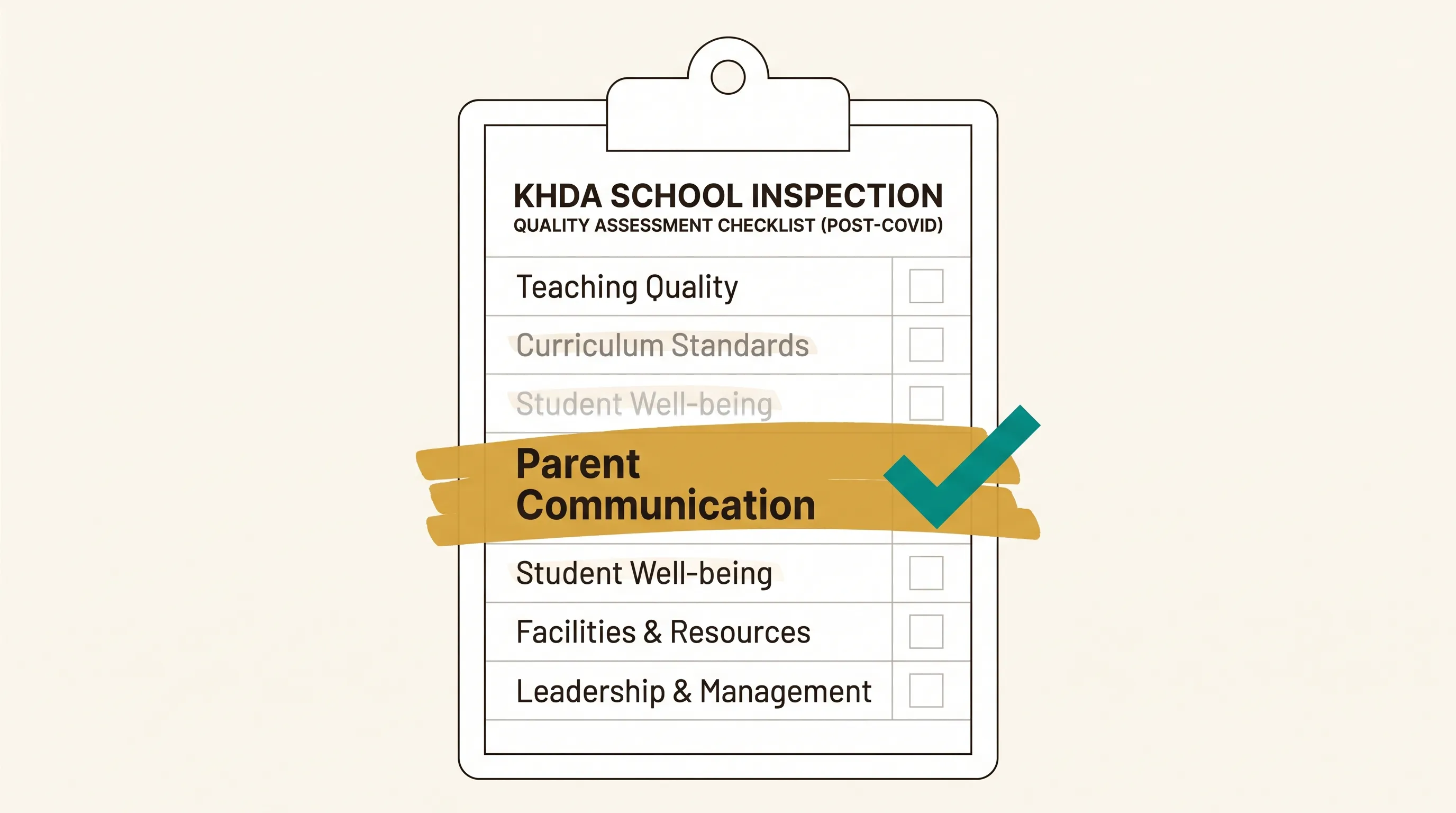
Dubai’s private school market has 24 hours. That is the notice KHDA inspectors will give when they arrive for full inspections in 2026-27 — down from one week in earlier cycles. For school leaders who adapted to lower-intensity monitoring visits, the change is operational, not procedural. Inspectors will arrive without the preparation window that allowed staged performances; only schools receiving full inspections will earn new overall ratings; and teacher turnover rates return as explicit data points in reports. Ratings have historically gated fee eligibility and competitive positioning — a mechanism expected to resume in future cycles — in a market where more than 200 private schools compete for enrollment.
This article looks at what inspection research — from Europe and the Gulf — reveals about which quality signals become priorities when formal ratings return, and what that means for parent communication specifically.
What changed in the 2026-27 framework
The most operationally significant shift is the pre-visit notice window. KHDA’s stated rationale for reducing it from one week to 24 hours is authenticity: shorter notice, the regulator explains, “helps ensure that visits reflect the everyday reality of school life, providing a more authentic picture of teaching, learning, student wellbeing, and day-to-day operations” (Allan / WhichSchoolAdvisor UAE, 2026).
Two structural changes reinforce this. A two-tier visit system now distinguishes full inspections from monitoring visits — only full inspections produce new overall ratings. And teacher turnover rates, absent from recent reports, return as a data point. Taken together, the 2026-27 framework is harder to prepare for and produces outputs with higher commercial stakes.
Research published in 2022 — by authors with direct institutional familiarity with the KHDA system — describes Dubai’s inspection ratings as a “governance mechanism to promote educational quality in an entirely open K-12” private market, noting that ratings directly influence school fee eligibility, competitive positioning, and parent enrollment decisions (Ben Jaafar, Alzouebi & Bodolica, 2022). That analysis predates the two-year pause and should not be read as a description of the current 2026-27 framework, but its foundational observation holds: in a fully private market with 215 schools across 17 curricula, a KHDA rating shapes what a school can charge and what parents choose.
One clarification before proceeding: KHDA’s available reporting names “teaching, learning, student wellbeing, and day-to-day operations” as the scope of 2026-27 inspections. The available sources do not confirm whether parent-confidence metrics constitute a separately rated criterion in the reinstated framework. The argument below is grounded in what inspection research shows about how schools respond when parent engagement is evaluable — not on a named, confirmed criterion in the 2026-27 documentation.
When a rating affects fee ceilings, parent engagement gets resourced
Research on inspection systems in Europe offers consistent evidence that formal ratings change what schools resource.
A 2025 case study of the Flemish Education Inspectorate — which operates a “dialogue with schools” and works “in a participatory manner” — documents conditions under which inspections can function as genuine quality levers rather than compliance exercises (Vanhoof, Buvens & van Petegem, 2025). KHDA’s move to 24-hour notice is consistent with this framing: a prepared performance is harder to stage when there is no preparation window.
The Italian evidence adds a layer specific to parent engagement. A mixed-methods study of 375 Italian schools — drawing on evaluation data from 2014 to 2017, so predating the current KHDA framework and reflecting a different national context — found that when inspection frameworks explicitly evaluate school-parent collaboration, external evaluators identify “significant criticisms” of schools’ improvement objectives in this area (Giampietro & Romiti / INVALSI, 2025). The logic is straightforward: when a dimension is ratable, it gets resourced.
Parent communication is not the only quality factor
Before drawing operational conclusions, a point of honesty is necessary.
A 2026 quantitative study of 274 Dutch school staff — one of the most recent large-sample investigations of what distinguishes high-performing schools — identifies four factors correlated with strong school performance: quality of school management, internal organisation quality, teacher and staff quality, and educational approach quality (de Waal, Goossens, Bos & Jeurissen, 2026). Parent communication does not appear in this validated framework.
This matters for how Gulf school leaders set priorities under inspection pressure. Communication upgrades are not a substitute for management depth, staffing stability, or curriculum quality. KHDA inspectors will review teacher turnover data directly. No parent newsletter closes a staffing gap, and no communication platform replaces a well-led faculty. The honest case for investing in communication infrastructure is that it is an additional quality signal — one that is particularly visible to inspectors arriving with 24 hours’ notice and speaking with parents — layered on top of the operational fundamentals that have always determined school quality.
What research says about communication quality and parent confidence
Given that caveat, the evidence on parent communication as a measurable quality dimension is consistent.
A 2026 systematic review of technology-mediated parent-school communication found that parents value transparency, responsiveness, and actionability — and that school-initiated, proactive communication correlates with higher parent confidence compared to reactive-only communication (Lee, Gao, Tan & An, 2026). The practical implication: parent confidence tracks with the structure and frequency of outgoing communication, not solely with academic outcomes. A school where parents regularly receive timely, actionable updates presents a different confidence profile than one where parents only hear from the school when a problem arises.
A 2026 longitudinal study tracking parent-teacher communication across elementary school years found that communication follows distinct trajectories — stable high, stable low, declining, and improving — and that these trajectories are associated with children’s academic abilities and school enjoyment (Roy et al., 2026). Consistent structured communication was linked to outcomes including teachers’ ability to “adjust their educational practices and interactions with students and increase parent involvement at school.”
Both studies are correlational; neither isolates communication as a controlled cause of the outcomes documented.
The consistent signal across both studies: rhythm matters more than volume. Proactive, structured, regular communication is associated with a different parent confidence trajectory than sporadic or reactive communication — regardless of the underlying academic quality of the school.
Four steps before the inspection window opens
With 24-hour notice, there is no preparation sprint. The communication infrastructure you have built across the semester is what inspectors will find. Here is what that implies in practice.
Audit your current communication cadence. Map what parents actually receive, at what frequency, and through which channels. The goal is to identify whether outgoing communication is predominantly proactive or reactive. In practice, this looks like pulling the last 90 days of sent messages from your school system and tallying the ratio of school-initiated updates — class summaries, event reminders, wellbeing check-ins — to responses triggered by parent inquiries. A school that responds promptly but rarely initiates is operating in a reactive mode associated with lower parent confidence in the research.
Build structured weekly touchpoints. Rather than adding communication volume, add predictable rhythm. In practice, this looks like a weekly 3-sentence class summary sent by each form teacher every Friday at 4 pm — one learning highlight from the week, one upcoming event, one suggestion for a home activity. The channel matters less than the consistency: whether it goes via a dedicated school messaging app, WhatsApp, or email, the discipline of 38 consecutive weeks of predictable communication is what builds the confidence trajectory the longitudinal evidence documents. For schools with parents communicating across English, Arabic, or other languages, the same cadence runs in parallel per language — a centralised platform with built-in translation support reduces the administrative cost of maintaining consistency across all groups.
Make wellbeing visible, not just academic progress. Inspection frameworks increasingly evaluate student wellbeing alongside academic outcomes. In practice, this looks like a short termly parent survey — four to five questions, sent in the first week of October, February, and May — with a brief summary of results sent back to parents within two weeks of closing. The feedback loop signals that parent input shapes school decisions, not just that it is collected.
Document your communication record. A school with 24 hours’ notice needs the principal and deputy to be able to demonstrate, at a moment’s notice, what the school communicated to parents and when. In practice, this looks like a shared dashboard or folder containing a chronological message log, survey distribution and response-rate records, and any follow-up actions taken — accessible without preparation to whoever receives the inspector.
Parent-communication infrastructure, built before you need it, is precisely the kind of evidence a 24-hour-notice inspection is designed to surface. The schools that arrive at 2026-27 with a consistent, proactive communication record already in place will not need to reconstruct one — because there will not be time to.
For Gulf school leaders looking to operationalise the communication infrastructure described above — proactive, documented, and delivered consistently across languages and channels — BeeNet for schools is one concrete implementation path worth reviewing before the inspection window opens. The question is not whether to build this infrastructure, but whether to start now or after the inspector calls.
References
-
Carli Allan / WhichSchoolAdvisor UAE (2026). KHDA Inspections Return to Dubai Schools After Two-Year Pause. https://whichschooladvisor.com/uae/school-news/khda-inspections-return-to-dubai-schools-after-two-year-pause
-
Letizia Giampietro & Sara Romiti / INVALSI (2025). Parents, Schools and Community Collaboration for Improvement: Insights from the Evaluation Processes. Journal of Professional Capital and Community (Emerald). https://doi.org/10.1108/JPCC-09-2024-0165
-
Sonia Ben Jaafar, Khadeegha Alzouebi & Virginia Bodolica (2022). Accountability and Quality Assurance for Leadership and Governance in Dubai-Based Educational Marketplace. International Journal of Educational Management (Emerald). https://doi.org/10.1108/IJEM-11-2021-0439
-
André de Waal, Paul Goossens, Marjolein Bos & Nicole Jeurissen (2026). Identifying and Validating Characteristics of High-Performing Schools: A Quantitative Study in Dutch Education. Quality Assurance in Education (Emerald). https://doi.org/10.1108/QAE-09-2025-0265
-
Jan Vanhoof, Randi Buvens & Peter van Petegem (2025). School Inspections as a Lever for Educational Quality: Case Studies on Processes and Effects. Research Papers in Education (Taylor & Francis). https://doi.org/10.1080/02671522.2025.2464740
-
Suzanne May Shwen Lee, Lin Gao, Cheng Yong Tan & Qi An (2026). Parents’ Perspectives of Technology-Mediated Parent-School Communication: A Review. Review of Education (Wiley / BERA). https://doi.org/10.1002/rev3.70137
-
Maggie Roy, Catherine Julien, Jasmine Gobeil-Bourdeau, Marie-France Nadeau, Caroline Fitzpatrick & Gabrielle Garon-Carrier (2026). Longitudinal Trajectories of Parent-Teacher Communication during Elementary School. British Journal of Educational Psychology (Wiley / BPS). https://doi.org/10.1111/bjep.70026



Ready to Transform Your School Communication?
Start saving time and increasing parent engagement with BeeNet.
Request Demo