The Parent Information Gap: How Schools Are Using SMS to Close It
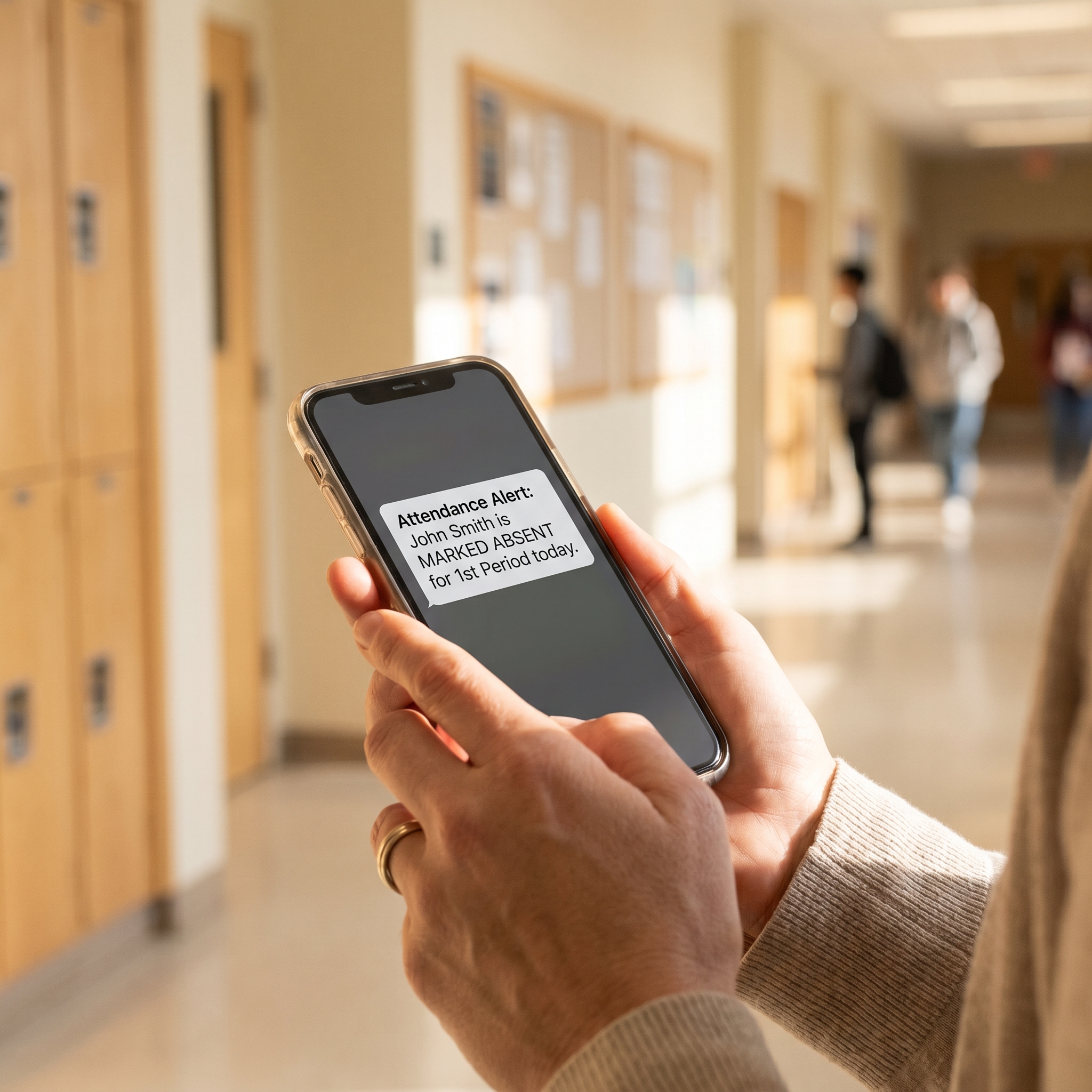
This is not a failure of parental interest. It is a structural feature of how schools communicate — or more precisely, how they don’t. In most schools, a parent’s knowledge of their child’s academic situation lags weeks behind reality. A student’s attendance has been slipping for a month. Grades in mathematics have been declining since the first trimester. Behavior in the classroom has changed. The school holds all of this information. The parent, statistically speaking, does not.
The gap between the information schools hold and what parents actually receive is wide, persistent, and, as a growing body of randomized controlled trial evidence now shows, directly responsible for measurable losses in student achievement.
The good news: closing that gap does not require new staff, new programs, or significant budget. It requires sending the right information to parents at the right frequency. RCT evidence from France and Chile demonstrates that SMS alone — without any other intervention — is enough to change student behavior.
Half of Parents Cannot Accurately Report Their Child’s Attendance
Every school principal understands intuitively that engaged parents produce better outcomes. But engagement is not simply a matter of parental attitude or motivation. It is constrained by information access.
The scale of this constraint is larger than most administrators realize. A landmark study published in the Journal of Human Resources — a randomized controlled trial of a Chilean school SMS program known as “Papas al Día” (Parents Up to Date) — found that at baseline, 26% of parents could not accurately report their child’s grades, and 48% could not accurately describe their child’s attendance from the prior two weeks.
Nearly half of parents did not know whether their child had been absent the week before. This was not a sample of disengaged families. These were parents whose children were enrolled in school and who, presumably, assumed things were proceeding normally. The absence of information produces a dangerous assumption: that no news is good news.
This is the information gap. It is not a gap in parental concern. It is a gap in data transmission — and it has direct consequences for how parents interpret and respond to their child’s school trajectory.
The Chile RCT: Math Scores Up, Cost Under $2 Per Student Per Year
The “Papas al Día” RCT, conducted across low-income Chilean schools from 2013 to 2017 and evaluated by the Abdul Latif Jameel Poverty Action Lab (J-PAL) at MIT, is one of the most rigorous examinations of this question to date.
The intervention was deliberately minimal: parents received weekly SMS updates on attendance and monthly reports on grades and behavior. No counseling. No additional tutoring. No changes to classroom instruction. Just information, delivered consistently, directly to a mobile phone.
The results over 18 months were significant:
- Math scores improved by 0.09 standard deviations — a meaningful effect size for a single low-cost communication intervention
- Language scores rose 0.11 standard deviations, despite no targeted messaging on language performance
- The share of students meeting attendance requirements for grade promotion increased by 4.7 percentage points
- Effects were 40–60% larger for at-risk students, the cohort with the most to gain from early parental awareness
To put this in perspective: the program achieved measurable academic gains at $1.21 per student per year — less than the cost of a single photocopied letter home.
The language score finding deserves particular attention. The intervention only explicitly addressed attendance, grades, and behavior. Yet literacy improved. This points to a broader mechanism: when parents receive regular, concrete information about their child’s school life, it changes the nature of conversations at home. Questions get asked. Homework habits shift. A student who knows their parent is receiving weekly updates has a different relationship to their own school behavior.
Classroom peer effects also emerged in the data, suggesting that the benefits of an informed parent cohort extend beyond the individual student. When a critical mass of parents are receiving and acting on school information, the social norms within a classroom change.
Paris Middle Schools: SMS Raises Parent Meeting Attendance by 12 Points
The Chilean RCT is not an isolated finding. A randomized trial conducted in suburban Paris by J-PAL-affiliated researchers Marc Gurgand, Nina Guyon, and Eric Maurin examined 37 middle schools in the Paris banlieues — a context directly relevant to French school administrators.
The study tested multiple communication strategies to increase parent participation in school meetings. The finding was unambiguous: simple letters proved ineffective, but text message reminders significantly enhanced attendance at school meetings. Personalized SMS invitations raised parent attendance at school meetings by 12 percentage points — a substantial shift in a population that institutions typically struggle to reach through traditional written communication.
The downstream effects on students mirrored the Chilean findings. Students in high-intensity communication classes were more likely to receive top marks for behavior and showed greater classroom participation and homework completion. Critically, these benefits extended to students whose parents had not personally attended the meetings — a spillover effect suggesting that the communication environment itself reshapes classroom dynamics, not just the behavior of students with newly engaged parents.
Why SMS Works When Other Methods Don’t
School administrators who have sent newsletters, posted updates on parent portals, or scheduled information evenings know the pattern: the families who most need the information are least likely to receive it through those channels. Digital portals require parents to proactively log in. Newsletters are read selectively or not at all. Information evenings exclude parents who work evenings or have no childcare.
SMS-based parent communication is different for three structural reasons.
Delivery is push, not pull. The parent does not need to seek out the information. It arrives on a device they already check multiple times per day. There is no friction between the school sending information and the parent receiving it.
Timeliness changes the action window. A monthly newsletter about last month’s absences arrives too late for a parent to intervene. A weekly SMS about this week’s attendance arrives in time to have a conversation before a pattern becomes entrenched. The information gap is not just about quantity — it is about timing. Parents who receive data in near-real time can act on it. Parents who receive data retrospectively cannot.
Personalization amplifies effect. Research on SMS-based parent engagement programs — including early literacy interventions documented in the Journal of Human Resources — finds that personalized messages are 63% more effective than generic ones. A message that names the child, specifies the absence dates, or references a particular subject performs significantly better than a broadcast message.
This is achievable at scale. Modern school communication platforms can generate personalized messages automatically from existing attendance and grade data, without requiring any additional teacher effort.
The Teacher Time Context
But a common objection from administrators is worth addressing directly: if teacher time on parent communication is already rising, why aren’t outcomes improving?
According to the OECD’s TALIS 2024 survey, full-time teachers spend 1.8 hours per week on average communicating and cooperating with parents and guardians — and this figure has increased in 24 education systems since 2018.
That is not time teachers spend sending targeted, high-frequency information updates. The bulk of that 1.8 hours is reactive: responding to parent inquiries, managing concerns that arise because parents did not receive timely information in the first place, and preparing for individual parent meetings that are often triggered by problems that have already escalated.
The paradox is precise: schools spend growing teacher time on parent communication, yet parents remain systematically underinformed. The issue is not effort. It is architecture. Reactive, teacher-initiated communication is inefficient and chronically late. Systematic, automated information delivery to parents addresses the root cause rather than the symptom.
When parents receive accurate, timely information through automated SMS channels, the volume of reactive inquiries decreases. Teachers are not pulled into conversations about information they should have already sent. The 1.8 hours per week does not disappear — but it shifts from damage control toward genuine partnership.
What This Means for School Administrators in Practice
The RCT evidence from France and Chile establishes something that intuition alone cannot: the information gap is causal, not correlational. Closing it through high-frequency SMS produces measurable improvements in attendance and academic performance, even without any other change in school practice.
For school leaders, this creates a clear implementation framework:
Define what information parents receive and at what frequency. The Chilean evidence points to weekly attendance updates and monthly grade and behavior reports as sufficient to produce the observed effects. These are not onerous amounts of information — they are the minimum a parent needs to maintain an accurate picture of their child’s school trajectory.
Automate where possible. Teachers should not be manually composing individual parent messages. Effective SMS programs operate through platforms that draw on existing school data — attendance registers, grade books, behavioral records — and generate personalized messages without additional staff workload. Modern platforms handle parent opt-in and phone number collection as part of onboarding, so this step does not fall to individual teachers.
Target at-risk students explicitly. The Chilean study found effects 40–60% larger for students already identified as at-risk. For schools managing resource constraints, this argues for prioritizing communication intensity for the students whose parents have the most to gain from timely information.
Measure what changes. Attendance rates, grade promotion rates, and parent meeting participation are all trackable metrics that will shift if a structured SMS program is implemented with fidelity. The Paris banlieues trial achieved a 12-percentage-point increase in parent meeting attendance through SMS alone. That is a verifiable outcome that school boards can evaluate.
The Gap Is a Choice, Not a Constraint
The parent information gap exists not because schools lack data, but because they lack systems to deliver it consistently. The data on student attendance, grades, and behavior sits in school information systems. The parent’s phone is already in their pocket. What has historically been missing is the connection between the two, running automatically and frequently enough to keep parents genuinely informed.
The evidence from France and Chile demonstrates that building that connection is neither technically complex nor financially prohibitive — and that doing so changes outcomes in ways that more expensive interventions often fail to achieve.
BeeNet automates exactly this — personalized SMS to parents drawn from your existing attendance and grade data, in French, Arabic, and English, without adding to teacher workload. Request a pilot at beenet.app/demo.
The gap does not require new teaching. It requires better transmission.
References
-
Berlinski, S., Busso, M., Dinkelman, T., & Martínez A., C. (2025). Reducing Parent–School Information Gaps and Improving Education Outcomes: Evidence from High-Frequency Text Messages. Journal of Human Resources, 60(4), 1284. https://jhr.uwpress.org/content/60/4/1284
-
Berlinski, S., Busso, M., Dinkelman, T., & Martinez, C. (2017). Reducing Parent-School Information Gaps and Improving Education Outcomes: Evidence from High-Frequency Text Messages [J-PAL Evaluation]. Abdul Latif Jameel Poverty Action Lab. https://www.povertyactionlab.org/evaluation/reducing-parent-school-information-gaps-and-improving-education-outcomes-evidence-high
-
Gurgand, M., Guyon, N., & Maurin, E. (2014). School Communication Strategies and School Outcomes in France [J-PAL Evaluation]. Abdul Latif Jameel Poverty Action Lab. https://www.povertyactionlab.org/evaluation/school-communication-strategies-and-school-outcomes-france
-
Heppen, J. B., Kurki, A., & Brown, S. (2020). Can Texting Parents Improve Attendance in Elementary School? A Test of an Adaptive Messaging Strategy. U.S. Institute of Education Sciences / National Center for Education Evaluation and Regional Assistance. https://archive.org/details/ERIC_ED607614
-
ParentPowered/READY4K! Research. (2019). One Step at a Time: The Effects of an Early Literacy Text Messaging Program for Parents of Preschoolers. Journal of Human Resources, 54(3). https://ready4k.com/research/
-
Organisation for Economic Co-operation and Development. (2025). Professional Relationships in School Communities: Results from TALIS 2024. OECD. https://www.oecd.org/en/publications/2025/10/results-from-talis-2024_28fbde1d/full-report/professional-relationships-in-school-communities_b6ddef33.html
Ready to Transform Your School Communication?
Start saving time and increasing parent engagement with BeeNet.
Request Demo