Qatar's New Private School Law: What the 2026 Reform Demands
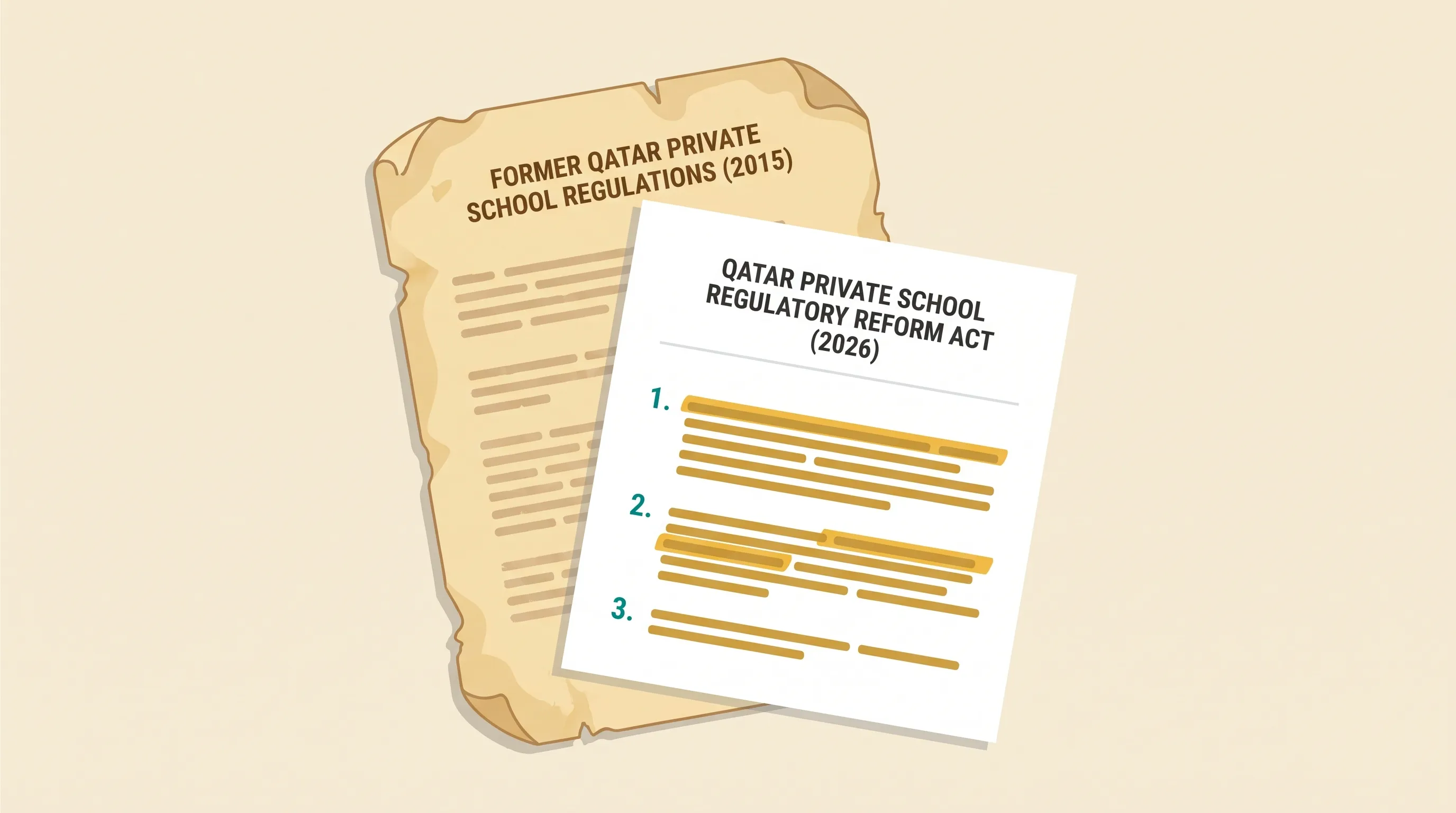
Two MoEHE Policies Already in Force Before the Law Passes
For school administrators, the headline is not the law itself — it is the window. On May 13, 2026, Qatar’s Cabinet approved a draft law overhauling private school governance (The Peninsula Qatar), designed to “tighten governance standards and lift the quality of education at every level” (Gulf Times). The bill will undergo public consultation on the government’s “Sharek” platform before advancing through legislative procedures — but Qatar’s Ministry of Education and Higher Education (MoEHE) has already moved ahead with two concrete policies: the School Fees Policy 2026, effective from the 2027-2028 academic year, and a revised Admission Guide for 2026. Together, they translate the reform’s intent into operational requirements that affect how you communicate with families right now.
This article breaks down the three parent rights the reform establishes, what a pilot enforcement phase already revealed about compliance gaps, and what structured communication practices administrators need to put in place before the law takes full effect.
The Three Parent Rights the Reform Establishes
1. Fee Transparency with 18-Month Advance Notice
The School Fees Policy 2026 requires private schools to give families 18 months’ advance notice of any fee increase. Schools must have at least three years of operating history and maintain 65% enrollment capacity before they can even apply to raise fees. Any increase above 5% must be distributed across two consecutive academic years (The Peninsula Qatar, June 2026).
The policy covers all 355 private schools in Qatar and is designed to “enhance educational quality, ensure fairness and transparency, and balance the financial sustainability of private schools with protecting parents from unjustified increases,” according to MoEHE.
The 18-month rule is the element that will reshape how schools communicate about finances. It means fee decisions cannot stay in the boardroom until the last minute. The moment a school projects a potential increase, it enters a communication obligation — and that communication needs to be documented, dated, and verifiable.
2. Standardized Enrollment and Transfer Timelines
The MoEHE Admission Guide 2026 establishes a unified timeline across the full academic year for registration, transfers, and withdrawals — applying to “all private schools and kindergartens in Qatar, including Qatari curriculum institutions, international schools, embassy schools, special education programs” (The Peninsula Qatar, April 2026).
Under the new rules: registration remains open throughout the academic year subject to available vacancies; enrollment for students arriving from outside the country continues until the end of the last week of May; and curriculum transfer flexibility allows grade-level continuity under specific conditions. Enhanced protections apply to students with disabilities.
For administrators, this is a procedural compliance requirement with a communication dimension. Families must be able to find, understand, and act on these timelines. Schools that bury enrollment deadlines in PDF annexes, or communicate transfer procedures only when families ask, will struggle to meet the spirit of the reform — and may face enforcement consequences once the law is fully active.
3. Student Data Protection
Qatar’s Personal Data Protection Law (Law No. 13 of 2016) already imposes data processing obligations on organizations operating in Qatar — including private schools. Even where the new draft law’s specific provisions on student data have not yet been published for public consultation, schools must already be able to demonstrate how student data is handled under existing law.
A peer-reviewed comparative analysis published in 2026 found that across widely-used classroom platforms, “data risks and privacy issues these tools pose continue to be addressed only minimally” (Le & Stewart, 2026). The researchers compared platforms developed in different regulatory environments — including Zoom (US-developed) and ClassIn (China-developed) — and found the data privacy implications were “more similar than different,” suggesting platform origin is not a reliable proxy for compliance.
For private schools in Qatar, this places the compliance burden squarely on the institution. Whether you use a third-party platform or an internal tool, you will need to demonstrate how student data is handled, stored, and protected — and communicate this to parents in plain terms.
What the Pilot Phase Already Revealed
The fee policy was not introduced without testing. MoEHE ran a pilot phase covering 99 schools. The results were instructive: 54 were approved, 22 were rejected, and the remainder were deferred or partially approved.
An approval rate of roughly 55% across the pilot suggests that compliance with transparent, documented fee governance is not a formality. Nearly one in four pilot schools was outright rejected. Schools that want to avoid a similar outcome would need systematic processes for documenting fee structures and communicating them clearly — the rejection rate demonstrates that formal compliance is not assumed by default.
This data comes directly from MoEHE. The pilot covered the 99 schools that submitted fee increase requests — a subset of the 355 private schools the policy regulates overall. It is the clearest signal that Qatar’s enforcement posture is serious.
The Research Case for Structured Communication
The reform’s focus on parent rights aligns with a growing body of evidence on what happens when parent-school communication is weak.
A 2026 systematic review of 51 studies found that technology-mediated communication between schools and families is associated with enhanced parental involvement and students’ motivation and engagement (Lee, Gao, Tan & An, 2026). Parents across the reviewed studies valued “instantaneity and convenience” but also consistently raised data privacy and security as concerns, and flagged excessive messaging volume as a barrier to meaningful engagement.
A separate 2026 longitudinal study following 1,486 families through elementary school identified three communication trajectory groups: 60.9% maintained high-quality communication throughout, 34.4% moderately high, and 4.7% fell into a low-quality trajectory. Children of mothers in the low-quality communication trajectory reported lower self-perceived ability at age 12 — this is a correlational finding from an observational study and does not isolate communication as the sole contributing factor.
Two things stand out from these findings. First, most families already maintain reasonably strong communication relationships — the compliance challenge is structural, not attitudinal. Second, the 4.7% low-quality group is not random: it correlates with child behavioral issues and suboptimal parenting. Qatar’s parallel voucher program — which raised the income threshold from QAR 25,000 to QAR 35,000 and now covers over 9,000 subsidized seats worth QAR 28,000 each (Gulf Times, 2026) — signals that the Ministry is addressing this structural dimension at the system level.
For private school administrators, the implication is practical: the families most at risk of weak communication are often navigating financial stress, language barriers, or administrative complexity. The reform’s fee transparency and enrollment standardization requirements are partly a structural intervention targeting exactly those families.
Four Practices Administrators Should Build Now
Document Every Fee Decision as a Communication Event
The 18-month notice requirement means fee governance must become a communication discipline, not just an accounting one. Every board decision about the following year’s fee structure should generate a dated, addressed communication to families — not because the law demands a specific format, but because demonstrating compliance will require a paper trail.
In practice, this looks like: a formal notice sent via a tracked digital channel (not a class group chat) on the same day the board approves a fee decision, with a delivery receipt confirming acknowledgment from every household. The notice should state the approved fee, the effective date, and the comparison to the current fee — in both English and Arabic where your community expects bilingual communication.
Make Enrollment Timelines Visible Before Families Ask
The admission guide’s unified timeline covers the full academic year. Administrators who publish and actively resurface this timeline at key moments — not just during the June rush — will find it substantially easier to demonstrate procedural compliance when it is tested.
In practice, this looks like: a pinned announcement in your school’s formal communication channel at the start of each term; a direct message to families of students approaching grade transitions in October and February; and a weekly reminder push in the final three weeks of May for international-arrival enrollment. Each touchpoint should link to the same versioned, dated enrollment document.
Build a Parent-Facing Data Privacy Brief
Most schools have internal IT policies. Far fewer have a plain-language document explaining to parents which platforms their child’s data travels through, what those platforms retain, and how parents can request deletion. Qatar’s reform makes this gap a compliance exposure.
In practice, this looks like: a one-page privacy brief, updated annually, sent to all families at enrollment and re-sent at the start of each academic year. The brief should name every platform used for school-home communication (e.g., your school messaging platform, any class group chat tool, your SMS gateway, and any third-party assessment apps), specify the data residency for each (EU, Gulf, US, etc.), and include a direct contact for data enquiries. This directly addresses what peer-reviewed research found “addressed only minimally” in current platform policies.
Use Channels That Create a Verifiable Record
Group messaging apps are convenient but do not create the kind of documented, addressable record that compliance requires. Schools need at least one formal channel where communications to parents are logged, timestamped, and tied to individual family records.
In practice, this looks like: reserving a structured platform channel for anything with a compliance dimension — fee notices, enrollment decisions, withdrawal confirmations, data notifications — while using informal channels only for supplementary engagement. The distinction is not bureaucratic; it protects the school in any dispute, and it is what auditors will look for when enforcement intensifies.
Timing Is the Variable You Still Control
Qatar’s private school reform is unambiguous about direction. The draft law will move through public consultation and legislative review; the fee policy takes effect from 2027-2028; the admission guide is already operative. What remains uncertain is the precise pace of enforcement — and that uncertainty is your window.
Schools that build structured, documented communication practices now will be positioned to meet the reform’s communication requirements when the 2027-2028 enforcement window opens. Communication infrastructure is one compliance dimension — schools will also need to review their fee governance procedures and enrollment capacity metrics separately. Schools that wait for the law to be enacted before auditing their processes will find themselves retrofitting systems under time pressure and regulatory scrutiny.
Building these practices requires infrastructure that tracks delivery, archives compliance communications, and reaches multilingual households — capabilities that group messaging apps cannot reliably provide. BeeNet’s school communication tools offer one implementation path, covering tracked messaging, document delivery with read receipts, and multilingual notifications in a platform built for MENA private schools.
The reform has set the direction. The question now is how quickly you build toward it.
References
-
Gulf Times / Staff Reporter. (2026). Draft law to overhaul private schools regulation approved. Gulf Times. https://www.gulf-times.com/article/725437/qatar/draft-law-to-overhaul-private-schools
-
The Peninsula Qatar. (2026, May 13). Qatar Cabinet approves draft law regulating private schools. https://thepeninsulaqatar.com/article/13/05/2026/qatar-cabinet-approves-draft-law-regulating-private-schools
-
Ataullah, S. (2026, April 13). MoEHE launches private school admission guide 2026 with new reforms. The Peninsula Qatar. https://thepeninsulaqatar.com/article/13/04/2026/moehe-launches-private-school-admission-guide-2026-with-new-reforms
-
The Peninsula Qatar / Qatar Ministry of Education and Higher Education. (2026, June 18). MOEHE launches new policy regulating private school fees starting from 2027-2028 academic year. https://thepeninsulaqatar.com/article/18/06/2026/moehe-launches-new-policy-regulating-private-school-fees-starting-from-2027-2028-academic-year
-
Gulf Times / Qatar News Agency. (2026). MoEHE reopens applications for educational vouchers. https://www.gulf-times.com/article/728114/qatar/moehe-reopens-applications-for-educational-vouchers
-
Lee, S. M. S., Gao, L., Tan, C. Y., & An, Q. (2026). Parents’ Perspectives of Technology-Mediated Parent-School Communication: A Review. Review of Education. https://doi.org/10.1002/rev3.70137
-
Roy, M., Julien, C., Gobeil-Bourdeau, J., Nadeau, M.-F., Fitzpatrick, C., & Garon-Carrier, G. (2026). Longitudinal Trajectories of Parent-Teacher Communication during Elementary School. British Journal of Educational Psychology. https://eric.ed.gov/?id=EJ1496113
-
Le, T. T. K., & Stewart, B. (2026). Data Risks in Online Classroom Platforms: A Comparative Analysis of Policy Documents. Journal of Teaching and Learning. https://eric.ed.gov/?id=EJ1508164



Ready to Transform Your School Communication?
Start saving time and increasing parent engagement with BeeNet.
Request Demo