The 99-Point Reading Gap: What the Brain Science on Read-Alouds Means for Schools
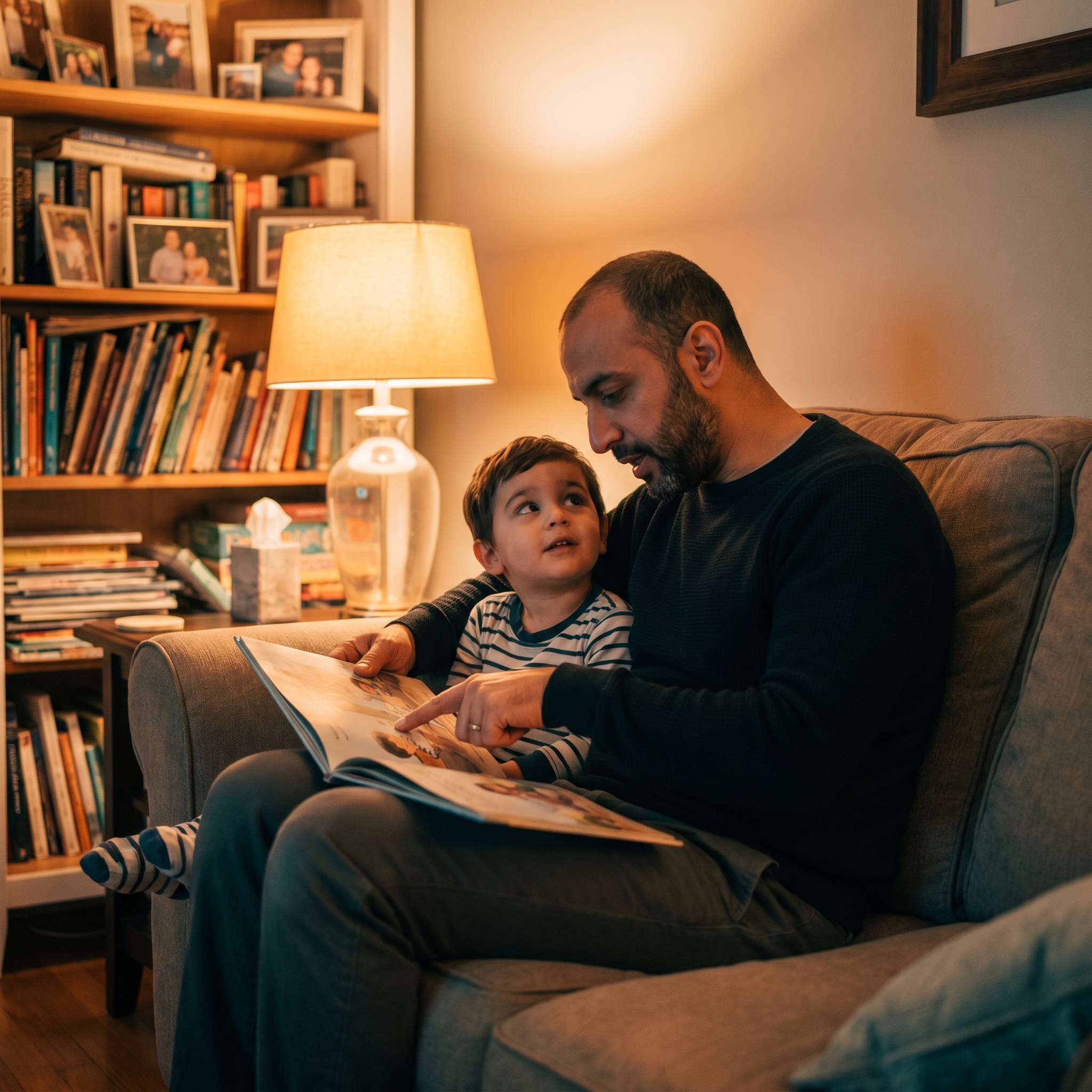
A 99-point gap in reading achievement. That is what the PIRLS 2021 international study found between Grade 4 children who were frequently read to at home in early childhood and those who were rarely or never read to — the largest home-environment gap in the PIRLS 2021 dataset. For context, researchers typically equate roughly 40–50 scale points with one year of schooling. The home literacy gap is the equivalent of two full years of school, showing up before the child has even sat a standardised test.
That number should land differently for school administrators than it does for parenting magazines. Because while parenting magazines treat reading aloud as a lifestyle choice, the PIRLS data says it is a structural predictor of academic outcomes. One that most schools are currently treating as someone else’s business.
Neural Wiring, Not Income: What fMRI Studies Show About Early Reading
The PIRLS gap is large enough to demand explanation. Neuroimaging studies now provide one.
A landmark fMRI study published in Pediatrics by Hutton, Horowitz-Kraus, Mendelsohn and colleagues scanned the brains of 3- to 5-year-olds while they listened to stories. The finding was precise: greater home reading exposure correlated with significantly higher neural activation in the left-sided parietal-temporal-occipital association cortex — the region that supports mental imagery, narrative comprehension, and semantic meaning extraction. This effect held after controlling for household income. The gap is not explained by money. It is explained by experience.
What a parent does when they read aloud to a child — point to pictures, make voices, pause to ask “what do you think will happen?” — is building neural infrastructure that classroom instruction will later build on. Children who arrive at school without that infrastructure are not less intelligent. They are less prepared in a specific, measurable, correctable way.
The American Academy of Pediatrics’ 2024 policy statement on literacy promotion strengthened this picture further. Among 10-year-olds, time spent reading a book predicted greater connectivity in brain areas related to language and cognitive control. Time spent on screen-based media predicted lower connectivity. The AAP now recommends shared reading from birth as a health intervention, not merely a cultural practice.
The mechanism is clearer than it has ever been. The question for schools is whether they are acting on it.
The Gap Persists for Eleven Years
One of the most consequential findings in the research literature is that early home reading advantages do not fade. A 2023 study by Araújo and Costa from Nova University of Lisbon, analysing both PIRLS and PISA data, found that children who received frequent home book-reading in early childhood showed significantly higher reading performance not only at Grade 4 (age 9–10) but also at age 15 — eleven years after those early-childhood reading sessions. Their conclusion is unambiguous: “Advantages associated with book reading in the early years are maintained throughout students’ schooling.”
This is not a preschool story. It is a whole-schooling story. The neural wiring laid down by shared reading at age 3 shows up in PISA scores at age 15. Every school thinking about its PISA trajectory is, whether it realises it or not, thinking about what its students’ parents were doing at bedtime in the pre-school years.
Two Gaps, Not One: Why the 99-Point PIRLS Finding Matters More Than Schools Realise
It is worth dwelling on the PIRLS 2021 numbers specifically because they are often cited without context.
The PIRLS 2021 data identifies two separate gaps worth understanding:
The first is the parental reading enjoyment gap: children whose parents “very much like” reading score 46 points higher than children whose parents “do not like” reading. That is more than one year of schooling, associated with parental attitude toward reading — which shapes the home environment.
The second, larger gap is the early literacy engagement gap: children whose parents “often” engaged them in early literacy activities (telling stories, singing alphabet songs, reading books, talking about things they had read) scored 99 points higher than those “never or almost never” engaged. Ninety-nine points. That gap does not originate in the school. But it is the school’s problem by Year 1.
For school administrators in Belgium, France, and Morocco — countries where PIRLS 2021 results have prompted national reading reviews — these numbers are not abstract. Belgian PISA and PIRLS analysts at KU Leuven and Ghent University applied structural equation modelling to 5,114 Grade 4 students and confirmed the mechanism: parental reading behaviours do not directly raise reading comprehension scores. The effect is indirect — passing entirely through children’s reading enjoyment, motivation, and frequency. The practical implication for schools is significant: if you target only parental behaviour without also building children’s intrinsic reading motivation, the intervention will fail. Both sides of the chain matter.
Schools that design interventions without understanding this mechanism will keep running parent evenings and wondering why outcomes do not improve.
Why Schools Are Getting This Wrong
The standard school response to low home literacy is a parent evening. Run once a term. Attended by parents who are already engaged. Presenting information in a format that assumes a literate, confident audience. Offered in one language.
The research on what actually prevents shared reading tells a different story about what intervention is needed. A 2025 meta-synthesis of nine qualitative studies across six countries by Nan and Tian identified the real barriers: parents who perceive reading as an educational task rather than a pleasurable activity, and parents who lack confidence in interactive reading techniques. Neither of these barriers is addressed by a parent evening. Both are addressable through well-designed, ongoing school communication and guidance.
The other structural failure is about who schools think of as “the parent.” A 2025 study of 80 fathers across eight Abu Dhabi kindergartens by Gallagher, Dillon, Saqr and colleagues found that 54% of fathers cited busy work schedules as the primary barrier to shared reading. More concerning: some school staff actively preferred mothers-only workshops, institutionally sidelining fathers. Yet after targeted workshops, 75.5% of fathers agreed that shared reading strengthens the parent-child bond. The willingness was always there. The school system was actively excluding it.
This pattern of institutional exclusion is not unique to the Gulf. Research on parental engagement in MENA school contexts consistently shows that fathers are structurally sidelined by school communication systems designed around an assumption of maternal availability — with predictable results for home literacy outcomes.
This is the category of failure that matters most: not parental apathy, but institutional design that mistakes indifference for absence.
What an Effective School-Designed Intervention Looks Like
The research does not stop at diagnosis. A well-designed school intervention on home literacy produces measurable gains — but design specifics matter.
An 18-month structured home literacy environment programme studied by Romero-González and colleagues at the universities of Seville and Málaga gave families specific guidance: read aloud four times per week, 10–15 minutes per session, with comprehension questions and weekly book exchanges through the school. By nine months, the programme showed significant improvements in reading speed (p = 0.000). Comprehension gains (p = 0.026) were measured at both the nine-month and final assessments. But one of the most important findings was qualitative: parents reported that conversation quality mattered more than reading time. “Conversations about books, and their role as a reading role model would have a slightly greater influence on their children’s motivation than the amount of time spent reading.”
The implication is that schools do not need to ask parents to make large time commitments. They need to give parents the right guidance on how to use the time they already spend.
Three things schools should be doing differently
Guide the behaviour, not just the awareness. Most schools communicate that parents should read to children. Effective programmes communicate how: specific techniques (asking open questions, connecting story to personal experience, making predictions), specific frequency targets, and the assurance that 10–15 minutes four times a week is enough. Guidance at this level of specificity changes behaviour in a way that general exhortation does not. For example: “Ask your child what they think will happen before you turn the page” changes a reading session in a way that “read more at home” never will.
Design for the working parent — both parents. The Abu Dhabi fathers study is a useful mirror for schools across MENA and Europe. Communication about home reading needs to be mobile-first, brief, actionable, and scheduled at hours that fit working schedules. It needs to explicitly address fathers, not default to an assumption that the mother will relay everything. Schools running workshops during school hours are selecting for a specific socioeconomic group — and excluding the families where intervention would have the most impact.
Build children’s reading motivation alongside parental guidance. The KU Leuven finding matters operationally. The home literacy effect on reading comprehension runs through children’s enjoyment and motivation — not directly. A school that sends weekly reading guidance to parents while failing to make reading an enjoyable classroom experience is working against itself. The two levers — home guidance and classroom motivation — have to move together.
The Structural Argument Schools Need to Accept
The research brief assembled from PIRLS 2021, neuroscience, and intervention studies from Belgium, Spain, the UAE, and China converges on a single argument that school administrators should internalise: the home literacy gap is not an immovable socioeconomic fact. It is a design failure — and a correctable one.
The 99-point PIRLS gap is largely established before a child walks through the school door. But the school is not a passive observer. Schools that communicate specific, actionable home literacy guidance to all parents — continuously, not once per term; in accessible language, not formal letters; to both parents, not only the one who attends evening events — can close meaningful portions of that gap.
This is not a marginal intervention. It is arguably the highest-leverage thing a primary school can do for its long-term reading outcomes. The neuroimaging studies show the brain architecture being built. The PIRLS data shows the assessment gap that architecture produces. The intervention studies show that school-designed guidance changes parental behaviour and children’s outcomes.
The question is no longer whether schools should act on this. The question is whether they have the communication infrastructure to act on it at scale.
If your school is ready to deliver specific, multilingual home literacy guidance to every parent — weekly, on their phone, without adding to teacher workload — see how BeeNet is built for exactly this.
References
-
Araújo, L. & Costa, P. (2023). Reading to Young Children: Higher Home Frequency Associated with Higher Educational Achievement in PIRLS and PISA. Education Sciences, 13(12), 1240. https://www.mdpi.com/2227-7102/13/12/1240
-
IEA / PIRLS 2021 International Study Center, Boston College. (2022). PIRLS 2021 International Results: Context — Home / Parents Like Reading. https://pirls2021.org/results/context-home/parents-like-reading
-
Hutton, J.S., Horowitz-Kraus, T., Mendelsohn, A.L. et al. / C-MIND Consortium. (2015). Home Reading Environment and Brain Activation in Preschool Children Listening to Stories. Pediatrics. https://pmc.ncbi.nlm.nih.gov/articles/PMC9923605/
-
Klass, P., Mendelsohn, A.L., Hutton, J.S., Navsaria, D. et al. / American Academy of Pediatrics. (2024). Literacy Promotion: An Essential Component of Primary Care Pediatric Practice. Pediatrics, 154(6), e2024069090. https://publications.aap.org/pediatrics/article/154/6/e2024069090/199467/Literacy-Promotion-An-Essential-Component-of
-
Nan, J. & Tian, Y. (2025). Parent–child shared book reading challenges and facilitators: a systematic review and meta synthesis. Frontiers in Psychology. https://pmc.ncbi.nlm.nih.gov/articles/PMC12326312/
-
Romero-González, M. et al. (2023). Active Home Literacy Environment (Spain). Frontiers in Psychology. https://www.frontiersin.org/journals/psychology/articles/10.3389/fpsyg.2023.1261662/full
-
Gallagher, K., Dillon, A.M., Saqr, S., Habak, C. & Alramamneh, Y. (2025). “Come back home early and read for us!” Enabling father-child shared reading. Frontiers in Education. https://www.frontiersin.org/journals/education/articles/10.3389/feduc.2025.1529382/full
-
Claes, R., Laga, J. et al. (2024). Home literacy environment, reading attitudes and comprehension — PIRLS 2021 Belgium. Large-scale Assessments in Education, SpringerOpen. https://link.springer.com/article/10.1186/s40536-024-00233-8
Ready to Transform Your School Communication?
Start saving time and increasing parent engagement with BeeNet.
Request Demo