Report Cards as Communication Decisions: What Research Says Schools Get Wrong at Year-End
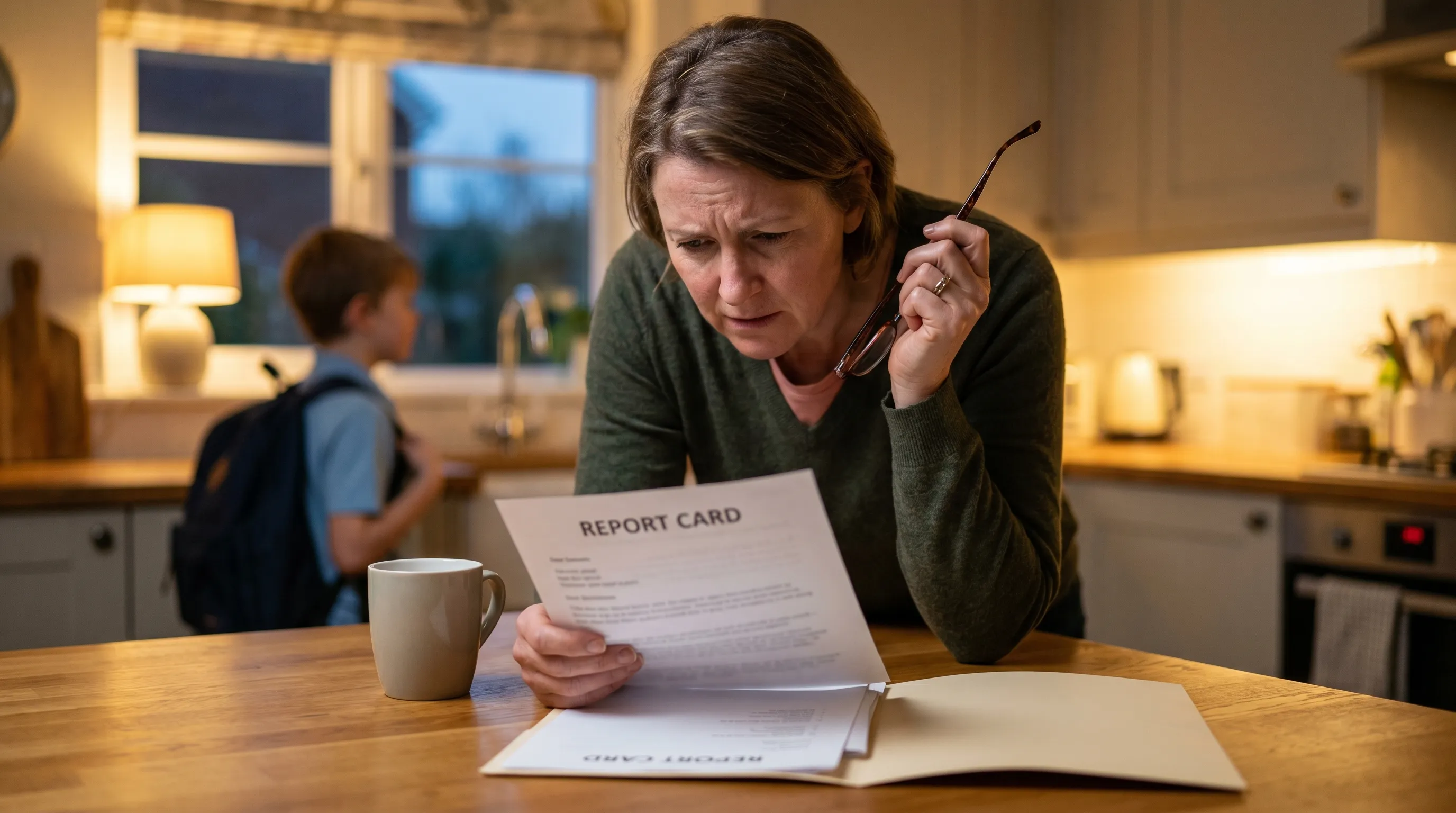
Every June, schools send the document that carries the most emotional weight of anything they will produce all year. And yet, most schools treat the report card as an administrative output rather than a communication decision.
Recent peer-reviewed research suggests this is a consequential mistake. What the evidence shows is not that grades are unimportant, but that the framing of academic results — the interpretive context that surrounds them — is associated with whether parents develop constructive or anxious responses to what they read. Schools that send naked grade summaries at year-end are not just missing a communication opportunity. They are handing parents a set of numbers and walking away at the moment those numbers land.
Why the Last Report Card Hits Differently
The end-of-year report card is not functionally the same as a mid-year one. It arrives at a moment of transition — the child will move to a new class, possibly a new school, possibly a new teacher. There is no next parent-teacher conference to clarify what a grade meant. There is no opportunity to course-correct before the year closes. The document lands, and then the school goes quiet for two months.
Research published in the School Community Journal (2024) describes parent-school communication as cumulative: “every communication exchange between teachers and parents occurs within the context of what has gone before and sets the stage for future interactions”. The end-of-year report card, by this logic, carries the full weight of every communication decision made across the preceding ten months. A year of sparse, transactional updates does not get repaired by a single year-end letter. The interpretive trust that makes academic information feel safe to receive has either been built or it has not.
What Parental Educational Anxiety Actually Is
A 2025 psychometric study in the Journal of Psychoeducational Assessment developed and validated the Parental Anxiety about Children’s Education Scale (PACES) across a sample of 465 participants in development and 4,566 in validation. The study identified four distinct dimensions of parental educational anxiety: (1) academic performance, (2) availability of family educational resources, (3) quality of school education, and (4) the broader educational macroenvironment.
This is a useful diagnostic for school administrators. A bare report card with grades activates all four dimensions simultaneously — it signals something about academic performance without explaining it, prompts parents to wonder whether they have the resources to respond, implies something about school quality without context, and arrives within whatever ambient anxieties parents already carry about the educational system. Schools that send grades without interpretive framing are not delivering neutral information. They are handing parents an activation trigger with no accompanying guidance.
The Communication-Anxiety Link
A 2024 longitudinal study from Shandong Normal University examined 495 families over two timepoints using structural equation modelling. The study measured parent-child communication quality within the family — not school-to-parent communication — and found that communication quality negatively predicted parental educational anxiety (β = -0.31, p < 0.001), partially mediated by parent-child trust, with an indirect effect of -0.47. Specifically, the study found that communication quality positively predicted parent-child trust (β = 0.487, p < 0.001).
The study is correlational and measures within-family communication, not school-to-parent outreach — it does not test whether improving school communication would produce the same effect. That said, the direction is consistent with the broader literature: higher-quality communication within the family system is associated with less parental anxiety about academic outcomes. To the extent that school communication practices shape how families talk about education at home, the implication for schools may run in the same direction. The end-of-year report card, sent without context, sits at the low end of communication quality by definition. It is, as the School Community Journal taxonomy describes it, a one-way channel inherently incapable of interpretive dialogue.
The Walton Family Foundation and Gallup’s 2025 national survey of US parents is instructive here. Parent satisfaction with schools rose between 2024 and 2025 — with 40% of parents rating their child’s school an A, up from 33% — and the researchers attributed part of this improvement to “growing confidence in how schools are communicating, addressing individual needs and preparing students for life beyond high school”. Confidence in communication, not just in outcomes.
Communication Is Not the Only Factor
Honesty requires naming what communication cannot fix. A 2025 study in BMC Public Health surveying 6,393 parents in China found that household income, mortgage burden, and monthly educational spending are significant structural drivers of parental educational anxiety — independent of what schools communicate or how. A separate 2025 study in Frontiers in Psychiatry (N=2,932) found that one-unit increase in family socioeconomic status (SES) correlated with a 0.062-point decrease in parental anxiety, and that educational anxiety was “prevalent among parents with an overall medium-to-high intensity level”. School communication framing is one lever. Economic precarity, competitive educational environments, and structural policy conditions are others that sit largely outside a school’s control. A well-framed report card will not neutralize the anxiety of a family carrying significant financial stress. But it can avoid amplifying it.
What Schools Are Getting Wrong
The core error is treating the report card as an administrative artefact rather than a communication product. Three specific failure modes appear across the research:
Grades without trajectory. A grade without directional context leaves parents with no way to distinguish “this child has plateaued” from “this child made significant gains that brought them to this level.” The emotional valence they assign to the grade will depend on their prior assumptions — which the school has done nothing to inform.
In practice, this looks like: a brief written paragraph per subject — or a standardised 30-word teacher comment field in the school’s communication system, not a custom letter per student — sent with the report card, that describes directional progress. Not just where the student is, but where they started and what the next year’s natural starting point looks like. The class teacher or homeroom coordinator is the natural owner of this comment; school administrators set the template and the expectation.
Context sent too late to act on. End-of-year communication that arrives after school has closed gives parents nothing to do with what they have learned. If the school’s message is that a child struggled in mathematics, a June 20 report card with no accompanying guidance leaves a family with two months of unaddressed concern and no institutional support structure to turn to.
In practice, this looks like: flagging borderline academic situations no later than two weeks before the final report card is sent, via a direct channel — a private message through the school’s communication platform, not a general newsletter — so that a conversation can happen while teachers are still accessible. The homeroom coordinator or class teacher initiates; the school secretary logs receipt.
The trust deficit that precedes the grade. The 2024 School Community Journal study is clear that communication is cumulative. A school that has communicated infrequently, transactionally, or only when problems arise has not built the interpretive trust that allows parents to receive academic information calmly. The end-of-year report card arrives into whatever relational context the school has constructed across the year. Schools that want parents to respond constructively to year-end grades need to have been communicating constructively since September.
In practice, this looks like: a communication calendar that includes at least two substantive proactive updates per term — not requests for signatures or event reminders, but brief academic progress notes — so that the year-end report card is the conclusion of a conversation parents have been part of, not the first real update they have received.
What the Research Points Toward
None of this requires a complete overhaul of how schools report grades. The three shifts above share a common requirement: the school’s communication system must allow for targeted, timed, two-way contact — not just document delivery.
The year-end moment also offers something most other communication moments do not: parents are actively reading. Schools that add two sentences of interpretive context to a grade summary are reaching more families, more attentively, than they will at most other points in the year.
Why Execution Fails at Year-End
The practical barrier is not knowing what good communication looks like. The barrier is having the systems to execute it consistently, at volume, across a full student body, at the moment when staff capacity is at its lowest and the school year is closing.
Schools that have built structured, channel-appropriate communication systems across the year find the year-end transition easier — because the infrastructure for proactive, segmented family communication already exists. For schools still operating through fragmented channels — a combination of printed letters, email, and informal messaging — the June report card typically becomes what it has always been: a document sent in a hurry, into a communication vacuum, with no mechanism for parents to respond.
For school administrators thinking about what to change before the next academic year begins, BeeNet is one implementation path — a platform designed for the specific communication patterns of schools, with structured channels for proactive updates, private direct messaging, and the kind of cumulative communication record that makes each year-end report card the end of a conversation rather than the start of a crisis.
The last report card of the year is a communication decision. Most schools are making it by default. The research suggests the cost of that default is measurable in parental anxiety, trust deficits, and missed opportunities to shape how families enter the summer and the year that follows. The decision point is now, before June closes.
References
- Fengqiang Gao et al., “Parent-child communication and educational anxiety: a longitudinal analysis based on the common fate model,” BMC Psychology, 2024. https://pmc.ncbi.nlm.nih.gov/articles/PMC11514826/
- Liping Zhang et al., “Factors influencing parents’ educational anxiety of primary and secondary school students: evidence from parents in China,” BMC Public Health, 2025. https://pmc.ncbi.nlm.nih.gov/articles/PMC11706096/
- Susan Graham-Clay, “Communicating with Parents 2.0: Strategies for Teachers,” School Community Journal, Vol. 34 No. 1, 2024. https://eric.ed.gov/?id=EJ1425334
- Guo Xiaolin et al., “Parental Anxiety about Children’s Education: Construct Clarification and Scale Development,” Journal of Psychoeducational Assessment, Vol. 43 No. 6, 2025. https://eric.ed.gov/?id=EJ1478735
- Jinfang Niu et al., “Family socio-economic status and parental education anxiety,” Frontiers in Psychiatry, Vol. 16, 2025. https://pmc.ncbi.nlm.nih.gov/articles/PMC12171434/
- Walton Family Foundation / Gallup, “Grades Are In: Students and Parents Say Schools Are Improving—But Still Not Making Honor Roll,” 2025. https://www.waltonfamilyfoundation.org/about-us/newsroom/grades-are-in-students-and-parents-say-schools-are-improving-but-still-not-making-honor-roll



Related BeeNet Features
Ready to Transform Your School Communication?
Start saving time and increasing parent engagement with BeeNet.
Request Demo