Sleep-Deprived Students and the Parent Communication Gap — What School Administrators Can Actually Do
The Scale of the Problem Your School Is Probably Underestimating
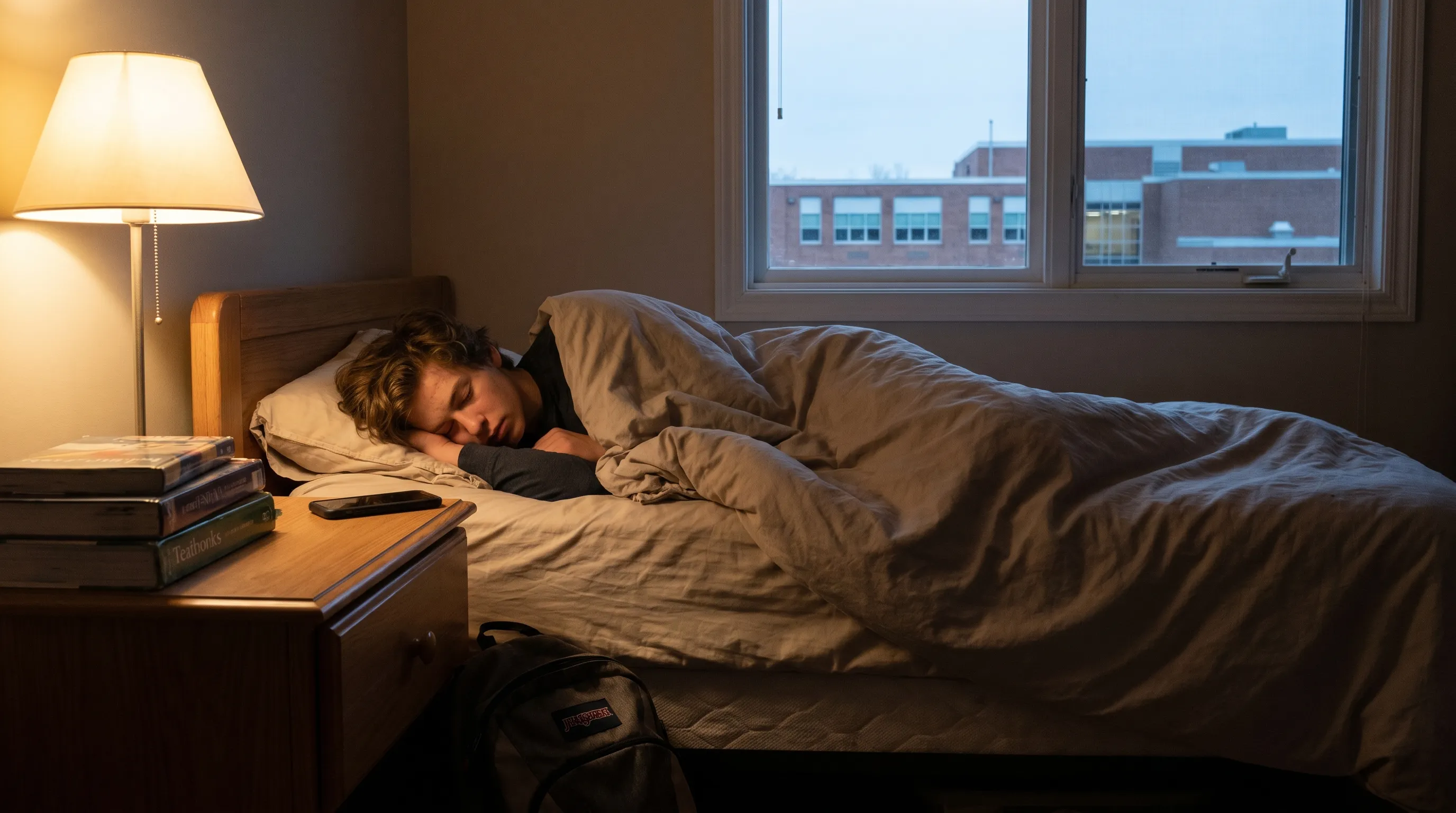
Walk into any secondary school at 8 a.m. and the evidence is in the room: slumped postures, glazed eyes, coffee cups in year-10 hands. This is not an attitude problem. It is a population-level physiological crisis, and the data consistently confirms what teachers already feel. The question is not whether your school has a sleep problem. It does.
CDC data cited by Lightspeed Systems indicates that more than two-thirds of high-school-aged adolescents do not meet basic sleep requirements. The National Sleep Foundation puts the figure in sharper relief: around six out of ten middle schoolers and seven out of ten high schoolers fail to get enough sleep on school nights. These are not outliers — they are the majority of students in the majority of classrooms.
The consequences are measurable. Sleep deprivation is associated with impaired learning consolidation, reduced capacity for abstract thinking, and weakened emotional regulation. The mental health dimension is stark: approximately one in three students sleeping fewer than six hours per night shows a high number of depression symptoms, compared with roughly one in ten among students who sleep adequately. For school administrators managing wellbeing referrals and managing staff capacity, these are not abstract statistics.
The question is whether your current response is actually addressing it.
Why Your Sleep Education Programme Is Probably Not Working
Most schools that address student sleep do so through the curriculum: a module in health class, a guest speaker, a poster campaign, maybe a digital wellbeing week. The impulse is sensible. The evidence, however, is not encouraging.
A 2024 systematic review by Gaskin et al. analysed 21 randomised controlled trials across 13 countries involving more than 10,800 adolescents. The conclusion is direct: “Short-term school-based education interventions are associated with minimal to no changes in the sleep behaviors of adolescents.” Some studies showed short-term improvements; most of those improvements faded. The review’s overall finding was that “current evidence does not provide school-based solutions for improving sleep health.”
This does not mean schools should abandon sleep education. It means the delivery model is broken — and the reason why points administrators toward a specific structural fix.
The Mechanism That Actually Works: Reinforcement at Home
If school-side education produces transient effects at best, where does durable change come from? The most instructive recent evidence comes from a 2025 randomised field experiment by Giuntella, Saccardo, and Sadoff at the University of Pittsburgh, Carnegie Mellon, and UC San Diego. Students were assigned to one of four conditions: Fitbit sleep-tracking alone (control), tracking with immediate financial incentives for meeting sleep targets, tracking with delayed financial incentives, or a cue and feedback-only arm with no financial reward.
The immediate-incentives arm — where students received structured, consistent feedback loops combined with financial accountability for their sleep behaviour — produced a significant improvement in sleep regularity and a measurable positive effect on end-of-semester GPA. The cue and feedback-only arm produced substantially smaller effects. The active ingredient was not information alone. It was a combination of structured accountability and immediate incentives that extended beyond the school day.
This points directly to the home environment. A qualitative study published in Preventing Chronic Disease interviewed 25 parents about school-based sleep programmes and found that parents themselves identified the missing link: sleep education “needs to be coming from both sources.” The same parents acknowledged being “very bad role models” — staying up late themselves — which suggests that awareness alone may not be sufficient; parents appear to need structural support, not just information, to change their own habits at home.
The implication for school administrators is structural. The intervention that works is not a better lesson plan. It is a communication infrastructure that keeps parents informed, equipped, and consistently engaged on the same messages the school is delivering.
What Communication Alone Cannot Fix — And Why That Narrows the Problem Usefully
Before turning to practical recommendations, intellectual honesty requires acknowledging what school-to-parent communication cannot fix.
Adolescent sleep deprivation has multiple contributing factors that no messaging programme addresses on its own. Puberty shifts the circadian rhythm; the Children’s Hospital of Philadelphia review confirms that teens cannot physiologically fall asleep earlier even when motivated, because melatonin release delays with age and the sleep drive slows. Early school start times compound this biological constraint — school start-time reform is a structural lever that is compelling in the research but typically outside most administrators’ direct control and beyond this article’s scope. Digital devices also play an independent role: an umbrella review from the University of Catania covering more than 867,000 participants found smartphone use correlated at r = −0.33 with sleep health issues, with blue light, psychological arousal, and fear of missing out identified as the operative mechanisms. Communication strategy addresses the parent reinforcement gap. It does not substitute for reviewing start times or school device policies.
What School Administrators Can Actually Do: Four Operational Levers
1. Make Sleep a Standing Agenda Item in Parent Communication
Sleep education delivered once a year, in a letter home or an assembly, is unlikely to change anything. What changes behaviour is repeated, low-friction exposure to the same message across multiple touchpoints, aligned with moments when parents are already paying attention.
In practice, this means building sleep into your regular communication cadence — not as a special campaign but as a recurring thread. A weekly school newsletter, for example, might include a 40-word “sleep tip of the week” tied to the academic calendar: one week before end-of-term assessments, a reminder about sleep and memory consolidation; in the final week of the summer holiday, a note about re-establishing sleep schedules before school resumes. Channel: newsletter or SMS. Length: 30–50 words. Trigger: academic calendar milestones (exam periods, term transitions). Sample content: “This week your child begins mock exams. Research consistently links sleep regularity — not just duration — to academic performance. A consistent bedtime this week, even by 30 minutes earlier than usual, may make a meaningful difference.”
2. Give Parents Specific Behavioural Guidance, Not Just Awareness
The parental qualitative data is clear: awareness of the sleep problem is not the bottleneck. Parents know. What they lack is specific, actionable guidance on what to do at home. Generic messaging (“make sure your child sleeps enough”) produces no behaviour change because it requires the parent to translate awareness into a specific action with no support.
Evidence from a University of Geneva survey of 329 adolescents aged 13 to 15 provides unusually precise guidance. A bedroom smartphone ban was associated with 33 additional minutes of sleep per night. An evening smartphone ban — prohibiting use from a set time before bed — was associated with 66 additional minutes. Time limits, screen-time caps, and switching to airplane mode showed no significant improvement, suggesting that the mere proximity of the device continues disrupting sleep regardless of its operational status. Parents who receive that specific finding — bedroom bans matter, time limits largely do not — have something concrete to act on.
In practice, this looks like a single-page guide distributed at the start of the academic year and referenced in communications at high-stakes periods. Channel: printed handout at parent evening plus a digital version linked from the school app. Length: one page, five concrete actions. Trigger: start of year, before exam periods. Sample content: “Keeping phones outside the bedroom — not just switched to silent — is associated with an additional 33 minutes of sleep per night. A full evening ban can add up to 66 minutes.”
3. Align Messaging Between Teachers and Parents
The parents in the Preventing Chronic Disease study were explicit: the same message needs to come from both school and home simultaneously. When a teacher mentions sleep in a classroom context and then nothing arrives at home to reinforce it, the school-side message dissipates. When a parent reminder arrives the week after a health lesson and explicitly references what was covered in school, the message lands differently.
This requires a minimal coordination layer: teachers flag when sleep content is being addressed in the curriculum, and the school’s parent communication reflects that timing. In practice, this is a standing item in the weekly staff briefing agenda — form tutors check a curriculum schedule posted in the staff area and flag upcoming health content to the pastoral lead, who queues the parent message. This looks like a form teacher sending a brief note home the evening of a health or science lesson covering sleep: “Today in class we discussed why teenagers need 8–10 hours of sleep and why earlier bedtimes are harder to enforce at this age than they seem. Here are two things you can do at home that the research supports.” Channel: school messaging platform notification. Length: three sentences plus two bullet points. Trigger: curriculum delivery. No special technology required — but the coordination requires deliberate process design, not improvisation.
4. Build Feedback Loops, Not One-Way Broadcasts
The Giuntella et al. RCT suggests that structured accountability mechanisms — combining incentives and regular feedback — are central to effective sleep interventions, not information delivered once. The school communication corollary is that effective parent engagement requires response mechanisms, not just one-way broadcasts.
This means creating structured moments for parents to report back: a brief term-time survey on whether their child’s sleep patterns have changed, a question appended to existing parent evenings, or a simple acknowledgement mechanism in the school app. The goal is not surveillance. It is to create the social accountability loop that the evidence suggests is necessary for behaviour change to persist.
In practice, this looks like a three-question end-of-term check-in sent to all parents of secondary-age students. Channel: school app push notification linking to a short in-app form. Length: three questions, completable in under two minutes, sent once per term. Trigger: end of each term, two weeks before the holiday break. Sample content: “Has your child’s bedtime shifted since September? (Earlier / About the same / Later). Have you tried any of the phone-free bedroom strategies we shared? (Yes / Not yet). Would you find a short sleep workshop at parent evening useful? (Yes / No).”
The Communication Infrastructure Schools Actually Need
The four levers above share a common dependency: they require a communication infrastructure that can deliver targeted, timely, and consistent messages to parents without creating significant administrative overhead for staff.
This is where the practical constraint bites. Most schools have parent communication systems that are capable of broadcasting information but not of delivering segmented, triggered, curriculum-aligned messages at the right moment without someone manually executing each send. The result is that good intentions collapse into occasional email blasts.
The operational requirement is a platform that allows schools to schedule and segment parent communications by year group, link messaging triggers to the academic calendar, and track engagement — so that the school can distinguish between parents who received a message and parents who need a follow-up. This is not a novel requirement; it is the same infrastructure that governs any effective population health intervention.
Several tools exist to help schools operationalize this kind of coordinated home-school communication. BeeNet is one implementation path: a multilingual school communication platform designed specifically for managing segmented, scheduled, and calendar-linked parent messaging across year groups and subject areas. Whether or not schools choose a purpose-built tool, the infrastructure requirement is the same — and meeting it is the precondition for the evidence-based approach to actually work.
The Window Is Now
Student sleep is not a new problem, but the evidence on what does and does not work has sharpened considerably in the past two years. School-side education alone is demonstrably insufficient. The Giuntella RCT confirms that structured accountability mechanisms combining incentives and regular feedback improve sleep regularity and GPA. The parental qualitative evidence confirms that parents want to engage — they are asking for the specific guidance and the school-side support to do it. The communication infrastructure to deliver that engagement at scale is available. The parents are ready — the qualitative evidence is unambiguous on that point. What they need is for the school to give them specific guidance and a consistent communication rhythm to act on it.
References
-
Giuntella, O., Saccardo, S., & Sadoff, S. (2025). Sleep Incentives, Education, and Defaults: A Randomized Field Experiment. UC San Diego Rady School of Management. https://rady.ucsd.edu/_files/faculty-research/sadoff/Giuntella_Saccardo_Sadoff_Sleep_March_2025.pdf
-
Gaskin, C. J., et al. (2024). School-based interventions for improving sleep health in adolescents: A systematic review of randomised controlled trials. SLEEP Advances, 5(1), zpae019. https://academic.oup.com/sleepadvances/article/5/1/zpae019/7637435
-
Askew, K. (2025). Sleep deprivation in schools: The hidden mental wellness crisis. Lightspeed Systems Blog. https://www.lightspeedsystems.com/blog/sleep-deprivation-in-schools-the-hidden-mental-wellness-crisis/
-
Bird, M., et al. (2023). Parental perspectives on school-based sleep education and home-school partnerships. Preventing Chronic Disease. https://pmc.ncbi.nlm.nih.gov/articles/PMC10199697/
-
Fiore, M., et al. (2025). Digital devices and sleep in adolescents: An umbrella review. International Journal of Environmental Research and Public Health. https://pmc.ncbi.nlm.nih.gov/articles/PMC12564284/
-
Suni, E., & Dimitriu, A. (2023). Sleep for teenagers. National Sleep Foundation. https://www.sleepfoundation.org/teens-and-sleep
-
Mammeri, N., Riontino, V., Schwartz, S., & Sterpenich, V. (2025). Parental device rules and adolescent sleep. Discover Public Health. https://pmc.ncbi.nlm.nih.gov/articles/PMC12414006/
-
Afolabi-Brown, O., Moore, M., & Tapia, I. E. (2024). Sleep deficiency and school start times. Sleep Medicine Clinics. https://pubmed.ncbi.nlm.nih.gov/39455177/
Ready to Transform Your School Communication?
Start saving time and increasing parent engagement with BeeNet.
Request Demo