TALIS 2024 and Teacher Burnout: Why Parent Communication Is a Retention Crisis
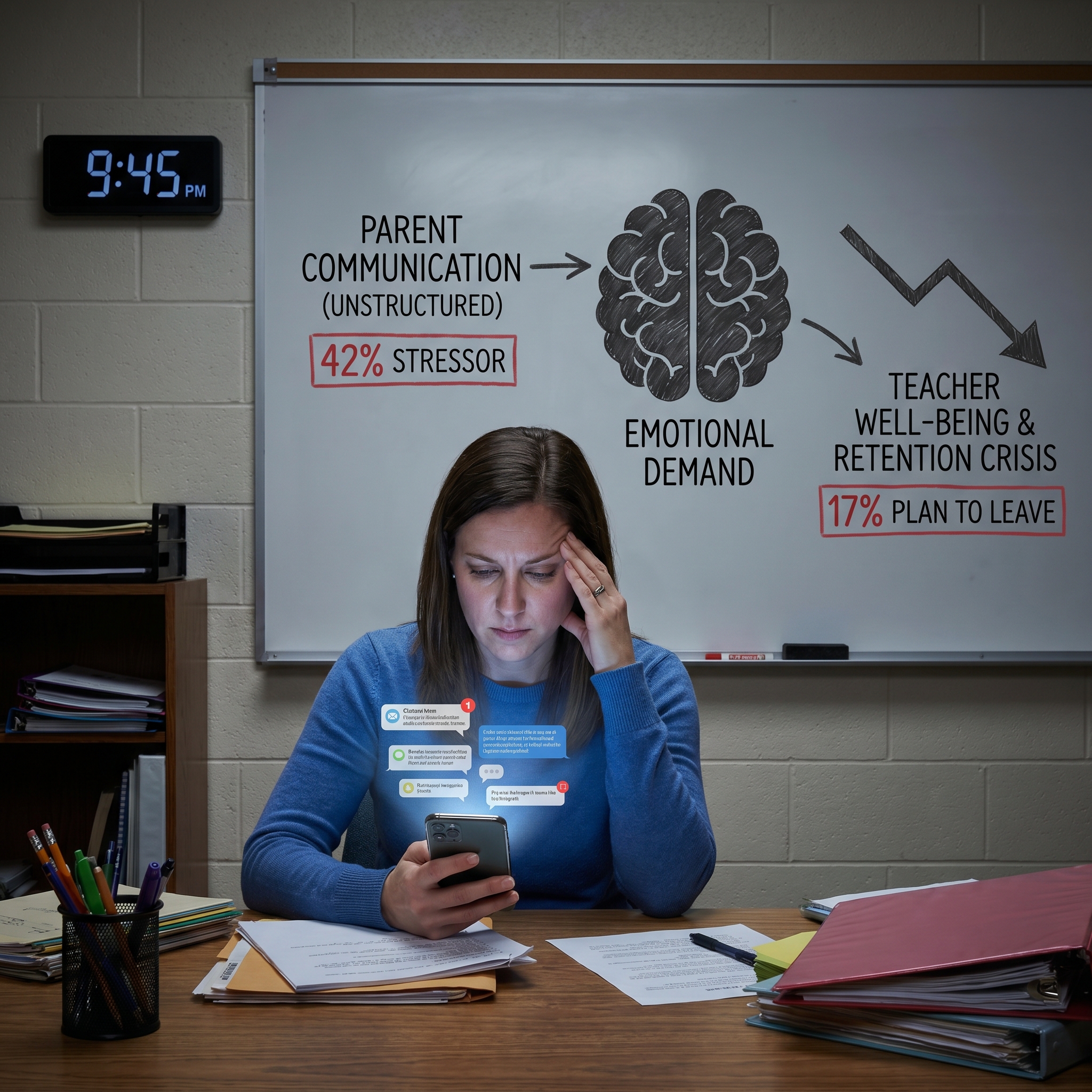
Seventeen percent of all non-retirement-age teachers globally plan to leave the profession within five years. That figure, drawn from the OECD’s TALIS 2024 survey, is not a statistic about workload in the abstract. It is a staffing forecast. And the data behind it points to a cause that many school leaders have not yet treated as the priority it is: unstructured parent communication.
The Stressor That Gets Overlooked
When administrators think about teacher burnout, the conversation usually focuses on administrative paperwork, curriculum demands, or classroom discipline. These are real pressures. But TALIS 2024 adds a finding that complicates the familiar picture.
According to Education International’s analysis of TALIS 2024, 42% of teachers globally cite “addressing parents’ concerns” as a significant stressor — placing it among the top stressors globally, alongside administrative work (52%), discipline management (45%), and accountability pressures (45%). More critically, the survey doesn’t just rank stressors. It quantifies their cost: “An additional hour spent on administrative tasks, marking or communicating with parents is associated with a steeper decrease in teacher well-being.”
That single finding reframes the conversation. Parent communication is not a soft, relational variable on the margins of teacher well-being. It is measurably in the same harm category as the paperwork burden that has occupied school reformers for decades.
Regional Scale: What This Looks Like Inside Real Schools
To understand what this data means for a school, consider the regional picture.
In Alberta, Canada, teachers report working 47 hours per week — five hours above the OECD average — and 42% report experiencing high levels of work-related stress, compared to a global average of just 19%. Belgium shows a similar pattern: more than 50% of teachers consider their job negatively affects their mental and physical health, according to a 2025 bibliometric analysis of five decades of teacher burnout research published in Acta Psychologica. The same study reports 76% of Canadian teachers experience emotional exhaustion.
These are not outlier figures. They reflect a profession in which the accumulation of hours spent on tasks outside direct teaching — including communication demands — is actively degrading the resource schools most need to protect.
For school leaders in France, Belgium, and across the Gulf region, the question is no longer whether this is happening. The question is whether it is being treated seriously enough to change the conditions that produce it.
The Early-Career Problem Is Acute
TALIS 2024 is especially pointed about one group: novice teachers.
Education International’s analysis finds that more than 20% of novice teachers intend to leave teaching within five years in nearly one-third of participating education systems. A 2025 study published in Frontiers in Education reinforces this finding: “young teachers with limited experience are the least satisfied and have lower levels of mental health and wellbeing, making them more at risk of burnout and attrition” (Frontiers in Education, 2025).
Early-career teachers are typically the least equipped to manage the emotional demands of parent communication. They have not yet developed the professional scripts and boundary-setting habits that more experienced colleagues use to contain the cognitive load. When a parent sends a message at 9 pm about a grade, a novice teacher often feels obligated to respond — immediately, personally, and with care. Multiply that across a class of 30 families and the toll becomes structural.
Parent Communication as an Emotional Demand, Not Just a Time Cost
The time cost of parent communication is measurable. But TALIS 2024 and the research it has catalyzed suggest the problem goes deeper than hours logged.
A 2025 study in Frontiers in Psychology, examining preschool teachers in Taiwan, found that both workload and emotional demands significantly predict turnover intention — with burnout as the mediating factor. The study explicitly classifies parent communication as a source of emotional demand: “Preschool teachers are expected to meet parents’ high demands concerning learning outcomes, instructional approaches, parent–teacher communication, and timely responses — all identified as sources of emotional strain” (Frontiers in Psychology, 2025).
This distinction matters for school administrators. Reducing the time spent communicating with parents is not sufficient if the nature of that communication remains reactive, unstructured, and emotionally unpredictable. A teacher who spends 30 minutes writing a careful, defensive email in response to an agitated parent has absorbed an emotional load that the clock does not fully capture.
The implication is that structure matters as much as volume. Predictable, contained channels — where communication happens at set times, in defined formats, with clear scope — reduce both the time burden and the emotional charge. A parent who knows they will receive a weekly structured update through the school’s platform is less likely to send an anxious late-evening message. The teacher who knows communication is bounded feels less perpetually on-call.
What the Data Says About Satisfaction and Retention
TALIS 2024 also contains a finding that should focus the attention of any school leader concerned about staff stability: satisfied teachers are five times less likely to plan to leave the profession (Education International, 2025).
Meanwhile, a 2025 independent synthesis of the full OECD TALIS 2024 report notes that workload and administrative demands “continue to erode the energy teachers need to sustain good teaching” (The Economy of Meaning, 2025). The connection is direct: eroded energy produces dissatisfaction; dissatisfaction produces attrition.
The financial dimension is not negligible either. Research estimates that replacing a teacher costs between $11,860 and $24,930 when recruitment, onboarding, and lost productivity are factored in. For a school that loses three teachers in a year, that is a budget line that dwarfs the cost of any communication tool.
School administrators often frame staff retention as a matter of salary, culture, or leadership. TALIS 2024 adds a more granular variable: the daily texture of a teacher’s workload. Communication burden is controllable in a way that many other retention levers are not. It does not require a budget negotiation or a cultural transformation. It requires structural decisions about how and when communication with families happens.
From Data to Decision: What Administrators Can Do
The TALIS 2024 findings point toward a specific type of intervention. Research compiled from multiple sources identifies communication with families explicitly among the tasks “that can be simplified with software” to reduce burnout. But the tool is only as effective as the policy that governs its use.
Three structural decisions translate the TALIS data into school practice:
1. Move family communication to asynchronous, platform-based channels. In practice, this means messages from parents go through the school’s app (such as BeeNet’s messaging channels), not the teacher’s personal phone, and responses happen during working hours. When communication happens through a defined channel rather than personal phone numbers and email, it creates a natural boundary. The record is shared and visible. The emotional charge of a private message — which can feel like a personal confrontation — is reduced.
2. Establish communication norms that are communicated to families at the start of the year. Response time expectations, appropriate topics for digital messages, and the distinction between urgent safeguarding contacts and routine updates should be explicit. Many teachers absorb unreasonable parent expectations simply because no one has ever set a different standard.
3. Protect early-career teachers specifically. Given what TALIS 2024 shows about novice teacher attrition, schools should consider actively monitoring communication loads for teachers in their first three years — for example, a brief monthly check-in with their department head about the volume and nature of parent contacts — and offering structured support when those loads spike.
None of these interventions requires extraordinary resources. They require administrative will to treat teacher communication burden as a retention variable — not a personal coping problem.
If you are reviewing how your school manages family communication and looking for a platform that brings structure, boundaries, and simplicity to the school-family channel, BeeNet brings structured, time-bounded communication channels between teachers and families. The data from TALIS 2024 is a clear signal. The structural response is a decision that sits with school leadership.
References
-
Education International. (2025). New TALIS data: Report confirms need to act on global teacher shortage and working conditions. https://www.ei-ie.org/en/item/31459:new-talis-data-report-confirms-need-to-act-on-global-teacher-shortage-and-working-conditions
-
Education International. (2025). Novice teachers under pressure: Insights from TALIS 2024. https://www.ei-ie.org/en/item/31469:novice-teachers-under-pressure-insights-from-talis-2024
-
Alberta Teachers’ Association. (2025). TALIS results reveal a profession under pressure. https://teachers.ab.ca/news/talis-results-reveal-profession-under-pressure
-
The Economy of Meaning. (2025). OECD TALIS 2024 Global Teacher Survey Findings — The State of Teaching Around the World. https://theeconomyofmeaning.com/2025/10/07/talis-2024-the-state-of-teaching-around-the-world/
-
Acta Psychologica (Elsevier). (2025). Five decades of teacher burnout research (1970–2024): A comprehensive bibliometric analysis. https://www.sciencedirect.com/science/article/pii/S0001691825006316
-
Frontiers in Psychology. (2025). The impact of workload and emotional demands on turnover intentions: the mediating and moderating effects of job burnout. https://www.frontiersin.org/journals/psychology/articles/10.3389/fpsyg.2025.1699421/full
-
Frontiers in Education. (2025). From burnout to growth: the relationship between teachers’ job satisfaction, wellbeing and mental health. https://www.frontiersin.org/journals/education/articles/10.3389/feduc.2025.1708863/full
-
Wooclap. (2025). Teacher Burnout Statistics in 2025: Causes, Effects, and Solutions. https://www.wooclap.com/en/blog/teacher-burnout-statistics/
Ready to Transform Your School Communication?
Start saving time and increasing parent engagement with BeeNet.
Request Demo