The Six-Week Family Communication Loop Morocco Built Into Schools — And Why Most Miss It
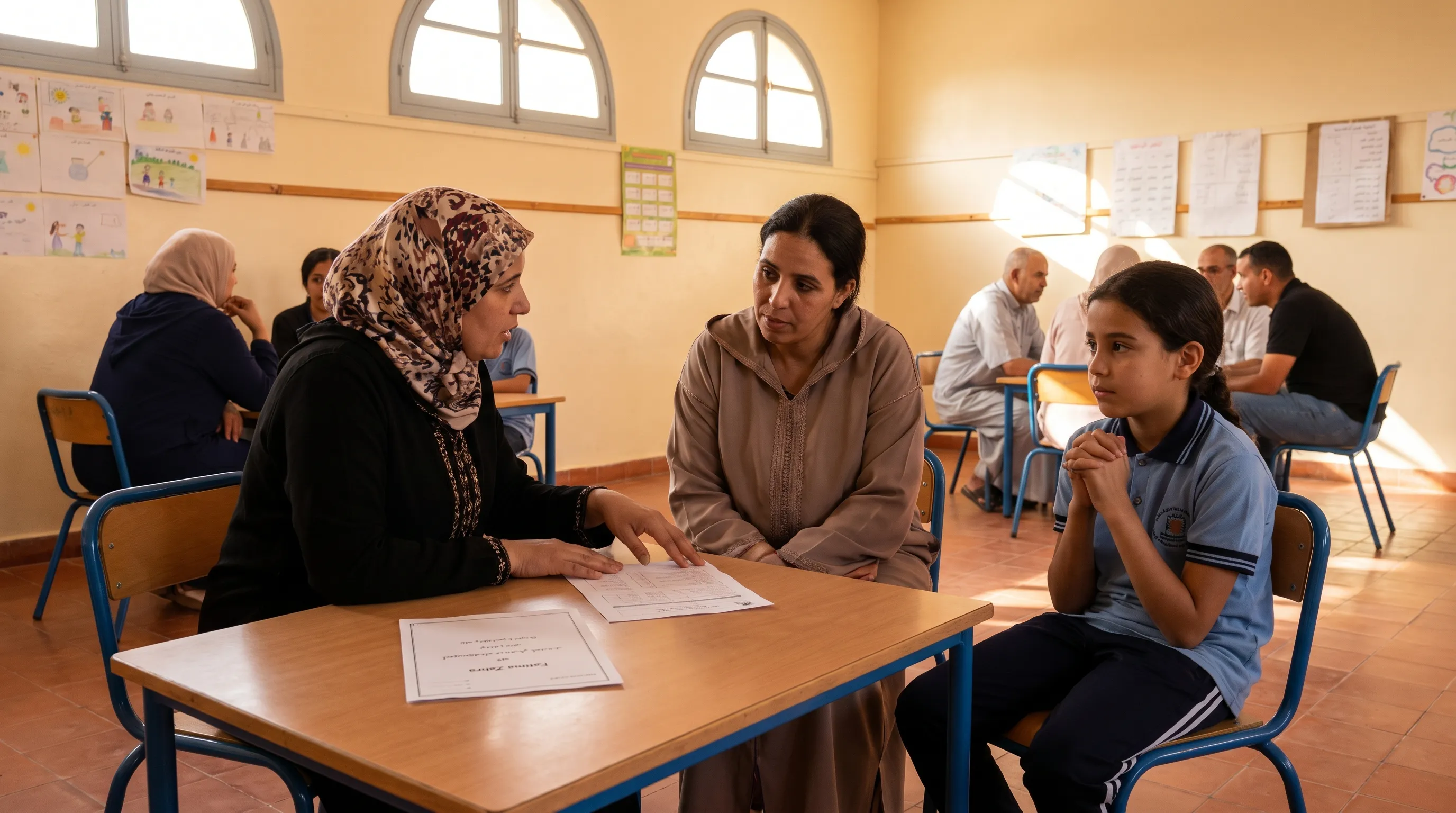
Every school communicates with parents. Most do it when something goes wrong. Morocco decided to do it on a schedule — and in its first cohort of lower-secondary schools, dropout fell by a third. That schedule was built into the architecture of the school year itself.
The result is a programme in which family communication is embedded inside every six-week learning cycle, and that programme — as a whole — produced a 31.4% reduction in end-of-year dropout rates in its first cohort of lower-secondary schools. That is not a claim about what parent communication alone can do. It is a claim about what happens when you stop treating family contact as an afterthought and start treating it as a design requirement.
For school administrators in France, Belgium, Morocco, the UAE, or anywhere else managing dropout risk and disengaged families, the question is not whether Morocco’s results are transferable in full. The question is whether the structural idea — a mandatory, rhythmic parent touchpoint baked into the academic calendar — is something your school could install without a national reform.
The answer is yes. Here is how it works and what you would need to do.
What the Pioneer Schools Programme Actually Built
Morocco’s Pioneer Schools programme is a whole-school reform that restructured how primary and lower-secondary schools organize time, teaching, and family relationships.
At the core of the programme is a six-week learning cycle. As documented by the UNESCO Global Education Monitoring Report, the remaining periods within each cycle “alternate new learning and integrated remediation for five weeks, followed by one week of assessment.” That sixth week includes post-testing — and parent communication.
This is not a parent newsletter. It is a structured touchpoint built into the calendar: after every five weeks of instruction, families receive information about where their child stands, tied directly to the assessments their child just completed. The communication is not reactive — triggered by poor grades or disciplinary issues — it is scheduled. Families know it is coming. Teachers prepare for it. Administrators plan around it.
The programme also reorganized how students are grouped. Rather than locking students into year-groups by age, Pioneer Schools uses competency-based grouping — students move through content at a pace matched to their demonstrated level. The sixth-week assessment is the mechanism that drives those grouping decisions, and parent communication is how families are kept inside that loop rather than outside it.
By 2023–2024, 628 public primary schools were operating under this model, serving 322,000 students with 10,700 teachers. A cohort of 232 lower-secondary Pioneer Collèges launched in September 2024. Morocco has set a target of reaching 500 lower-secondary schools and, eventually, 80% of primary schools — though those are targets for 2025–26 and 2026–27 respectively, not yet confirmed as achieved.
What the Research Shows — and What It Does Not
The controlled assessment of the 2023–2024 primary cohort, conducted by UM6P, J-PAL, Harvard’s Center for International Development, and Community Jameel, found an improvement of 0.9 standard deviations across all subjects — meaning Pioneer Schools students outperformed approximately 82% of peers in comparison groups. An independent evaluation cited by the Scaling Community of Practice found that learning gains more than tripled compared to control schools, alongside a 30% reduction in dropout rates.
At the lower-secondary level, the research led by Andreas de Barros (UC Irvine) and Florencia Devoto (UM6P) found the reform achieved a 31.4% reduction in end-of-year dropout rates, bringing figures from 5.1% to 3.5%, alongside an 8.5 percentage point reduction in grade repetition.
These outcomes belong to the full Pioneer Schools package — not to any single component. The research designs compared schools running the complete programme against schools that were not; no study isolates the sixth-week parent communication touchpoint as independently causal. The honest claim is that a programme in which family communication is built into the architecture achieved these results. That distinction matters, and the next section addresses it directly.
The Communication Rhythm Is One Component, Not a Silver Bullet
Before drawing lessons for your school, it is worth being clear about what else Morocco built alongside the family communication rhythm.
The programme includes intensive teacher training in structured pedagogy; a September pre-year remediation block (TARL methodology); a financial incentive of 10,000 MAD per year for participating teachers; inspector supervision; psychosocial support structures; and, critically, institutional continuity — the reform survived ministerial transitions because it was embedded in evaluation infrastructure at UM6P rather than depending on a single minister’s commitment.
Ali Bouabid, Director of Education Sciences at UM6P, attributes success explicitly to this combination of factors. No single element produced the results. Morocco also significantly increased its education budget — from approximately $6.8 billion in 2019 to $8.5 billion in 2025.
What you can take from this as an administrator is not “install the sixth week and cut dropout by a third.” What you can take is a structural design principle: if dropout is, as UNESCO-IIEP describes it, “a gradual, often long and silent process, marked by the accumulation of academic difficulties, psychosocial vulnerabilities and a gradual breakdown in the relationship with school” — then the counter-design is a rhythm that makes the breakdown visible before it becomes irreversible.
Why Most Schools Miss It
Most schools communicate with families in one of two modes: crisis response (a student is failing, there has been an incident) or annual ritual (the parent-teacher evening in October, the end-of-year report).
Neither mode catches dropout in progress. UNESCO-IIEP’s analysis is precise on this: disengagement is gradual and silent. A student who will leave school in March may have shown the first signals months earlier — disengagement accumulates before it becomes visible. By the time a school contacts the family, the family has already partially disengaged too.
Morocco’s design counters this with frequency and predictability. Families are not contacted when a threshold is crossed. They are contacted on a schedule — after every assessment cycle — so that no six-week period passes without a family knowing where their child stands. The communication is not exceptional. It is expected.
This distinction — between exceptional and expected contact — is the design principle most European and Gulf schools are missing. It is also the one that requires the least infrastructure to install.
How to Build the Rhythm in Your School
You do not need a national programme to implement a structured parent communication rhythm. You need a calendar, a protocol, and a platform that makes the touchpoint low-friction enough to sustain.
Define the cycle length
Six weeks is not a magic number — it is the interval Morocco chose to match its instructional design. For your school, the right interval is the one that aligns with your assessment schedule. If you assess every half-term (six to eight weeks), the communication touchpoint goes at the end of each half-term. If you run internal assessments every four weeks, use four weeks. The principle is that the communication follows the assessment automatically, not optionally.
In practice, this looks like: at the end of each assessment cycle, every class teacher sends a structured update — three to five sentences, tied to that cycle’s assessed competencies — to every family. Not to families whose children struggled. To every family.
Standardize what families receive
The six-week communication only works if families can act on it. That requires standardization. Morocco’s programme ties the parent communication to the post-testing results from that cycle — families receive information in a consistent format that allows them to track progress over multiple cycles, not just react to a single report.
In practice, this looks like: a brief structured message that covers three things — what was assessed this cycle, where the student stands relative to expected progress, and what the family can do at home to support the next cycle. The message should take a teacher under five minutes to send and a parent under three minutes to read. Track whether families engage from cycle one; set a baseline, not a perfection target, and treat persistent non-response as an early-warning signal rather than a communication failure.
Build the touchpoint into the calendar as a non-optional event
The difference between a communication rhythm and a communication intention is whether it appears on the school calendar as a fixed event. Morocco built the sixth week into the programme’s architecture — it is not something teachers do when they have time. It is something the school year is structured around.
In practice, this looks like: blocking one day per cycle in the school calendar as “family communication day,” making it visible to teachers, families, and administrators simultaneously. Teachers who ask why it is mandatory can be shown the cycle’s assessment data: the touchpoint is the mechanism that closes the loop between assessment and family awareness, not an addition to the assessment. When families can predict when they will hear from the school, response rates and engagement increase.
Use a platform that reduces friction for both sides
A structured communication rhythm fails if sending and receiving the message takes meaningful effort. Email is inconsistent. Paper notes go missing. A WhatsApp group is unsuitable for structured academic updates. What the rhythm requires is a platform where teachers can send structured updates by class, families receive them in a channel they check reliably, and administrators can verify that the touchpoint happened.
Keeping that rhythm consistent across a full school — across all classes, every six weeks, in a format families can act on — is where purpose-built platforms matter. Tools like BeeNet are designed specifically for this: a platform where teachers can send structured updates by class, families receive them reliably, and administrators can see whether the cycle’s touchpoint happened. It is one implementation path, not the only one, but the operational requirement is real regardless of which platform you use.
Install the Rhythm Before the Next Term Starts
Every administrator reading this already believes parent communication matters. The research on family engagement and student outcomes is not new or contested.
What Morocco demonstrated — at scale, with controlled evaluation, across both primary and lower-secondary levels — is that belief is not enough. The schools that reduced dropout built the communication rhythm into the structure of the year so that it happened regardless of how busy the term became. The schools that did not kept intending to communicate better and found that intention competed with everything else on the calendar.
The families of the students most at risk of disengaging are the least likely to initiate contact with the school. The school has to come to them — on a schedule, after every cycle, before the silence becomes permanent.
That is not a reform. It is a calendar decision. Make it before the next term starts.
References
-
UNESCO Global Education Monitoring Report. (2026). Morocco Country Case Study — 2026 GEM Report: Access and Equity. https://www.unesco.org/gem-report/en/2026-gem-report-country-case-studies/morocco
-
Morocco World News. (2024, September). Morocco’s Pioneer Schools Program Produces Significant Positive Impact on Students’ Learning. https://www.moroccoworldnews.com/2024/09/14317/moroccos-pioneer-schools-program-produces-significant-positive-impact-on-students-learning-assessment-shows/
-
Morocco World News. (2026, April). UM6P Education Chief Explains Why Morocco’s School Reform Is Finally Working. https://www.moroccoworldnews.com/2026/04/285397/um6p-education-chief-explains-why-moroccos-school-reform-is-finally-working/
-
Morocco World News. (2026, March). Morocco National Teacher Forum — Study Finds ‘Pioneer Colleges’ Program Cuts Dropout Rate by One Third. https://www.moroccoworldnews.com/2026/03/284439/morocco-national-teacher-forum-study-finds-pioneer-colleges-program-cuts-dropout-rate-by-one-third/
-
Scaling Community of Practice. (2025). Partnering for Impact — Morocco’s Experience Using Evidence and Evaluation to Scale Education Reforms. https://scalingcommunityofpractice.com/partnering-for-impact-moroccos-experience-using-evidence-and-evaluation-to-scale-education-reforms-delivering-impact/
-
Jumelages Partenariats. (2024). Morocco/School Year 2023/2024 — Implementation of the ‘Pioneer Schools’ Project. https://jumelages-partenariats.com/en/actualites.php?n=18816
-
Ecofin Agency. (2025). Morocco’s TARL Program Lifts Learning for 1.3M Students in 3 Years. https://www.ecofinagency.com/news-services/2205-46934-morocco-s-tarl-program-lifts-learning-for-1-3m-students-in-3-years
-
UNESCO International Institute for Educational Planning (IIEP). (2025). Educational Planning to Reduce Early School Dropout in Morocco. https://www.iiep.unesco.org/en/articles/educational-planning-reduce-early-school-dropout-morocco



Related BeeNet Features
Ready to Transform Your School Communication?
Start saving time and increasing parent engagement with BeeNet.
Request Demo