AI Homework: What Schools Must Tell Parents Now

A Year 7 student (around age 12) opens a chatbot after dinner, pastes in tomorrow’s history essay prompt, and submits a polished paragraph by bedtime. Her teacher reads it the next morning and grades it well. Her parents see a finished homework folder and assume the system is working. Six weeks later, in a closed-book classroom assessment on the same topic, she struggles to organise three coherent sentences.
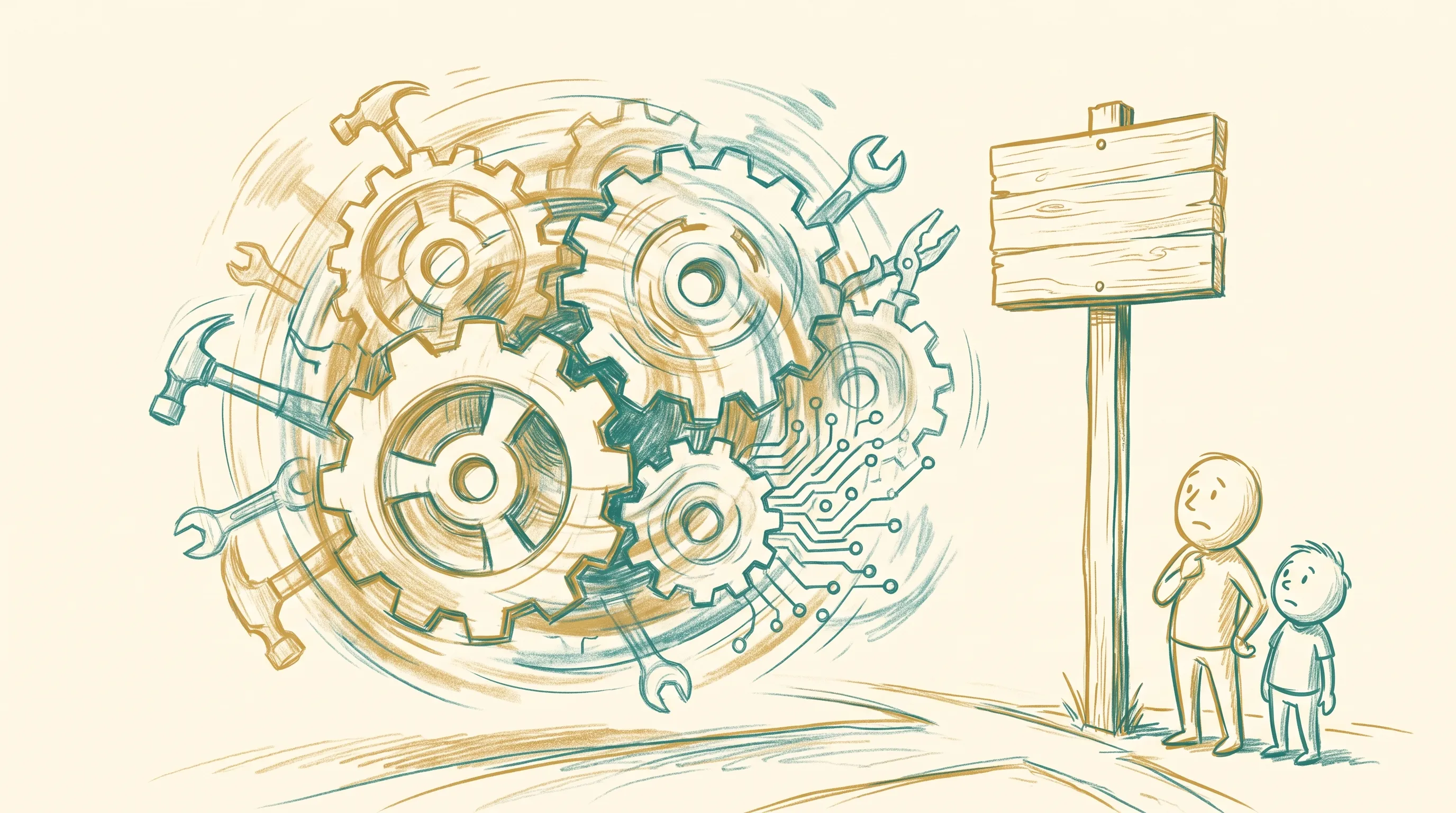
This is the pattern the OECD Digital Education Outlook 2026 is asking schools to confront. The OECD reports that students using a general-purpose AI tool improved short-term task performance by up to 48%, yet performed 17% worse once access was removed (Worlddidac). A closely matching pattern appears in a separately reviewed University of Pennsylvania study covered in Frontiers in Psychology — ChatGPT-assisted students answered 48% more problems correctly, but their conceptual understanding scores were 17% lower (Frontiers in Psychology). The OECD calls this the “crutch effect”, and attributes it to cognitive offloading: when AI does the thinking, the brain stops practising the thinking.
That finding alone would be reason enough for school administrators to act. But it sits alongside a second, equally uncomfortable data point: in a US survey from the National Parents Union, 47% of parents say their child’s school has not shared any information about AI policies at all (EdWeek). No equivalent MENA or European parent survey has yet been published, so the US figure currently stands as the closest available signal — but anecdotally, the silence is familiar to administrators across the OECD.
The combination is the story of this article. The evidence on what undermines learning at home is now specific enough to act on. The communication channel from school to parent, on this specific topic, is largely empty. Closing that gap is one of the most concrete, low-cost levers a school leadership team has in 2026.
What the crutch effect actually measures
A single caveat, stated once: the OECD’s 48%/17% figures are a synthesis of observational studies, not a single randomised controlled trial. Stanford research in the same review found a 15% increase in standardised test scores using AI platforms — depending on how those platforms were designed and used.
The mechanism, across studies, is described as cognitive offloading and what researchers studying ChatGPT-assisted essay writing call “metacognitive laziness” — outsourcing the synthesis, analysis and explanation steps that build durable understanding (Hechinger Report). An Anthropic study of 574,740 Claude conversations with university students over 18 days found that nearly half requested direct answers with minimal engagement.
The one piece of causal evidence in the picture comes from a Corvinus University of Budapest randomised experiment with around 100 students, which found that “uncontrolled use of AI tools leads to disengaged students and low understanding of material,” with performance 20% to 40% lower than in previous cohorts (Benedek & Sziklai, 2025). It is a single-course, single-university preprint, and should be cited as such — but it points in the same direction as the broader synthesis.
The OECD’s framing matters here: the problem is not AI in learning. The problem is uncontrolled AI in learning, particularly outside the classroom, where no teacher is shaping how the tool is used.
The communication vacuum at home
Home is exactly where most AI use is happening. A Pew Research Center survey of US teens and parents found that 64% of teens report using chatbots, but only 51% of parents believe their children do (Fortune / Pew Research Center). Fifty-four percent of teens use AI for schoolwork assistance. A RAND American Youth Panel found student AI use rose from 48% to 62% between May and December 2025, and that 67% of students themselves now say AI use has harmed their critical thinking skills (eSchool News) — up from 54% earlier in the year.
Students’ own conception of cheating has also drifted. In the same panel, nearly 80% said using AI to “understand assignments” was not cheating; only 45% considered getting direct answers cheating. Only one-third reported a schoolwide AI policy at all — most said rules varied teacher by teacher.
The parental picture is the mirror image. In the EdWeek/National Parents Union survey:
- 37% have received any AI policy information from the school
- 57% have not been asked for input on the school’s AI policy
- 79% believe parental permission should be required before minors use AI tools
- 85% want chatbots to alert parents if children discuss harmful content
Parents are not asking schools to ban AI. They are asking to be told what’s happening and what they should do about it. Most are still waiting.
Worlddidac’s coverage of the OECD report also surfaces what the EPALE summary calls the “Second Digital Divide”: well-supported learners use AI as tutoring, while disadvantaged students use it as a shortcut (EPALE). Parent guidance is one of the few levers that touches that divide directly — because the families least likely to coach their children through AI use are precisely the families that get no coaching from the school either.
Parent communication is one lever — not the only one
Parent communication is one lever, not the lever. The OECD review is clear that teacher classroom practice matters at least as much — its three-model framework (Replacement, Complementarity, Augmentation) describes whether teachers let AI do work for students, work alongside students, or actively extend professional judgement (CIDDL). Assessment and curriculum design that rewards finished outputs over visible thinking is another driver of the crutch effect. And cognitive offloading is a broader phenomenon than school policy can solve on its own. The case for closing the parent guidance gap is not that it fixes everything — it is that, of the available levers, it is the one most schools are not yet pulling, and the one with the lowest implementation cost.
What concrete parent guidance looks like
What follows is a description of what parent-facing communication on home AI use should look like in practice — specific enough that a deputy head could brief a year team on Monday morning. Of the four, the per-assignment AI-on/off/conditions tag is the lowest-cost starting point — it requires no new channel, just a label.
A weekly, teacher-level homework signal
Generic school-wide AI policy documents are necessary but not sufficient. Parents need to know, for this week’s homework, when AI is welcome and when it is not.
In practice, this looks like a 60-to-90-second voice or video message from the class teacher every Sunday evening, sent through the school’s parent channel: “This week, Year 5 has a personal writing assignment. Please ask your child to write a first draft on paper before opening any chatbot — the draft is where the learning happens. After the draft, AI is welcome for spelling and grammar checks, but not for rewriting paragraphs. Maths homework this week is fine to discuss with a chatbot, but please ask your child to explain their reasoning back to you in their own words before submitting.”
Three sentences. One channel. Once a week.
A clear “AI off / AI on / AI with conditions” tag per assignment
In practice, this looks like every homework task being posted with one of three visible labels: AI off (closed-book practice, no chatbot use of any kind), AI on (research, brainstorming, exploration — AI use is expected and not cheating), or AI with conditions (draft first, then check; or explain the AI answer back in your own words). Parents do not need pedagogy training. They need a label. The label is what turns a vague worry into a household rule.
A short, one-page family-facing explainer
In practice, this looks like a single A4 page, translated into the school’s main parent languages, distributed once at the start of the year and re-sent at each report cycle. It should cover three things: what the crutch effect is in two sentences, three home behaviours that protect learning (paper drafts first, explain-back, AI-off practice for upcoming closed-book assessments), and the school’s escalation contact for AI concerns. The version reviewed by the parent council should be available in every language the school serves — in MENA and European multilingual contexts, anything less excludes the families most at risk of the Second Digital Divide.
A pre-assessment signal
In practice, this looks like a short message ten days before each closed-book or end-of-unit assessment: “Year 8 has a closed-book history assessment on the 14th. For the next ten days, please support your child to revise without a chatbot. The skill being tested is recall and explanation in their own words.” This single message would address the precise mechanism the OECD describes — the gap between AI-supported performance and unassisted understanding.
What this means for school leadership
Two things follow from the evidence. First, schools that have an AI policy but have not communicated it to parents in concrete, weekly, homework-level language are not yet operating that policy. Policy that lives only in a staff handbook does not reach the kitchen table where the chatbot is actually opened. Second, the communication itself has design constraints the evidence makes explicit: it must be multilingual (to avoid widening the Second Digital Divide), structured (labels and routines parents can act on without training), and on a weekly cadence that matches the rhythm of actual homework, not the annual rhythm of policy documents.
Most schools already have parent communication channels. The question is whether those channels are carrying this specific signal, in the languages families read, at the cadence the problem requires. Whether your school does this through email, paper newsletters, WhatsApp groups, or a dedicated parent communication platform is a secondary question — what matters is that the signal is structured, multilingual, and reliably weekly. BeeNet is one implementation path schools in MENA and Europe use to do this: structured per-class messaging, multilingual delivery, and per-assignment guidance to families in their own language. It is not the only path. The point is that some path now has to be operational.
The OECD finding is not a forecast. It is a description of what is already measurable in classrooms today. The 17% gap between AI-supported performance and unassisted understanding is happening in your students’ homes tonight; the only open question is what your school says about it tomorrow morning.
See how schools in MENA and Europe deliver this signal weekly, in every parent’s language: Parent communication for schools →
References
- CIDDL. (2026). Summary of OECD Digital Education Outlook 2026. https://ciddl.org/summary-of-oecd-digital-education-outlook-2026/
- EPALE / European Commission. (2026). The Future of Learning: Key Takeaways from the OECD Digital Education Outlook 2026. https://epale.ec.europa.eu/en/blog/future-learning-key-takeaways-oecd-digital-education-outlook-2026
- Worlddidac. (2026). OECD Digital Education Outlook 2026: When Technology Does Not Equal Transformation. https://worlddidac.org/news/oecd-digital-education-outlook-2026-when-technology-does-not-equal-transformation/
- European Commission Digital Skills & Jobs Platform. (2026). OECD Digital Education Outlook 2026: How Generative AI Can Support Learning When Used with Purpose. https://digital-skills-jobs.europa.eu/en/latest/news/oecd-digital-education-outlook-2026-how-generative-ai-can-support-learning-when-used
- Jose et al. (2025). The Cognitive Paradox of AI in Education. Frontiers in Psychology. https://www.frontiersin.org/journals/psychology/articles/10.3389/fpsyg.2025.1550621/full
- Hechinger Report. (2025). University students offload critical thinking to AI. https://hechingerreport.org/proof-points-offload-critical-thinking-ai/
- eSchool News / RAND American Youth Panel. (2026). Student use of AI for homework rises. https://www.eschoolnews.com/digital-learning/2026/03/25/student-use-of-ai-for-homework-rises/
- EdWeek / Echelon Insights / National Parents Union. (2026). How Do Parents Want Schools to Handle AI? Insights from a New Survey. https://www.edweek.org/technology/how-do-parents-want-schools-to-handle-ai-insights-from-a-new-survey/2026/03
- Benedek, A. & Sziklai, B. (2025). Impact of AI Tools on Learning Outcomes. arXiv preprint, Corvinus University of Budapest. https://arxiv.org/html/2510.16019v1
- Fortune / Pew Research Center. (2026). Teens use AI for schoolwork. https://fortune.com/2026/02/25/teens-use-ai-for-schoolwork-pew-research-study/

Related BeeNet Features
Ready to Transform Your School Communication?
Start saving time and increasing parent engagement with BeeNet.
Request Demo