Bac 2026: What Morocco's 64.8% Pass Rate Hides
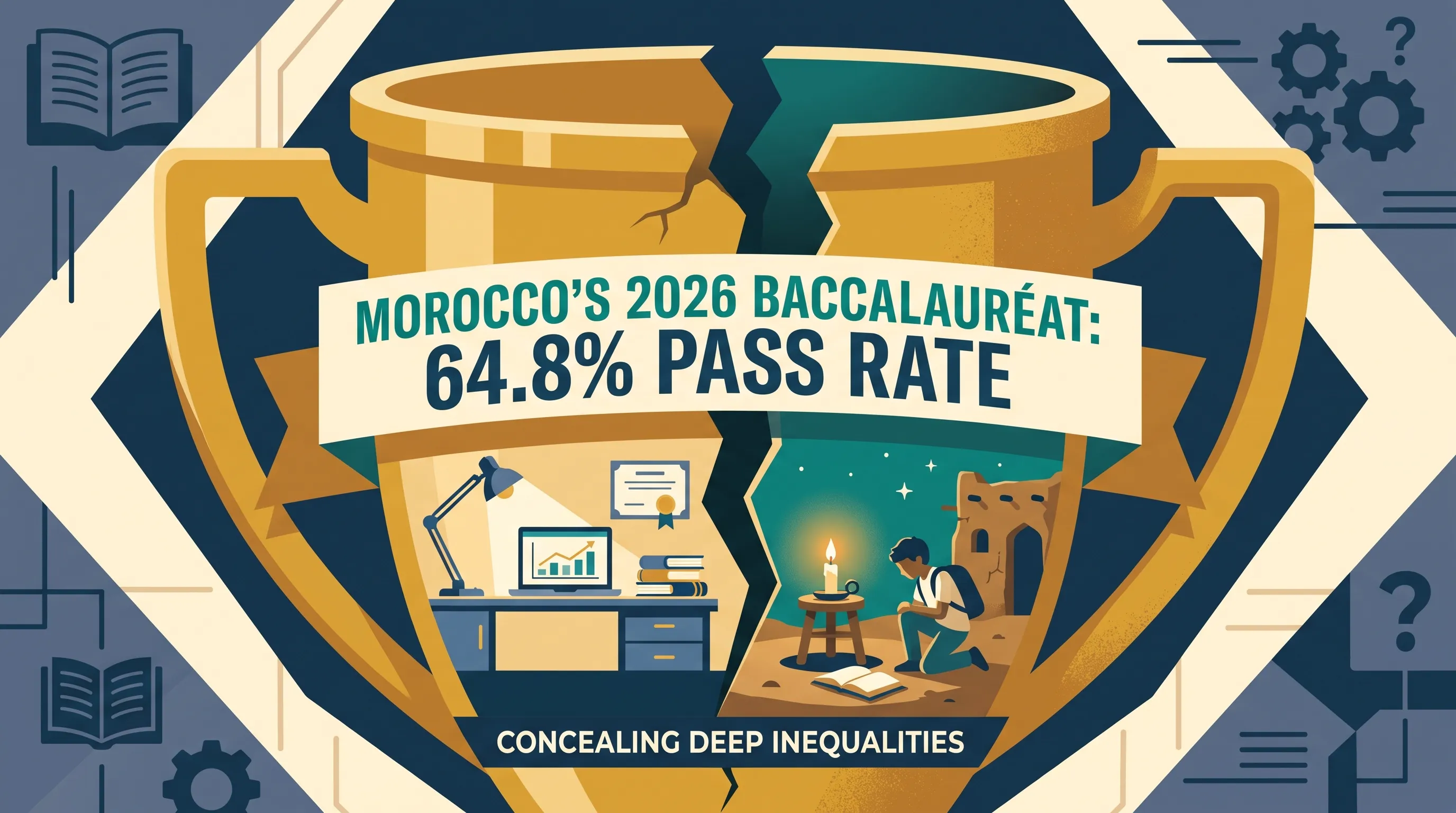
Morocco’s Ministry of National Education announced a 64.8% bac pass rate for the June 2026 session — an improvement on the previous year and accompanied by a high honors count noted by the ministry. The headline number received predictable coverage. But for school directors outside the top-performing academies, the national figure functions more as a distraction than a benchmark. With the Tawjihi orientation platform opening July 14 and closing July 28, directors have a three-week window to act — and it begins now.
Three structural fault lines run beneath the aggregate: a consistent gender gap that reflects dropout dynamics as much as classroom performance, significant regional concentration in results, and a widening private-public performance chasm that is geographically bounded. And with Tawjihi — the national post-bac orientation platform — opening on July 14, directors have roughly three weeks to act as active guidance partners for families who lack the social capital to navigate higher-education access on their own.
An 8.7-Point Gender Gap — and What It Actually Signals
Of the 404,957 enrolled candidates for the June 2026 bac, 262,442 were admitted, for an overall rate of 64.8% (Le360.ma). Girls achieved 68.7%; boys, 60%. Female students now represent 59% of all graduates — a figure that Le360.ma describes as demonstrating “consistent female academic superiority at the baccalaureate level.”
The gap is real and documented. Its interpretation, however, requires precision. Broken Chalk’s 2024 analysis notes a survivorship dynamic: girls exit the education system before reaching the bac at higher rates than boys, meaning the girls who sit the exam are, on average, a more academically selected cohort than their male counterparts. The bac gender result is therefore as much a signal about pre-bac dropout patterns as it is about what happens in the classroom.
For school directors, the practical implication is clear: if female enrollment in your graduating cohort is significantly lower than your intake at Year 10, the dropout pipeline is where the intervention belongs — not exam preparation. The bac gender gap does not tell you your school’s pedagogy is working for girls. It tells you which girls made it to the exam.
Where You Study Still Shapes Where You Finish
Not all regions shared equally in the 64.8%. Regions that exceeded the national average included Casablanca-Settat, Rabat-Salé-Kénitra, Fès-Meknès, and Tanger-Tétouan-Al Hoceïma. Rural areas, per Heure du Journal reporting on official ministry data, “record more modest performances, where teaching conditions remain difficult.”
This regional pattern is not isolated to a single year. A December 2024 peer-reviewed study by Boutayeb (University Mohamed Premier, Oujda) found that Morocco’s education Gini coefficient stands at 0.55, placing it 150th globally on educational equality, and that within the Rabat-Salé-Kénitra region alone, the gap in average years of schooling between the best and worst-performing communes reaches 10.5 years (Iris Journal of Educational Research, 2024). This is correlational evidence: regional location is associated with outcome variation; the sources do not isolate it as a direct causal mechanism.
The Fès-Meknès region illustrates the intra-regional spread. One student from the Fès-Meknès academy earned the best regional average, scoring 19.34/20 in physical sciences (Heure du Journal). Fès-Meknès also happens to be one of the three regions that concentrates the majority of Morocco’s private-school infrastructure.
Private Schools: An 82-Point Advantage Concentrated in Three Regions
Private schools represent a growing but geographically unequal presence. Their share of upper secondary enrollment grew from 4% in 2000 to 12% by 2023 (UNESCO GEM Report 2026). But 60.28% of private institutions are concentrated in just three regions: Casablanca-Settat, Rabat-Salé-Kénitra, and Fès-Meknès — three of the four regions that outperformed the national average. National private-school coverage does not exceed 20% of communes (Hespress English, 2024).
The performance differential documented by the Moroccan Council of Advisors is stark: a 30-point advantage for private schools at primary level, 60 points at preparatory level, and up to an 82-point advantage in French at the bac level. These figures describe an association between school type and results — the Council’s report does not present a controlled experiment isolating school type from confounding factors such as family income or parental education level — but the magnitude across all three levels is difficult to set aside.
What School-Level Action Cannot Change
Before treating any of the fault lines above as gaps that school-level communication or orientation support can close, a brief honest accounting of the structural constraints is necessary. Only 18% of Moroccan secondary teachers hold master’s degrees, and nearly one-third have six years or less of experience — with the most severe deficits in rural areas — according to OECD TALIS 2024 data reported by Morocco World News. The national teacher shortage exceeds 60,000 qualified educators (Broken Chalk, 2024). A 2016 national evaluation of academic achievements — cited in Boutayeb’s 2024 paper, and correlational rather than causal in design — found that social heritage accounts for approximately 80% of educational outcomes versus only 20% from school factors. These constraints operate well above the school-director level. Acknowledging them is not defeatism; it is clarity about where a director’s agency actually begins. For the next three weeks, that agency lies primarily in the Tawjihi window.
A Three-Week Window: July 14 to July 28
The Tawjihi.ma orientation platform (alouadifa.ma guide, 2026) opens on July 14, 2026. Candidates have until July 28 to submit ranked preferences across up to 15 programs — EST, FST, ENSA, ENSAM, ENSAD, ENCG. Selection is based exclusively on bac scores: 75% national exam, 25% regional exam. Continuous assessment is excluded entirely. Phase 1 responses arrive August 2–5. Phase 2 runs September 6–8.
For the 163,179 candidates sitting the makeup session on July 2–4 (Le Matin.ma), results arrive on July 11 — three days before the platform opens. Three days is not enough time for a family with no prior higher-education experience to research programs, understand the ranking logic, and submit a considered list.
Free and independent candidates — already outside the institutional pipeline — achieved only a 37.4% pass rate, versus the 64.8% national average. The families least equipped to navigate Tawjihi alone are the same ones enrolled in under-resourced public schools, and they are the ones who most need a director to act on their behalf during orientation season.
What Directors Can Do Before July 28
Communicate the Platform Before It Opens
Graduating families typically know their child’s result before they understand what Tawjihi is, how the 75/25 score weighting works, or that a 14-day submission window exists and closes hard. Directors should not assume that school-leaving students remain connected to institutional channels once results are posted — especially during the summer break.
In practice, this looks like: a group message sent through the school’s primary family channel today or tomorrow, containing four bullet points (platform opens July 14; deadline July 28; ranking is 75% national / 25% regional score; continuous assessment does not count). Under 120 words. No attachments required. Trigger: within 48 hours of results publication, before families disengage for the summer.
Run One Focused Session Before July 14
A single 45-minute orientation session — in person or via video call — can materially reduce the information asymmetry that disadvantages first-generation bac families. The goal is not comprehensive guidance on every program. It is clarity on one concept: rank programs where your score realistically places you, not programs you hope to get into.
In practice, this looks like: a video call scheduled for July 8 or 9, announced via SMS and class group message, with a one-page PDF summary of the 75/25 weighting logic shared 24 hours in advance as an attachment. The invitation message should explicitly name the target audience: “If you don’t have an older sibling or parent who attended university, this session is designed for you.” That framing removes the social barrier to attending.
Stay Proactive for Makeup-Session Students
Makeup-session students face the tightest timeline: results July 11, platform opens July 14. A general invitation to come ask questions if needed is not support — it places the burden on students who are least likely to seek it out. A directed, proactive message on July 11, specifying a concrete time and a concrete action, is the difference between institutional presence and institutional absence.
In practice, this looks like: a templated notification pushed to all makeup-session students and their families on July 11 at 6pm — timed to results publication — stating: “Results are published. Tawjihi opens in 3 days, on July 14. Deadline is July 28. Come to the school office on Wednesday July 15, 9am–12pm for help choosing your programs. No appointment needed.”
Reaching every family through the right channel at the right moment is a coordination problem. School directors who have infrastructure for scheduled, multichannel communication — not a phone tree assembled in a panic on July 11 — are the ones whose students will submit considered Tawjihi preferences rather than rushed ones. Schools building that infrastructure for orientation season and throughout the year will find that BeeNet’s school communication platform is one implementation path: message scheduling and group channels, document sharing, and notification delivery built around the rhythms of the school calendar.
The families who most need guidance will not find their way to your office on their own. The question is not whether to reach out — it is whether you do it before July 28.
References
-
Heure du Journal. (2026). Bac 2026 au Maroc : taux de réussite de 64,8% et disparités régionales marquées. https://www.fr.heuredujournal.com/bac-2026-au-maroc-taux-de-reussite-de-648-et-disparites-regionales-marquees/
-
Le360.ma. (2026). Bac 2026 : un taux de réussite de 64,8% à la session de juin. https://fr.le360.ma/societe/bac-2026-un-taux-de-reussite-de-648-a-la-session-de-juin_IMQPASLPTNGGJBB3YOIWRL4BHU/
-
Le Matin.ma. (2026). Bac 2026 : plus de 262.000 candidats admis et un taux de réussite de 64,8%. https://lematin.ma/enseignement/bac-2026-plus-de-262000-candidats-admis-et-un-taux-de-reussite-de-648/351101
-
Hespress English. (2024). Private and public schools in Morocco face widening gap, report alarms. https://en.hespress.com/68672-private-and-public-schools-in-morocco-face-widening-gap-report-alarms.html
-
Boutayeb, A. (2024). Education in Morocco: High Territorial Disparities and Severe Inequalities Constituting a Roadblock for Sustainable Development and Human Development. Iris Journal of Educational Research. DOI: 10.33552/IJER.2024.04.000590. https://irispublishers.com/ijer/fulltext/education-in-morocco-high-territorial.ID.000590.php
-
UNESCO. (2026). Morocco — Global Education Monitoring Report 2026 Country Case Study. https://www.unesco.org/gem-report/en/2026-gem-report-country-case-studies/morocco
-
Morocco World News. (2026). Morocco’s Education System Faces Deep Structural Challenges, TALIS 2024 Report Finds. https://www.moroccoworldnews.com/2026/03/284223/moroccos-education-system-faces-deep-structural-challenges-talis-2024-report-finds/
-
Alouadifa.ma. (2026). Tawjihi.ma 2026 : Guide d’inscription aux Écoles Supérieures au Maroc. https://alouadifa.ma/orientation/tawjihi-ma/
-
Broken Chalk. (2024). Beyond the Medina: Unpacking Morocco’s Educational Challenges. https://brokenchalk.org/beyond-the-medina-unpacking-moroccos-educational-challenges/



Ready to Transform Your School Communication?
Start saving time and increasing parent engagement with BeeNet.
Request Demo