Summer Learning Loss in UAE Schools: What MAP Growth Data Says Families Need to Know Before the Break
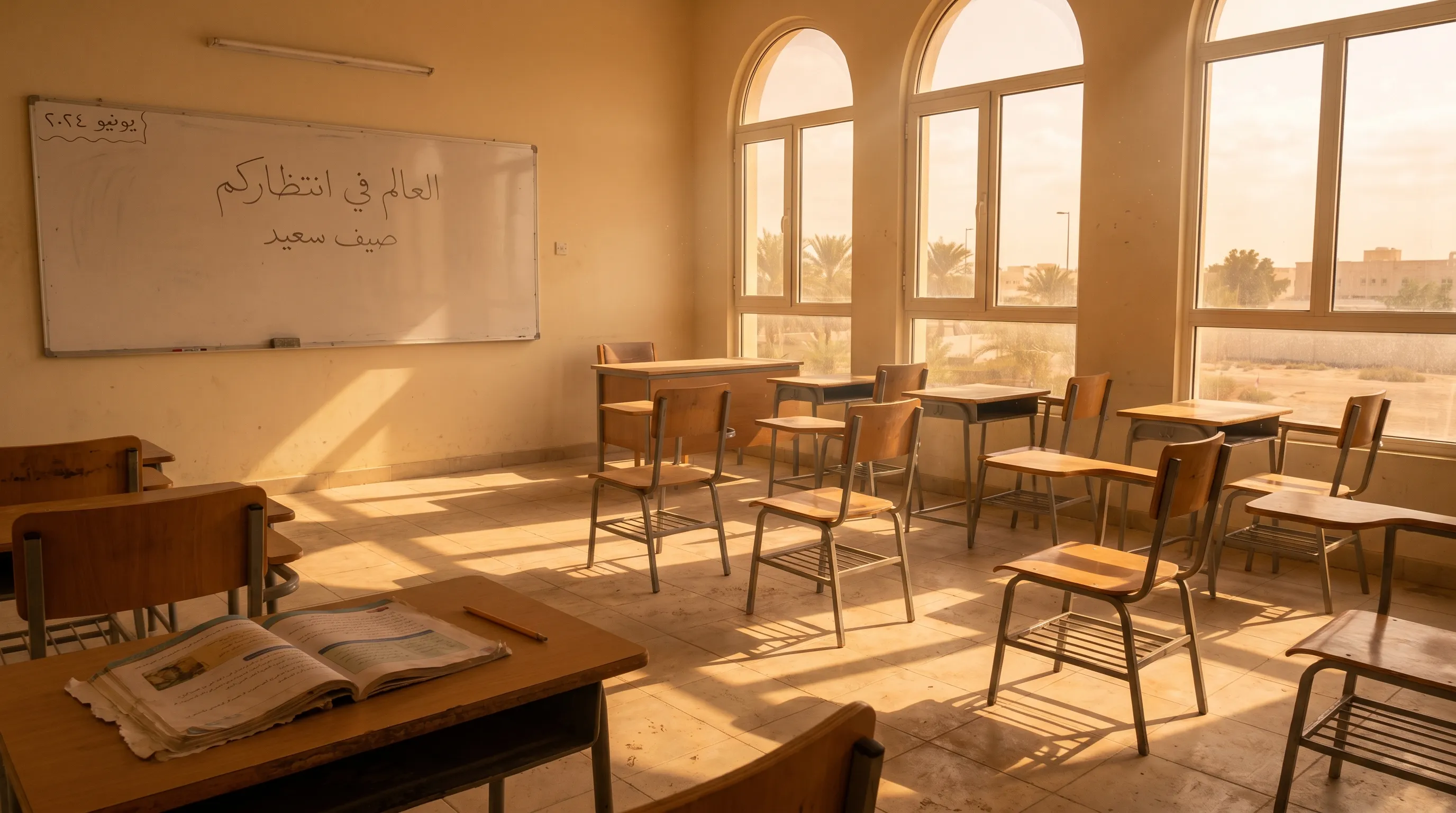
MAP Growth data from NWEA’s 2024–25 research shows math scores fall an average of 2.6 months over a six-week summer. UAE schools give students eight weeks — during the Gulf’s hottest months. Most schools send no pre-break guidance to families at all.
What the data reveals is a communication gap schools can act on right now — before the last day of term.
Why the UAE Break Is Different
UAE private schools, which serve the majority of the country’s expatriate families, operate an approximately eight-week summer break beginning in late June and ending in late August, per calendar data published by KHDA (Dubai), ADEK (Abu Dhabi), and SPEA (Sharjah) for the 2025–2026 academic year. That break falls entirely during the Gulf’s extreme heat season, where temperatures routinely exceed 45°C, severely limiting outdoor activity — the kind of informal learning through physical play and community experience that counteracts summer slide in cooler climates.
The result: UAE children sit in a double-bind. A longer-than-average break combined with fewer environmental buffers against inactivity makes the Gulf’s summer structurally more exposed to learning loss than a typical European or North American summer of equivalent length.
What MAP Growth Data Shows
NWEA’s 2024–25 MAP Growth research draws on assessment data from 13.8 million students — approximately 30% of US public schools. The findings are correlational (spring-to-fall test score comparisons, not controlled experiments), but the pattern is consistent across three major assessment datasets: MAP Growth, Star, and i-Ready all show “far larger summer drops across a range of grade levels” than earlier research suggested.
Mathematics shows the steepest declines. On average, students’ math scores drop between two and seven RIT points during summer, with the largest drops in elementary school grades — the 5th-to-6th grade transition (-7.3 RIT points) is the single largest, followed by the 2nd-to-3rd grade transition (-6.4 RIT points) and the 4th-to-5th grade transition (-6.0 RIT points) among the most pronounced. For the students least able to absorb the loss, the bottom 10th percentile experience summer learning loss equivalent to more than a year’s worth of typical school-year gains in most grades.
UAE school leaders cited by Khaleej Times report that students can lose 20–30% of academic progress during the break — an estimate consistent with, though not derived from, the NWEA assessment dataset. Mathematics shows the most significant decline in both the NWEA data and in UAE school leader reports.
Reading is a different picture — and in some ways a more urgent one for school planning. MAP Growth data shows reading scores are essentially flat across summer (-0.2 to +0.8 RIT points across all grades). That sounds reassuring until you consider the context: NWEA’s Spring 2025 Trend Snapshot reports that national reading achievement has plateaued — math shows “a modest, incremental recovery post COVID” while “progress in reading achievement has plateaued.” If reading is not improving during the school year and is not actively declining over summer, the gap for at-risk readers is simply holding open. Pre-break communication to families about reading maintenance carries particular urgency precisely because there is less school-year momentum to draw on.
The Parent Engagement Gap in UAE Schools
A survey of over 1,000 parents conducted by Parents United UAE and published by SchoolsCompared.com found that only 6% of UAE parents maintain a structured summer learning routine. A further 75% took the position that children should simply enjoy the break without structured activity.
That is not an unreasonable position on its own. The problem is that the school system largely agrees with it — and then says nothing further. The 6% figure suggests most UAE schools have not successfully communicated the stakes of summer learning loss to families — likely reflecting the absence of a structured pre-break communication protocol in the weeks before the break: no information about what the summer slide risk looks like for their child’s grade level, no guidance on which subjects are most at risk, no suggested minimum-effort activities to keep skills active.
Dr. Funke Baffour-Awuah of GEMS Education frames the stakes carefully: “Summer should not be a diluted version of school. It should be a time of intentional, joyful learning.” That framing is important. The goal is not to send parents worksheets. It is to equip families with enough understanding to make the summer intentional — in whatever form fits their family — rather than simply unstructured.
Dr. John Robert Brown of Woodlem Education and Pretty Khosla of Apple International Community School have both echoed this view: the recommendation is embedding learning in daily life rather than replicating school at home. For school admins in UAE operating under KHDA and ADEK inspection frameworks — where parent satisfaction and engagement scores are formally assessed — that pre-break communication also carries inspection relevance: demonstrating structured family outreach is increasingly part of what good governance looks like at inspection time.
What Drives Summer Learning Loss — And Where Schools Have Leverage
An honest reckoning is warranted before turning to practical recommendations. The relationship between summer learning loss and socioeconomic access is well-established in the research literature. The “faucet theory,” developed by Entwisle, Alexander, and Olson and examined by the Brookings Institution (2017), argues that differential summer loss is driven primarily by resource access, not break length alone. The “resource faucet” stays on for advantaged families over summer — through enrichment programs, travel, books, and parental time — while slowing for families with fewer financial and social resources. Separately, NWEA’s own equity research shows that gaps between students in low- and high-poverty schools “do not consistently widen during the summer,” and race-based gaps hold steady or narrow — complicating any single-factor explanation. Pre-break communication from schools is one lever among several. It cannot compensate for access gaps, and it is not a substitute for funded summer programs. But it is the lever schools control most directly, and the evidence suggests it is underused.
What Schools Can Communicate Before the Last Bell
A school-to-family communication protocol before the summer break does not need to be elaborate. Research on text-messaging interventions — including a causal study from the US context showing effect sizes of .21–.29 for grades 3–4 reading — demonstrates that low-cost, high-frequency school-to-family messages including activity ideas and information about learning value can be meaningfully associated with reduced loss. The interventions that worked were simple: tips, reminders, resource pointers.
UAE school administrators can structure their pre-break communication around four elements:
1. Grade-specific risk framing. Not all students face the same risk. Share what the MAP Growth data shows for your child’s transition grade — a family whose child is moving from 5th to 6th grade needs different information than one whose child is finishing 2nd grade. In practice, this looks like a single-page PDF or a brief message sent in the final two weeks of term, customized by year group, citing the typical RIT-point drop for that grade transition and what it translates to in practical terms.
2. Subject-specific focus. Mathematics is the subject most associated with summer loss; reading needs maintenance rather than recovery. In practice, this looks like a short push-notification series (three messages over the final month of term) — a workflow that BeeNet’s notification features support without requiring a separate WhatsApp group per class — that names the subject and gives one concrete action per week: “ten minutes of mental arithmetic before dinner,” or “choose one book to read aloud together this summer,” rather than a generic “keep reading” reminder.
3. Low-effort, high-return activity guidance. The evidence supports embedding learning in daily routines, not adding a parallel school-at-home structure. In practice, this looks like a short bulleted card sent at the end of term with five specific activities — cooking using fractions, narrating a trip to the market, reading menus in a second language — that fit the UAE summer context (indoor activities that work in air-conditioned environments during peak heat hours).
4. An early-September re-engagement touchpoint. Families benefit from knowing the school will check in — it primes them to view summer maintenance as a shared responsibility rather than a school-to-family hand-off. In practice, this might read: “Welcome back. We know the summer was long — our first two weeks will include a short skills refresh before new topics begin. Watch this channel for updates.”
The Communication Infrastructure Problem
Most UAE schools do not fail at pre-break communication because they lack the knowledge. They fail because they lack the operational infrastructure to send grade-differentiated, multilingual, timely messages to several hundred families on a fixed schedule.
Sending a single all-school announcement is straightforward. Sending year-group-specific communications in English and Arabic, timed to arrive in the final two weeks of term, via the channel each family actually reads — that requires a communication system designed for that workflow, not a workaround using personal WhatsApp or one-size-fits-all email blasts.
Schools that want to close this communication gap need a platform that supports audience segmentation by class or year group, multilingual message delivery, and scheduled push notifications. BeeNet’s channels and messaging features are one implementation path for exactly this operational requirement — enabling school administrators to set up grade-level channels, schedule messages in Arabic and English, and reach families through the notification channel they have opted into. For schools already working toward this kind of pre-break protocol, the schools use-case page outlines how the platform supports structured family communication across the academic calendar.
The last bell is ringing in a matter of days. The families who receive clear, specific, low-effort guidance before it rings will spend the summer differently from those who don’t. The question is not whether to communicate — it is whether your school has a way to do it at the grade level of precision the data says is needed.
References
-
Sircar, N. (2026). “UAE schools warn of ‘summer slide’: What MAP Growth data reveals about learning loss.” Khaleej Times. https://www.khaleejtimes.com/uae/education/schools-warn-summer-slide-map-growth-data-learning-loss
-
Staff Writer (2026). “Summer slide concerns rise in UAE schools, with MAP Growth data showing learning loss trends.” Dubai Standard. https://www.dubaistandard.com/summer-slide-concerns-rise-in-uae-schools-with-map-growth-data-showing-learning-loss-trends/
-
Kuhfeld, M. & McEachin, A. (2026). “Summer learning loss: What we know and what we’re learning.” NWEA Blog. https://www.nwea.org/blog/2026/summer-learning-loss-what-we-know-what-were-learning/
-
Kuhfeld, M. & Morton, E. (2026). “What is ‘typical’ summer slide on MAP Growth?” NWEA Blog. https://www.nwea.org/blog/2026/what-is-typical-summer-slide-on-map-growth/
-
Barda, T. (2025). “Summer Learning Loss: Are UAE Children Falling Behind Over The Summer Holidays?” SchoolsCompared.com. https://schoolscompared.com/uae/guides/summer-learning-loss-are-uae-children-falling-behind-over-the-summer-holidays
-
Quinn, D.M. & Polikoff, M. (2017). “Summer learning loss: What is it, and what can we do about it?” Brookings Institution. https://www.brookings.edu/articles/summer-learning-loss-what-is-it-and-what-can-we-do-about-it/
-
Allan, C. (2025). “Dubai, Abu Dhabi & Sharjah Schools: When Does the 2025–2026 Academic Year Start?” WhichSchoolAdvisor.com. https://whichschooladvisor.com/uae/school-news/dubai-abu-dhabi-sharjah-schools-when-does-the-2025-2026-academic-year-start
-
Lewis, K. & Kuhfeld, M. (2025). “Trend Snapshots: Math Recovery Continues, Reading Remains Stalled in Spring 2025.” NWEA. https://www.nwea.org/research/publication/trend-snapshots-math-recovery-continues-reading-remains-stalled-in-spring-2025/



Related BeeNet Features
Ready to Transform Your School Communication?
Start saving time and increasing parent engagement with BeeNet.
Request Demo