Research-Backed Alphabet Activities for Preschoolers
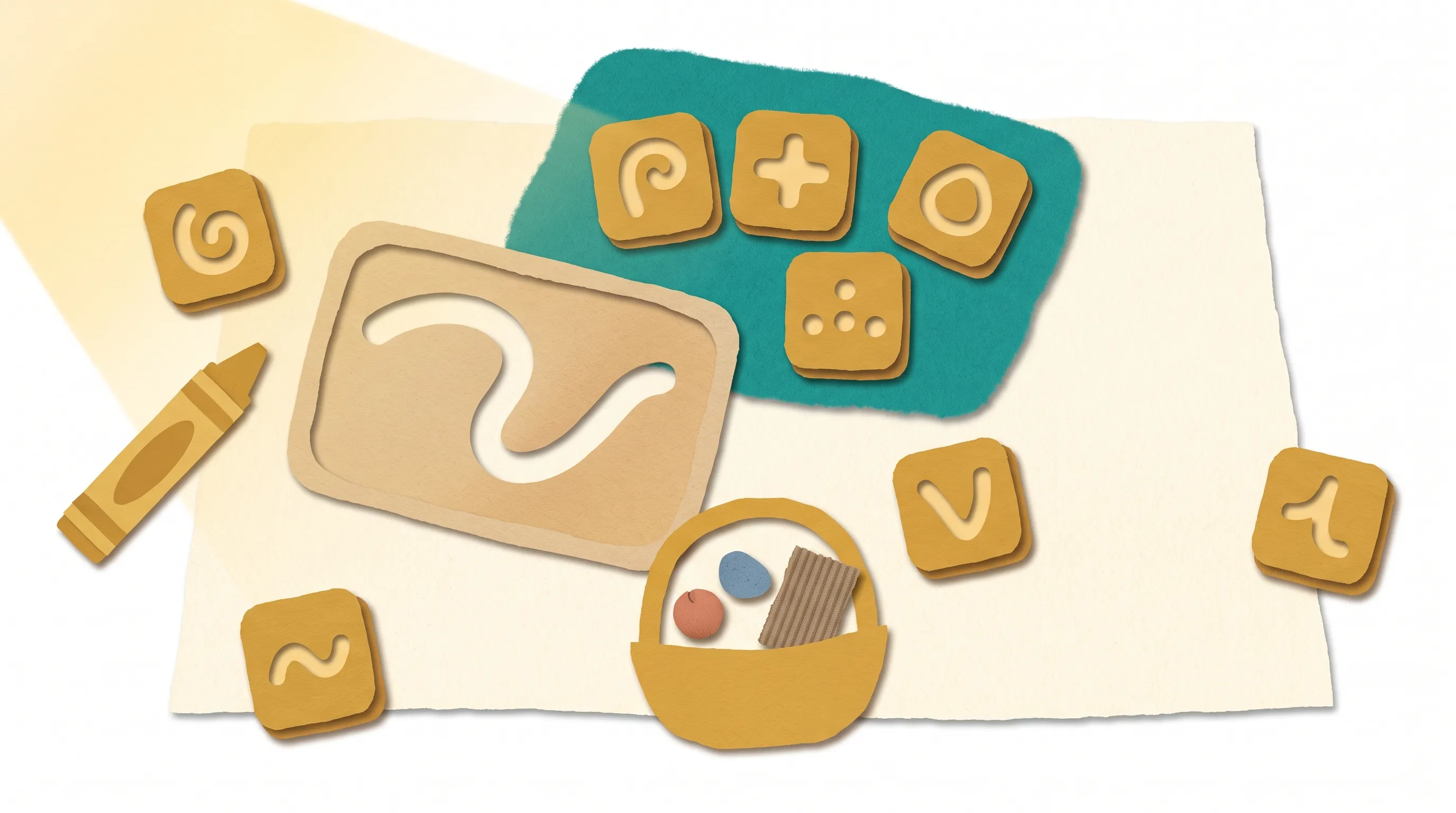
The alphabet activities for preschoolers with the strongest evidence behind them share three traits: they teach a letter’s name and sound together rather than one before the other, they move through several letters a week instead of one, and they get reinforced through touch, writing, and talk — not worksheets alone. That combination, not simple exposure to letters, is what the research on early reading actually supports.
Quick answer — three things to change this week:
| Principle | What it looks like | Weekly cadence |
|---|---|---|
| Names + sounds together | Letter cards paired with their sound, never taught as separate steps | Ongoing, every letter |
| Mnemonics + writing | Embedded-picture letter cards, plus a 5-minute “morning message” for tracing | Reinforced daily |
| Faster, name-aware pace | 3-4 new letters a week, prioritizing letters already in each child’s own name | 3-4 letters/week |
Alphabet knowledge is frequently cited as one of the best early predictors of later reading. The National Early Literacy Panel’s 2008 meta-analysis is the source of that claim, and it is worth being precise about what the panel actually found: the predictive link is correlational — the report states plainly that its design “could not establish” the third condition needed to call it causal Developing Early Literacy: Report of the National Early Literacy Panel. For a program deciding what to actually do in the classroom, the more useful part of the same report is its analysis of interventions: combined phonological-awareness-plus-alphabet training produced a significant gain in alphabet knowledge (effect size 0.37, p = 0.012), and pairing phonological awareness with phonics produced a larger one (effect size 0.57, p < 0.0001) — while phonological-awareness training alone did not move alphabet knowledge at all (effect size 0.04, not significant) NELP Report.
What the Research Actually Supports
Teach Names and Sounds Together, Not One First
For preschoolers who don’t yet know many letters, research summarized by literacy researcher Timothy Shanahan (former chair of both the National Reading Panel and the NELP) finds that letter-name knowledge helps children learn letter sounds more than the reverse — “letter name knowledge had a larger impact on letter-sound acquisition than the reverse” — which is why starting with sounds alone is, in his words, “an opinion rather than a data-based, science of reading claim” Letter Names or Sounds First?. By kindergarten, names and sounds should be taught together. Reading Rockets frames the same idea from the child’s side: “printed letters are the visual links that we pair with speech sounds” Basics: Alphabet Knowledge.
Move Faster Than One Letter a Week
The traditional “letter of the week” pace is slower than what the evidence supports. A synthesis from The Reading League states it directly: “introducing one letter per week is too slow. Research suggests a faster pace, such as one letter per day … or 3-4 letters per week” — the extra speed leaves more time for reviewing the letters children find hardest Brick by Brick: Insights on Alphabet Instruction From Research. Instruction that combines names and sounds this way produced “statistically greater growth” than teaching either alone, according to the same synthesis.
Some Letters Are Just Easier, and That’s Not a Teaching Failure
Children learn letters faster when the letter appears in their own name — in one cited example, “a child named Macy was more likely to identify the letter M than a child named Sofie.” Uppercase letters also transfer to lowercase: one study found children were “16 times more likely to know a lowercase letter if they were already familiar with the shape of the corresponding uppercase letter” (Turnbull, 2010, cited in Brick by Brick) — a striking single-study figure worth treating as directional rather than a precise universal rate. Build this into pacing — expect the letters in a child’s own name, and high-frequency letters, to land first.
Alphabet Activities for Preschoolers That Match the Evidence
Mnemonics: Double the Letter-Sound Recall
Touching a letter while naming it keeps a child’s eyes on the shape, not just the sound: “touching letters while naming/singing them ensures children ‘look at the letters as he says its name’” Basics: Alphabet Knowledge. Embedded picture mnemonics — drawing a small insect inside the letter “i,” for instance — go further. In a controlled comparison, children taught with embedded mnemonics “learned, on average, twice as many letter sounds as their treated control peers” and identified more than 1.5 times as many initial phonemes Brick by Brick. In practice, this looks like a weekly set of letter cards where each letter’s shape is drawn as a small picture of an object starting with that sound, used during circle time and left out for free play.
Writing, Not Just Recognition
Writing has a two-way relationship with letter knowledge — practicing one strengthens the other. Interactive writing lessons (where children help write words letter by letter) improved Head Start preschoolers’ letter-name knowledge specifically, more than typical instruction did Brick by Brick. In practice: a five-minute “morning message” where the teacher writes a simple sentence aloud, sounding out and naming each letter, with children tracing the same letters in sand, shaving cream, or with a finger on carpet.
3-4 Letters a Week: A Pace That Covers the Target Range
The Head Start Early Learning Outcomes Framework expects five-year-olds to know 18 uppercase letters, 15 lowercase letters, and several sounds Brick by Brick. At 3-4 letters a week, that range is reachable well within a school year, with weeks left over for review of the letters that lag — commonly the ones absent from most children’s names and low-frequency in print. The Crane Center for Early Childhood Research and Policy at Ohio State developed differentiated alphabet lessons built around this approach in partnership with the university’s on-campus preschool, the A. Sophie Rogers School for Early Learning, then piloted the lessons in early childhood centers, reporting “measurable improvements in children’s letter-name knowledge, letter-sound knowledge, and letter writing abilities” Alphabet Learning and Instruction; the same research group publishes free assessment tools (Q-LNK for letter names, LSSF for letter sounds) that a program can use to check its own pace is working.
Where Shared Reading Fits — and Where It Doesn’t
Reading aloud from birth is a distinct, well-supported practice in its own right. The American Academy of Pediatrics’ December 2024 policy update recommends daily shared reading for its own benefits — building “loving, nurturing relationships during a critical time of brain development” — and prefers print books over screens, which typically offer “passive or solitary” experiences rather than back-and-forth interaction Beyond Literacy: Shared Reading Starting at Birth Offers Lifelong Benefits. A randomized-trial-backed program built on this idea, Reach Out and Read, has shown measurable gains from pediatric-office reading promotion, including a 6-month developmental increase in receptive language in one study Literacy Promotion: An Essential Component of Primary Care Pediatric Practice.
One nuance is worth stating plainly so it isn’t oversold: shared reading is not a substitute for explicit alphabet instruction when the goal is letter sounds specifically. In a direct comparison, children shown letters in isolation learned more letter sounds than children shown the same letters embedded in a storybook context, though letter naming was unaffected either way Brick by Brick. Treat storybook time and explicit letter-name-and-sound practice as two separate routines with two separate purposes, not one activity standing in for the other.
Sending It Home: What to Tell Parents
Families do not need a literacy lecture — they need to know which letter their child is working on this week and one simple thing to practice. In practice, this looks like: a short weekly message naming the letter, its sound, and a 2-minute activity (“Find something at home that starts with M — trace the letter on paper together”), sent once a week, timed to go out before the weekend so families have unhurried time to try it. Because the own-name advantage is real, a version personalized to whether a child’s own name contains that week’s letter — “M is in Macy’s name, so this one should feel easy” — gives parents a concrete reason to follow along rather than skip it.
A preschool or daycare that runs this kind of routine has to decide how the message actually reaches every family — a single group announcement works only if every parent reads the same language and checks the same channel. BeeNet is one way to handle this: send the weekly alphabet update to each class group, in every family’s preferred language, as a push notification rather than a paper note that gets lost in a backpack. See how multilingual class messaging works.
References
- Basics: Alphabet Knowledge — Reading Rockets, 2024
- Letter Names or Sounds First? … you might be surprised by the answer — Timothy Shanahan, 2021
- Developing Early Literacy: Report of the National Early Literacy Panel — National Early Literacy Panel, 2008
- Alphabet Learning and Instruction — Crane Center for Early Childhood Research and Policy, Ohio State University, 2025
- Brick by Brick: Insights on Alphabet Instruction From Research — Demchak & Solari, The Reading League, 2024/2025
- Beyond Literacy: Shared Reading Starting at Birth Offers Lifelong Benefits — American Academy of Pediatrics / HealthyChildren.org, 2024
- Literacy Promotion: An Essential Component of Primary Care Pediatric Practice — American Academy of Pediatrics, Council on Early Childhood, 2014


Ready to Transform Your School Communication?
Start saving time and increasing parent engagement with BeeNet.
Request Demo