Europe's 2026 School Phone Bans: What Your School Must Put in Place Before September
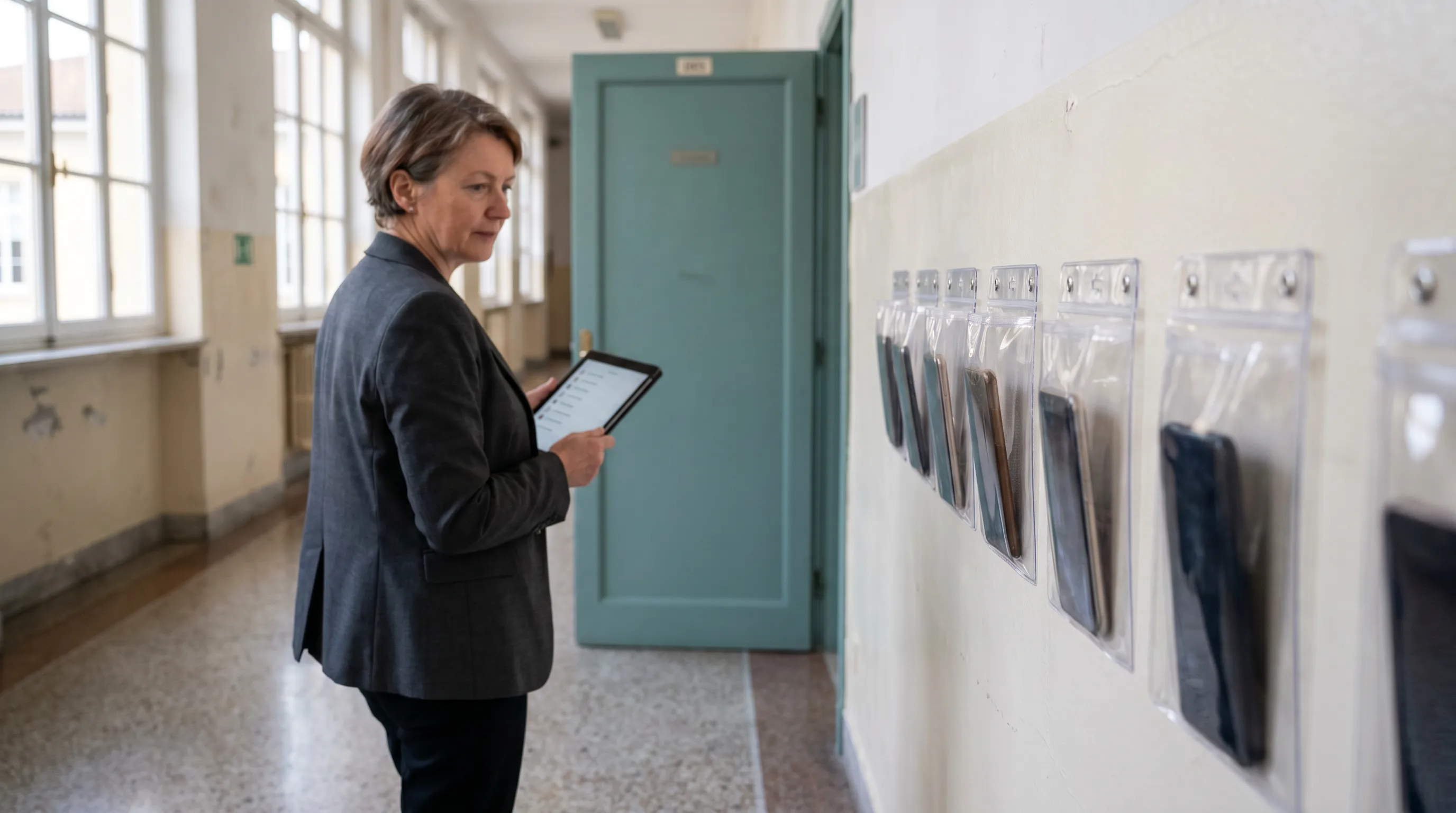
By the start of the 2026-27 school year, a student of compulsory-school age in France, the Netherlands, Croatia, and large parts of Belgium and Germany will be structurally unreachable on a personal device for the entire school day. The default daytime channel between parents and children is being closed by law.
That is a policy story — but it is also an operational story that most schools have not yet absorbed. Once the bell-to-bell rules are in force, the school’s own communication channel becomes the only remaining daytime bridge between families and their children, and the informal substitute that most parent communities still lean on — WhatsApp class groups — carries documented GDPR liability for the parents running them.
The new map of European bell-to-bell bans
The 2025-2026 wave is not a single law but a tight cluster of national decisions converging on the same shape.
France has moved fastest and furthest. The 2024 pause numérique pilot covered nearly 200 schools and roughly 50,000 students, before being generalised to all collèges at rentrée 2025, with each establishment choosing its own modality — pouches, lockers, casiers — to enforce the rule (Euronews; Ministère de l’Éducation nationale). President Macron’s framing has been explicit: “De la cloche à la cloche, du début à la fin dans l’établissement, il n’y [aura] pas de téléphone portable.” By rentrée 2026 the rule extends to lycées, and the government has signalled it will ban access to social networks for under-15s from 1 September 2026.
The Netherlands introduced its classroom phone ban for secondary education in January 2024 and extended it to all primary-school levels in the 2024-2025 academic year (Eurydice). The Eurydice review notes that some schools went further, banning phones “during school time altogether,” including lunch periods — and that “after getting used to the new measure, most pupils reflect on it positively.”
Croatia moved from a 100-school pilot in Zagreb to a nationwide primary-school ban, with Education Minister Radovan Fuchs stating the rules are intended to “clearly define student behaviour, improve safety and order in schools, and ensure the effective delivery of education” (Croatia Week).
Belgium is rolling out across its three communities for the 2025-2026 academic year, covering both primary and secondary schools, with exceptions only for educational, health, and emergency use. The three language communities apply different variants — the German-speaking community is the strictest, extending the ban to break times as well as lessons. “Cellphones, smartwatches, and connected devices face prohibition not only during classes but also during breaks” (Anadolu Agency). Wallonia-Brussels Federation Minister Valérie Glatigny has framed the move around “students’ focus and a healthier learning environment.” For broader Belgian school-equity context, the way these rules land will differ sharply between communities and socio-economic groups.
Germany is moving more cautiously but in the same direction. Baden-Württemberg Minister Theresa Schopper has said “private use of cell phones at school should be restricted in future,” and Hesse’s draft law would prohibit “use of digital devices anywhere on school grounds” — covering smartphones, tablets, and smartwatches. Klicksafe’s analysis is precise: these rules “do not constitute an outright ban. Rather, they shift the default from permission to prohibition” (Klicksafe).
The trend is not regional. UNESCO’s Global Education Monitoring team reports that 114 education systems now have national mobile phone bans — 58% of countries worldwide, up from 24% in June 2023 and 40% in early 2025 (UNESCO GEM).
The operational consequence schools are not preparing for
The discussion around phone bans has been almost entirely about classroom focus. The European Commission’s 2025 School Education Platform survey of 1,162 respondents — mostly teachers in Belgium, Germany, Italy, and Spain — found that 71% identified pupil concentration as the most severely affected area (EU School Education Platform). That is the headline finding everyone has heard.
But the same survey contains a quieter, more operationally consequential number: 25% of respondents flagged “concerns over emergency communication” as a top enforcement challenge. Once a student is unreachable from morning bell to afternoon dismissal, families lose the channel they have used by default for years. The pickup change, the sick sibling, the dentist appointment, the unexpected early dismissal — every one of those conversations now has to flow through the school.
Ofcom’s 2025 report on UK children confirms the baseline that bans are interrupting: 56% of children aged 8-17 who use their phones online say they are already banned from using their smartphones all of the time they are in school (Ofcom). The European wave is now extending that condition to the rest of the cohort, end-to-end, every day.
The WhatsApp problem schools have been ignoring
When schools do not provide a working channel, parents build their own — and the default is a WhatsApp class group. The legal analysis here is unambiguous and most school leaders are unaware of it.
Classlist’s GDPR review is direct: “Parents administering these groups become data controllers because they decide what personal data to collect, and how and why it is processed. The GDPR exemption for processing personal data ‘in the course of a purely personal or household activity’ would NOT apply to WhatsApp class or year groups” (Classlist). Material breaches must be reported to the relevant supervisory authority within 72 hours. Germany’s Data Protection Conference (DSK) explicitly recommends against using WhatsApp in schools. And WhatsApp’s own Terms restrict users to personal use, “potentially excluding school class or year groups.”
In other words: the moment the official channel goes quiet, the substitute that fills the vacuum exposes a parent volunteer to data-controller liability under GDPR. That is a problem the school created by not providing an alternative, even if the school is not formally the controller.
Bans don’t solve everything — they shift the problem
Bell-to-bell rules are not a silver bullet, and the evidence is more mixed than the headlines suggest. The only quasi-experimental European study, by Sara Abrahamsson at NHH, finds that banning phones is associated with higher girls’ grades and lower psychological-symptom healthcare use — with stronger effects for girls from poorer families (NHH). But the largest US quasi-experimental work, by Figlio and Özek, finds test-score gains of only 0.6 to 1.1 percentile points, alongside a 12% surge in suspensions in year one that disproportionately affected Black students (Education Week). The EU survey also shows that 22% of schools already had premises-wide bans and 27% classroom-only bans before this regulatory wave — so the 2025-2026 laws are largely consolidation, not invention. UNESCO’s own caveat applies: “bans alone will not solve the digital challenge.”
Whatever the academic effects, every variant of the policy shares one operational consequence: the school becomes the only daytime channel to the family.
What schools actually need to put in place before rentrée 2026
The operational requirement is narrow and practical: a single, school-controlled channel that can deliver routine and urgent information to the right guardian, in their language, on a known device, with a record. Five components matter.
- Guardian-of-record contact list — one primary + one secondary number per child, structured field not spreadsheet.
- Two-tier routing — routine in-app feed; SMS/push reserved for time-critical events.
- Pickup confirmations — automatic message to guardian the moment a student is collected.
- Translation-aware delivery — broadcast in school language, auto-delivered in each guardian’s language.
- Documented retention policy — named senders, fixed retention window, DPO-led deletion workflow.
A guardian-of-record contact list, not a class list
The school needs to know, per child, which adult is reachable today and on which number — not a generic “parents” address. In practice: before September, each homeroom teacher confirms one primary and one secondary guardian phone number per student, captured in a structured field in the school’s information system rather than in a teacher’s spreadsheet.
A two-tier channel: routine versus urgent
Routine information (homework, reminders, photos) and urgent information (lockdown, early dismissal, medical) should travel through different channels with different read-receipt expectations. In practice: a daily in-app feed for routine items at the end of each lesson block; an SMS or push notification with delivery confirmation reserved for time-critical events like an unscheduled early closure at 11:50.
A pickup and dismissal protocol that does not depend on the student’s phone
If the child cannot text “I’m staying late,” the school must close that loop. In practice: a 30-second message to the registered guardian phone at the moment a student is collected — for example, “Yasmine collected by registered guardian at 16:32” — generated automatically by the dismissal scan, not typed by a teacher.
A translation-aware default
In France, Belgium, Germany, and the Netherlands the parent body is frequently multilingual. A message that lands only in the school’s working language is operationally equivalent to no message. In practice: every broadcast message generated in the school’s primary language and auto-delivered to each guardian in the language they registered with, with no extra step for the teacher.
A documented retention and access policy
Once the school is the channel of record, the school assumes the GDPR responsibility for its own communication channel that the WhatsApp group used to carry informally on the school’s behalf. In practice: messages retained for 18 months, send-to-all rights limited to the head teacher and two deputies, deletion requests handled by the DPO within 30 days, with the policy linked from the parent portal at first login.
The decision waiting on every desk before September
The regulatory direction is decided. France’s 2026-27 lycée extension is on the calendar, the Netherlands is fully implemented, Croatia is national, Belgium is in force, and Germany is shifting the default. The only open question for school administrators is whether the official communication channel is ready by September, or whether parents will improvise around an unprepared school for a second year.
Purpose-built parent-communication platforms exist precisely for this workflow: guardian-of-record contact data, two-tier routing, multilingual delivery, dismissal-event automation, and GDPR-aligned retention in one place. BeeNet is one implementation path among several — built around the assumption that the school, not a parent volunteer in a chat group, is the channel of record. If you are mapping what to put in place before rentrée 2026, see what this looks like in a 20-minute walkthrough.
The phones are coming out of the classroom. The bridge to families has to be in place before they do.
References
- European Commission / ENESET. Mobile phone bans in schools across the EU (2026). https://op.europa.eu/en/publication-detail/-/publication/37a07be1-0241-11f1-825d-01aa75ed71a1/language-en
- Chadwick, L. Which countries in Europe have banned or want to restrict smartphones in schools? Euronews (Dec 2024). https://www.euronews.com/next/2024/12/29/which-countries-in-europe-have-banned-or-want-to-restrict-smartphones-in-schools
- Eurydice. Netherlands — A ban on mobile phones in the classroom (June 2025). https://eurydice.eacea.ec.europa.eu/news/netherlands-ban-mobile-phones-classroom
- Croatia Week. Croatia mobile phone ban primary schools education rules (Jan 2026). https://www.croatiaweek.com/croatia-mobile-phone-ban-primary-schools-education-rules/
- Anadolu Agency. Belgium to ban cellphones in schools starting with 2025-2026 academic year (2025). https://www.aa.com.tr/en/europe/belgium-to-ban-cellphones-in-schools-starting-with-2025-2026-academic-year/3662778
- UNESCO Global Education Monitoring Report. Phone bans in schools are spreading worldwide (March 2026). https://www.unesco.org/gem-report/en/articles/phone-bans-schools-are-spreading-worldwide-policy-debate-rages
- European Commission, School Education Platform. Mobile phones in schools survey (2025). https://school-education.ec.europa.eu/en/discover/surveys/mobile-phones-schools
- Abrahamsson, S. Smartphones out of the classrooms. NHH (2024). https://www.nhh.no/en/research/impact-cases/smartphones-should-be-out-of-the-classrooms/
- Classlist. Parent WhatsApp groups & GDPR liability for administrators (2024). https://www.classlist.com/blog/parent-whatsapp-groups-and-gdpr-liability-for-administrators
- Education Week. Do school cellphone bans work? What early findings tell us (Oct 2025). https://www.edweek.org/technology/do-school-cellphone-bans-work-what-early-findings-tell-us/2025/10
- Klicksafe. Neue Regeln für Smartphones in Schulen angekündigt (March 2025). https://www.klicksafe.eu/en/news/neue-regeln-fuer-smartphones-in-schulen-angekuendigt
- Ofcom. Children and parents: media use and attitudes report 2025. https://www.ofcom.org.uk/media-use-and-attitudes/media-habits-children/children-and-parents-media-use-and-attitudes-report-2025
- Ministère de l’Éducation nationale (France). Interdiction du téléphone portable dans les écoles et les collèges et pause numérique. https://www.education.gouv.fr/interdiction-du-telephone-portable-dans-les-ecoles-et-les-colleges-et-pause-numerique-455181
Related BeeNet Features
Ready to Transform Your School Communication?
Start saving time and increasing parent engagement with BeeNet.
Request Demo