Fine vs Gross Motor Skills: What's the Difference?
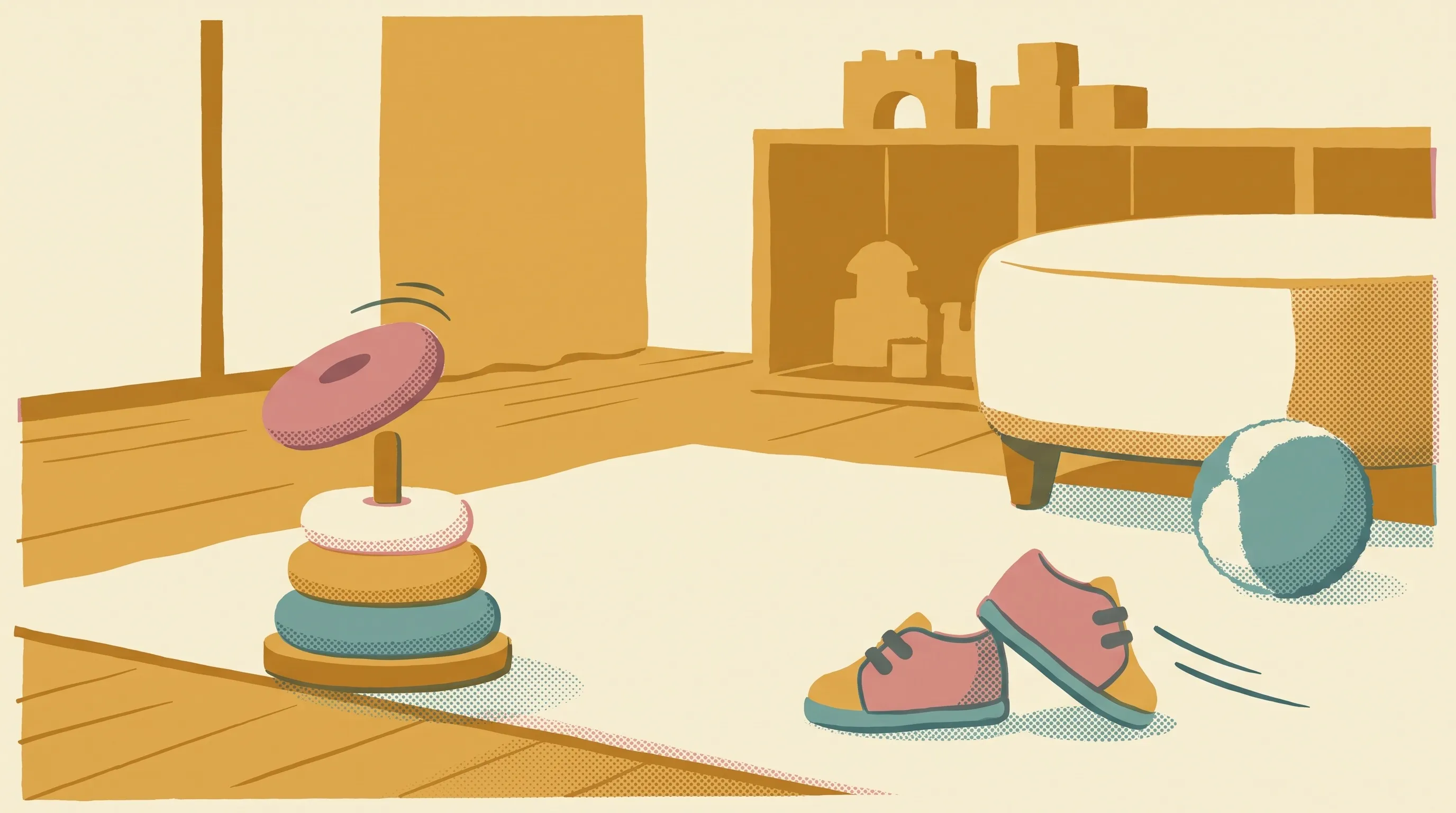
Fine vs gross motor skills — the difference comes down to muscle size and precision. Gross motor skills are the large, whole-body movements — walking, jumping, climbing, throwing — powered by the big muscles in the legs, arms, and torso. Fine motor skills are the small, precise movements of the hands and fingers — grasping a crayon, buttoning a shirt, using scissors — combined with eye-hand coordination. Every child develops both, on different timelines, which is why a pediatrician or occupational therapist tracks them as two separate checklists rather than one general “coordination” score. A delay in one does not automatically mean a delay in the other.
Fine vs Gross Motor Skills: The Core Difference
The Cleveland Clinic puts the distinction plainly: “Gross motor skills are the movements we make with large muscles, like those in your legs, arms and torso,” while fine motor skills are “the small, precise movements we make with our wrists, hands and fingers” — and, less often mentioned, “ankles, feet and toes” too, since fine motor control isn’t limited to hands Cleveland Clinic, Gross Motor Skills.
A simple way to sort any activity into one bucket or the other: if it moves the whole body through space or shifts your center of balance, it’s gross motor (running, climbing stairs, riding a tricycle, catching a ball with both arms). If it’s a small, targeted movement made mostly with the hand and fingers while the rest of the body stays still, it’s fine motor (stacking blocks, turning a page, holding a pencil, zipping a jacket). Some everyday tasks use both at once — getting dressed involves the gross motor work of balancing on one leg and the fine motor work of managing a button — which is part of why the two get confused, even though they develop through different muscle systems on different schedules.
Gross Motor Milestones, Age by Age
The most rigorous data on gross motor timing comes from the World Health Organization’s Multicentre Growth Reference Study, which followed 816 children monthly through their first year and every two months through their second, across Ghana, India, Norway, Oman, and the United States, to establish normal age ranges — not single “correct” ages — for six major milestones WHO Multicentre Growth Reference Study Group, Windows of Achievement for Six Gross Motor Development Milestones:
| Milestone | Typical age range (1st–99th percentile) |
|---|---|
| Sitting without support | 3.8–9.2 months |
| Standing with assistance | 4.8–11.4 months |
| Hands-and-knees crawling | 5.2–13.5 months |
| Walking with assistance | 5.9–13.7 months |
| Standing alone | 6.9–16.9 months |
| Walking alone | 8.2–17.6 months |
Two things stand out in that table. First, the ranges are wide — “normal” for walking alone spans nine months, and standing alone spans ten. Second, crawling is the odd one out: about 4.3% of the children in the study skipped hands-and-knees crawling entirely and still went on to walk normally, which is why most pediatricians don’t treat crawling itself as a required checkpoint the way sitting or walking are.
Beyond infancy, milestones become less about a single skill appearing and more about control and balance improving: by around 3 years, most children can jump in place, walk on tiptoe, and pedal a tricycle; by 5, catch a small ball with just their hands and skip; by 6, walk a balance beam and jump rope Cleveland Clinic, Gross Motor Skills. Between those anchor points, a toddler typically progresses from walking along furniture around 9 months, to walking independently and attempting a “bear crawl” around 12–14 months, to balancing on one leg for a few seconds and climbing stairs with alternating feet by age 2–3 Brown University Health, Children’s Developmental Milestones.
Fine Motor Milestones, Age by Age
Fine motor development follows a similarly gradual sequence, moving from reflexive hand movements in early infancy to a mature pencil grip by the time most children start school. Pediatric occupational therapists at Lurie Children’s Hospital lay out the progression in detail Lurie Children’s Hospital, Fine Motor Developmental Milestones:
| Age | What typically emerges |
|---|---|
| 0–2 months | Grasp reflex — hand closes when an object touches the palm |
| 4–6 months | Transfers a toy from one hand to the other |
| 8–9 months | Finger-feeds; grasps small items between thumb and the side of the index finger |
| 12–18 months | Stacks 2–5 blocks; develops a true pincer grasp (tip of thumb to tip of index finger) |
| 2–3 years | Snips with scissors; screws and unscrews lids; stacks 8–10 cubes; draws a circle |
| 3–4 years | Holds a marker in a tripod grip; cuts out a circle; colors mostly within the lines |
| 5–6 years | Cuts out a square; copies a triangle; writes letters and their own name |
The throughline is precision, not strength: a 9-month-old finger-feeding and a 5-year-old writing their name both draw on the same small-muscle, eye-hand-coordination system — just at very different resolutions. That system is also why fine motor skill shows up so often in “school readiness” conversations, even outside of gym class or PE: pencil grip, cutting, and copying shapes are fine motor tasks first, academic tasks second.
Why the Difference Actually Matters
The gross/fine distinction isn’t just clinical bookkeeping — the two systems appear to connect to different downstream skills, though exactly which skill connects to which is still an open, evolving research question rather than a settled formula. A 2016 study in Frontiers in Psychology found that fine motor skills were a better predictor of early maths ability than of early reading ability in two small UK samples of 5–7-year-olds Pitchford et al., Fine Motor Skills Predict Maths Ability Better Than Reading. A larger 2024 analysis of 3,188 children in the UK’s Millennium Cohort Study found something closer to the opposite pattern in its own sample — fine motor skill at school entry was associated with later English and science performance, not maths — while gross motor skill was linked to later spatial working memory Zhou & Tolmie, Associations Between Gross and Fine Motor Skills and Academic Achievement.
Motor skill is not the only factor at play, and neither study proves it drives the outcome it’s paired with. Both are correlational, not experimental: they show fine and gross motor skills tracking alongside certain academic outcomes, not causing them, and neither isolates motor skill from confounds like general cognitive ability, socioeconomic background, or how much structured practice a child gets in each area. The two studies disagreeing on which subject fine motor skill tracks with — maths in one dataset, English and science in the other — is itself informative: it suggests the mechanism connecting hand coordination to academic performance is real but not yet precisely mapped, closer to “a genuine correlate worth building into an early-years program” than “an early-years program should train fine motor skill to boost a specific subject.”
What both studies agree on is more useful in practice than the disagreement: motor development is not a side track running parallel to academic and cognitive development — it is threaded through it. That is the actual reason a preschool teacher tracks a wobbly pencil grip alongside a child’s letter recognition, not just as a fine-motor checkbox on its own.
When a Delay Is Worth a Conversation
Age ranges for milestones are, by design, wide — which is exactly why pediatric guidance moved away from vague “wait and see” advice. In 2022, the CDC and the American Academy of Pediatrics revised the “Learn the Signs. Act Early.” milestone checklists specifically to fix this ambiguity, setting each milestone at the age where most children — defined as 75% or more — are expected to have reached it, rather than a looser midpoint, so that missing one has a clearer meaning: something to act on, not just watch Zubler et al., Evidence-Informed Milestones for Developmental Surveillance Tools, Pediatrics, 2022, summarized by TNAAP.
For fine motor skills specifically, pediatric occupational therapists flag a consistent set of signs worth raising with a pediatrician rather than waiting out: not moving both arms freely by 3 months, not grasping objects by 6 months, not using both hands together by 9 months, not finger-feeding by 15 months, not making purposeful marks on paper by 24 months, and no established hand dominance by 36 months. A persistent whole-fist grip on a crayon after age 3, or consistently reaching with the middle finger and thumb instead of the index finger and thumb, are also flagged as worth a look LLA Therapy, Red Flags for Fine Motor Skill Development.
For gross motor skills, the clearer signal isn’t a single missed date so much as a regression — a skill a child already had that disappears. “If you or your child has a regression (decline) in gross motor skills, talk to your healthcare provider as soon as possible, especially if the regression is sudden” Cleveland Clinic, Gross Motor Skills. Outside of regression, a child sitting outside the WHO’s 1st–99th percentile window for their age — for instance, not walking independently by around 18 months — is the kind of data point worth bringing to a well-child visit rather than diagnosing at home.
Activities That Build Each Skill
Because the two systems are physically distinct, the activities that strengthen them are too — and neither substitutes for the other. In practice, building gross motor skill looks like large-space, whole-body play with a clear physical goal: an obstacle course of couch cushions to climb over and crawl under, a weekly 20-minute “follow the leader” walk that mixes tiptoe, hopping, and balancing on a painted line, or simply an hour of unstructured outdoor play with a ball. Building fine motor skill looks like small, hand-focused tasks with a natural stopping point: using kitchen tongs to move pom-poms between bowls, threading large beads onto a shoelace, or a five-minute “cut the lines” worksheet with child-safe scissors before dinner. A preschool classroom cycling through a whole group of activities like these each week can use our free weekly preschool lesson plan template to keep each day’s circle time, activity, and materials list in one place.
Neither list needs to be formal therapy — most of it is ordinary play, just aimed deliberately at one muscle system or the other instead of assumed to happen automatically. The main practical takeaway isn’t a specific activity, though: it’s noticing which of the two a child seems to be lagging in, since “more physical activity” and “more fine motor practice” are not interchangeable fixes for each other.
For organizations that track this kind of development formally — daycares and early-years centers running a named curriculum framework such as EYFS, EYLF, or a country-specific program — platforms built for the sector, including BeeNet’s milestone-tracking feature, record fine motor and gross motor progress as separate domains rather than one blended score, and generate a framework-aligned report a parent or inspector can act on. That’s one implementation path for centers already doing this tracking on paper; the distinction the tool encodes is the same one this article has walked through — fine and gross motor skill are related, but they are not the same measurement.
References
- Cleveland Clinic. “Gross Motor Skills: What They Are, Development & Examples.” https://my.clevelandclinic.org/health/articles/gross-motor-skills
- Ann & Robert H. Lurie Children’s Hospital of Chicago, Pediatric Occupational Therapy. “Fine Motor Developmental Milestones.” https://www.luriechildrens.org/en/specialties-conditions/pediatric-occupational-therapy/developmental-milestones/fine-motor-skills/
- Brown University Health. “Children’s Developmental Milestones: Gross and Fine Motor Skills.” https://www.brownhealth.org/be-well/childrens-developmental-milestones-gross-and-fine-motor-skills
- LLA Therapy. “Red Flags for Fine Motor Skill Development.” https://llatherapy.org/red-flags-for-fine-motor-skill-development/
- WHO Multicentre Growth Reference Study Group. “WHO Motor Development Study: Windows of Achievement for Six Gross Motor Development Milestones.” Acta Paediatrica Supplement, 2006;450:86–95. https://cdn.who.int/media/docs/default-source/child-growth/child-growth-standards/indicators/motor-development-milestones/who-motor-development-study-windows-of-achievement-for-six-gross-motor-development-milestones.pdf
- Pitchford, N. J., Papini, C., Outhwaite, L. A., & Gulliford, A. (2016). “Fine Motor Skills Predict Maths Ability Better than They Predict Reading Ability in the Early Primary School Years.” Frontiers in Psychology. https://pmc.ncbi.nlm.nih.gov/articles/PMC4884738/
- Zhou, Y., & Tolmie, A. (2024). “Associations between Gross and Fine Motor Skills, Physical Activity, Executive Function, and Academic Achievement: Longitudinal Findings from the UK Millennium Cohort Study.” Brain Sciences, 14(2):121. https://pmc.ncbi.nlm.nih.gov/articles/PMC10887312/
- Zubler, J. M., Wiggins, L. D., Macias, M. M., et al. (2022). “Evidence-Informed Milestones for Developmental Surveillance Tools.” Pediatrics, 149(3):e2021052138. Summary consulted: TNAAP, “What You Should Know About the Updated Developmental Milestones.” https://tnaap.org/resources/blog/03/2022/what-you-should-know-about-the-updated-developmental-milestones/

Ready to Transform Your School Communication?
Start saving time and increasing parent engagement with BeeNet.
Request Demo