How to Reach Low-Income Parents: 8 Channels to Audit
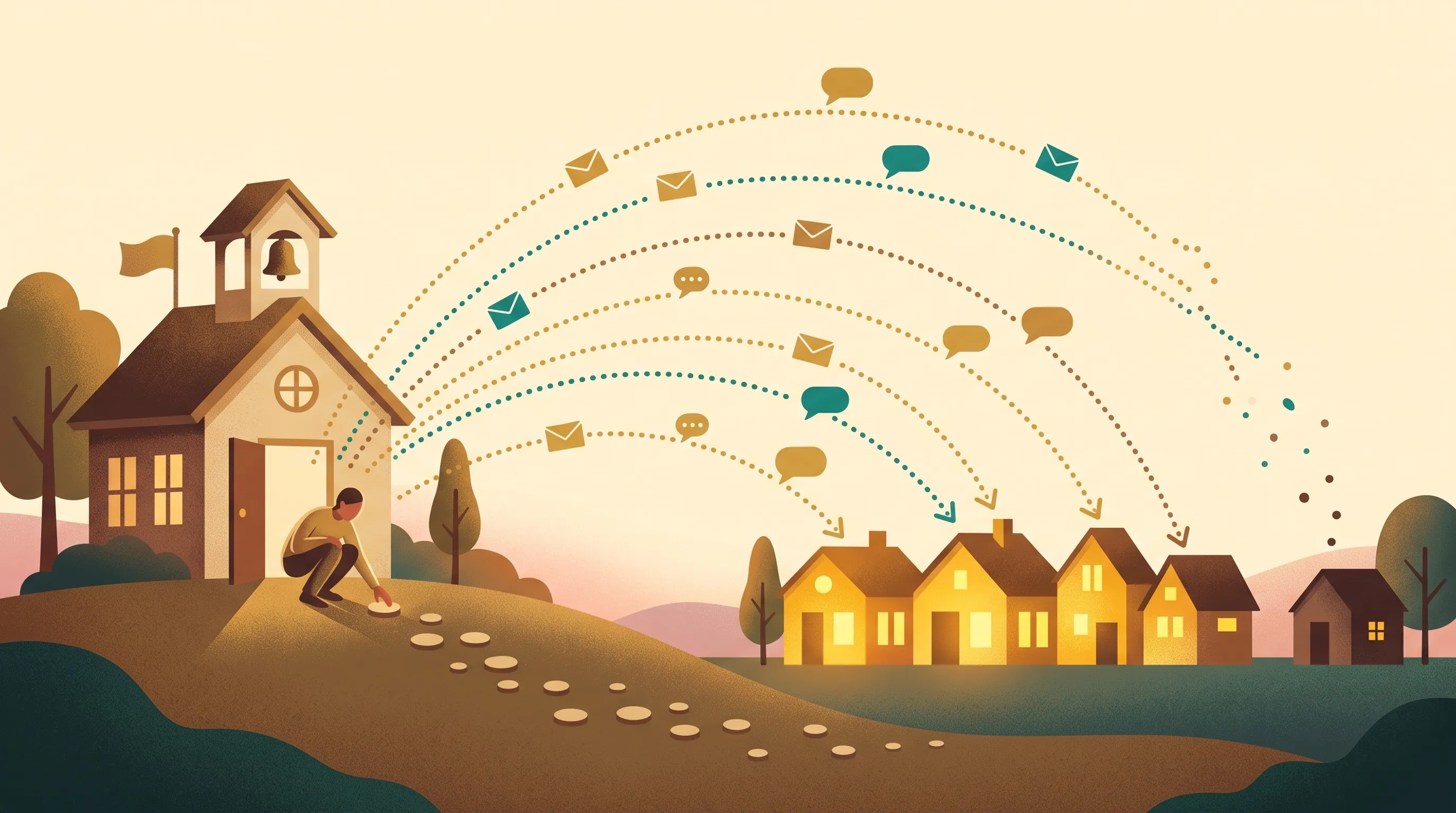
To reach low-income parents, stop relying on the channels that assume time, data and confidence they may not have. Audit each channel your school uses (website, email, app, printed notes, phone, meetings) against four barriers: language, cost, logistics and know-how. Then fix the single worst gap this month, not all of them at once. Give the audit to your office manager or a deputy head; it takes about 30 minutes. The checklist below shows where each channel can fail and what to change.
Channel-by-channel outreach checklist for low-income families
Our synthesis, built from the J-PAL taxonomy, the Davies study and the IZA trial discussed below, plus our own editorial judgment where no source covers a channel: each row pairs a common channel with a barrier it can run into and a concrete fix. Use it as a prompt for your own audit.
| Channel | Barrier it can hit | What to check | Fix to try |
|---|---|---|---|
| School website | Logistical, digital | Is key information only on the website? | Push the same item to a channel parents already open; keep the website as the archive |
| Digital, language | What share of families have an email address on file? Do messages open on a phone? | Shorten to three lines; put the action in the first sentence | |
| School app | Digital skills, data cost | Which families never activated their account? | Personal follow-up by phone or SMS for non-activated accounts |
| SMS | Cost to school, length | Do families who skip the app still receive urgent and practical messages? | Use SMS for action items, not newsletters |
| Printed notes in bags | Logistical (lost, unread) | Are notes used for deadlines or forms? | Duplicate any deadline on a second channel |
| Phone calls | Staff time, timing | Does the first call a family gets bring bad news? | Make the first call positive, early in the year |
| Meetings and parents’ evenings | Logistical, confidence | Are times set around staff schedules only? | Offer one early-morning or short slot, plus a named contact |
| Letters and forms | Language, informational | Do forms assume parents know school jargon? | Plain-language version, translated, with a “who to ask” name |
Pick the row where your school is weakest, and fix that one first.
What UNICEF’s May 2026 data shows about low-income families
Why now: in UNICEF’s new comparison of wealthier countries, 83% of 15-year-olds from wealthier families reach basic proficiency in reading and math, against 42% from poorer families (UNICEF Innocenti). That is the gap behind this checklist.
The figure comes from Report Card 20, Unequal Chances: Children and economic inequality, published in May 2026. It compares 44 high-income and OECD countries, including many European countries. The other figures an administrator will feel:
- Unequal countries, worse odds. In the most unequal countries, children face a 65% chance of leaving school without basic reading and math, against 40% in the most equal (UNICEF press release, 12 May 2026).
- Health. In EU countries, 58% of children in the lowest-income fifth are in very good health, against 73% in the top fifth.
- Life satisfaction. About 77% of the most advantaged children report high life satisfaction, against 67% of the most disadvantaged.
“Inequality profoundly affects how children learn, what they eat, and how they feel about life,” said Bo Viktor Nylund, Director of UNICEF Innocenti, in the launch release.
The report points to fewer and lower-quality resources at home, in the neighborhood and at school, and to more stress and stigma. Its recommendations are about income support, local services, and equitable schools: equal staffing and equipment, less socioeconomic segregation between schools, healthy school meals, consulting children, and better data. The pages of the report we read do not tell schools how to write to parents; that part is our practical reading.
A note on scope: these countries are high-income and OECD members. The figures should not be read across to Morocco, the Gulf or the wider MENA region, where the conditions and the data are different.
Why school channels can miss low-income parents
If the report does not cover communication, why connect the two? UNICEF points to fewer resources at home for poorer families, and many school channels quietly depend on resources such as time and connectivity, or familiarity with how school works.
Research on parent barriers names them. J-PAL’s summary of a parent-involvement evaluation (2021) lists linguistic, financial, logistical and informational barriers for disadvantaged parents, including not knowing how the school system works or how to help with homework. An older study by Davies, Ryan and Tarr (2011) of moderately marginalized parents at the primary-to-secondary transition reports barriers including a formal, directive newsletter tone, staff who were hard to reach, no named contact, one-way communication, slow replies and meeting times that did not fit their lives. Its sample was not defined by income, so treat it as indicative rather than as low-income evidence.
The digital piece has newer evidence. In a randomized trial of 859 low-income families in Turin (a preliminary IZA discussion paper, July 2025), researchers describe “a dual digital divide: limited access to technology and limited ability to use it effectively.” Giving parents a tablet, internet access and digital-skills training improved their digital skills and their confidence in guiding children online after one year, and made them more likely to use public services digitally. The authors’ analysis suggests skills, not just access, drive the effects. The trial did not test school messaging, so it tells us a digital channel is a skill as well as a device, not that apps close learning gaps.
Put together, a school that communicates mostly through its website, long emails and evening meetings may be reaching last the families that already face the most barriers to engaging with it.
How to reach low-income parents: fix one channel this month
Name one contact per family
A named person addresses the “who do I even ask?” barrier the Davies study describes. In practice, this looks like a two-line SMS in September from the class teacher: “Hi, I’m Ms. Laurent, Amina’s teacher. If anything about school is unclear, text or call me at this number.” Send it once, at the start of the year, before any problem arises.
Lead with the action, not the newsletter
Long newsletters can be hard going for families short on time or less comfortable reading in the school’s language. Try a three-line message every Thursday covering next week’s events, the parent’s action and the deadline. Or send a one-line reminder the evening before a form is due, with the form attached.
Follow up on silence
A family that never opened the app is a sign your main channel may not work for them, not proof they cannot be reached. In practice, this looks like a monthly list of accounts that were never activated, and a short call or SMS from the office to each: “We’ve been sending updates through the app. Would text messages work better for you?”
Make meetings easier to attend
Evening meetings can clash with work hours and childcare, and the Davies study lists inconvenient meeting times as a barrier. One option: for each parent-teacher meeting round, offer a 10-minute slot before school drop-off, booked by reply to a text, with an interpreter for families who ask.
Translate what matters
Language heads J-PAL’s list of barriers. Start by translating the three or four messages that carry a deadline or a decision (enrollment, meal forms, exam dates, trip consent) rather than every post.
Communication is not the only factor
Communication works alongside the income support and school funding UNICEF recommends. Family background matters too: a World Bank summary of OECD PISA analysis (2011) notes that parental education is linked to outcomes and that disadvantaged children tend to attend the least-resourced schools. The same summary reports that home-based involvement, such as reading to young children and asking about the school day, is associated with higher PISA scores, while volunteering and attending parent associations were not. Read as a correlation, that may point schools toward messages that help parents support learning at home, not just attend events.
Make outreach routine: check who you have not reached
The practical requirement: know which families your main channels miss, reach them on the channel they actually use, and give each one a named person to ask. That is a workflow, and it needs a regular check on which families have not been reached.
Purpose-built school communication platforms are one way to run it, and BeeNet is one implementation path. Invitations go out by email, SMS or WhatsApp (falling back to SMS when a number can’t receive WhatsApp); messages then arrive in the free BeeNet Connect app. SMS campaigns reach families who don’t use the app. See how SMS campaigns and family invitations work, or explore BeeNet for schools.
UNICEF has published the gap. Your school already knows which families it hears from least; this month is the time to fix the first channel on that list.
References
- UNICEF Innocenti (2026). Unequal Chances: Children and economic inequality (Innocenti Report Card 20). https://www.unicef.org/innocenti/reports/report-card-20
- UNICEF (12 May 2026). “Economic inequality harming children’s wellbeing in world’s wealthiest countries – UNICEF.” Press release. https://www.unicef.org/press-releases/economic-inequality-harming-childrens-wellbeing-worlds-wealthiest-countries-unicef
- Barone, G., Loviglio, A., & Tommasi, D. (2025). Reducing the Digital Divide for Marginalized Households. IZA Discussion Paper No. 18032 (preliminary). https://docs.iza.org/dp18032.pdf
- J-PAL (2021). “Getting Parents Involved.” Policy publication. https://www.povertyactionlab.org/publication/getting-parents-involved
- Davies, Ryan, & Tarr (2011). “What we tell them is not what they hear.” International Journal about Parents in Education, 5(2). https://testplatform.openjournals.nl/ijpe/article/view/18177
- World Bank Education for Global Development blog (8 December 2011). “Should developing countries shift from focusing on improving schools to improving parents?” https://blogs.worldbank.org/en/education/should-developing-countries-shift-from-focusing-on-improving-schools-to-improving-parents



Ready to Transform Your School Communication?
Start saving time and increasing parent engagement with BeeNet.
Request Demo