Morocco's School Dropout Crisis: Why Parent Communication Is the Variable Schools Control
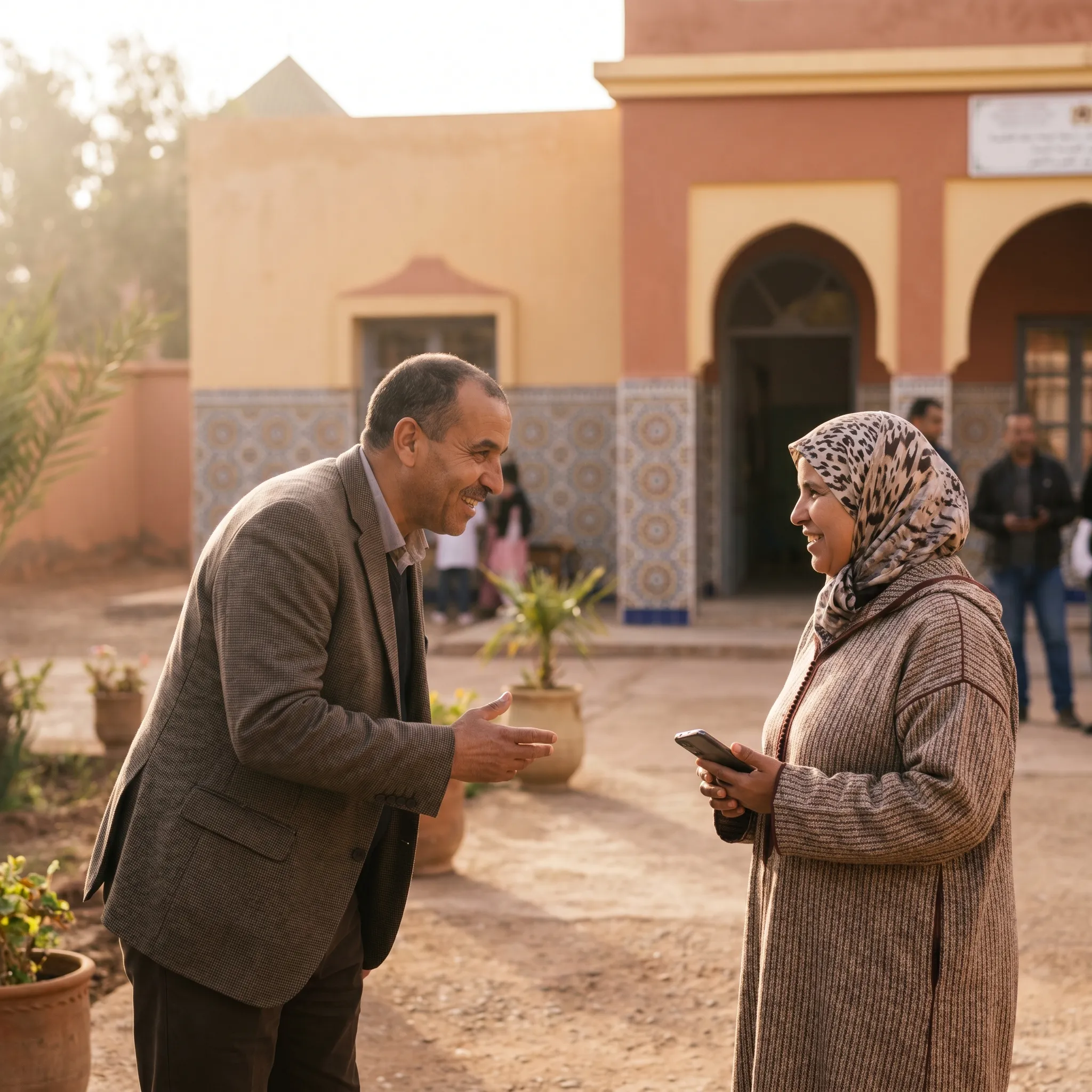
Every school year, roughly 280,000 students in Morocco abandon their education before completing it. According to an official statement from Minister Mohamed Saad Berrada, 160,000 of those dropouts occur specifically at the middle school level. The Ministry has set a target of reducing annual dropouts from 295,000 in 2024 to 200,000 by 2026. Research now identifies which school-controlled intervention most reliably moves that number — and it is not what most administrators focus on.
The dropout crisis is not a Moroccan peculiarity. The UNESCO Global Education Monitoring Report for 2026 notes that Morocco’s adolescent out-of-school rate dropped 85% over recent decades — from 42% to 6% — a substantial achievement. But secondary repetition rates have climbed to 23%, and the students who do stay in school are not all progressing. Keeping children enrolled is a different challenge from keeping them learning.
This distinction is where a growing body of research offers school administrators something genuinely useful: not a systemic intervention that requires political will or budget allocations, but a specific, measurable, school-controlled variable that predicts student outcomes.
What the Research Identifies as the Actual Driver
A 2023 study presented at the 64th ISI World Statistics Congress by researcher Nada Bijou applied structural equation modeling to PISA 2018 data — data covering approximately 600,000 students across 79 countries — with a specific focus on Morocco. The analysis traced a causal pathway between parental engagement, educational and cultural capital, and student achievement.
The headline finding: “children who are always accompanied by their parents at home are more likely to score better in mathematics, science and reading.”
That finding is not surprising in isolation — parental involvement and academic performance have been linked in educational research for decades. What gives the Moroccan study its operational value is the specificity of the mechanism it identifies. The parental behavior that predicts outcomes is not homework supervision, not private tutoring, not enforcing study hours. It is accompaniment — the kind of engaged, communicative relationship between parents and the school that signals to the child that their education is a shared family priority.
This matters because it changes the intervention target. If homework supervision were the driver, schools would need to change what happens inside families’ homes — largely outside the school’s reach. If the mechanism is school communication and relationship quality, the school itself is both the cause and the solution.
Why Dropout Is Not a Simple Problem — And Why That Doesn’t Help
Before focusing on what schools can control, it is worth being precise about what they cannot control, because the dropout literature can inadvertently demoralize school administrators by cataloguing factors that are beyond any individual school’s ability to address.
A 2024 peer-reviewed study by Aomar Ibourk and Soukaina Raoui, published in Heliyon and indexed in PubMed, conducted multivariate spatial analysis across 75 Moroccan provinces using 100 variables across ten territorial dimensions. Their core finding: dropout represents a “multifactorial, correlative, and cumulative” phenomenon. Distance from paved roads, household labor demands on children, linguistic barriers in instruction, local labor-market pull factors — all contribute. Remote rural areas experience substantially higher attrition rates. A separate qualitative study confirmed that language barriers in instruction were cited as a dropout factor by 45.7% of students studied, underscoring the multidimensional complexity that no single school can fully resolve on its own.
An IIEP-UNESCO analysis from 2026, co-authored with the Moroccan Ministry of Education, described dropout as “a gradual, often long and silent process, marked by the accumulation of academic difficulties, psychosocial vulnerabilities and a gradual breakdown in the relationship with school.” That phrase — “gradual breakdown in the relationship with school” — is the operational key. Dropout does not happen suddenly. It accumulates.
None of this territorial and structural analysis is an argument for resignation. It is an argument for targeting. A school in an urban Casablanca arrondissement cannot build paved roads to remote villages or restructure household economies. But it can prevent the gradual breakdown in the relationship with school from occurring — if it acts early enough, and through the right channels.
Parent Communication as the Specific Lever
The distinction that makes the Bijou study operationally useful is the one between types of parental involvement. This distinction is underappreciated in school policy discussions, where “parental engagement” is often treated as a single undifferentiated good.
A 2025 meta-analysis compiled by Dr. Kerry Hempenstall at the National Institute for Direct Instruction draws on 2020–2025 research to make this point directly: quality and type of parental involvement matter more than quantity. The finding is unambiguous: “effective communication between parents and teachers is foundational.” The same meta-analysis confirms that higher parental involvement is associated with “an increased probability of high school graduation” — precisely the outcome that Morocco’s Ministry is trying to protect.
You can measure this in your own setting with our free family involvement audit.
This research alignment — Moroccan PISA data, territorial dropout analysis, and international meta-analysis — points to the same conclusion from three different angles: parent-school communication is not one of many equivalent interventions. It is the foundational one.
What This Means for Day-to-Day Administration
For a school administrator, translating “communication is foundational” into practice requires answering three questions: Who is not being reached? When does disengagement become visible? What channel actually works?
On the first question: the Ibourk and Raoui spatial analysis identifies which families are structurally hardest to reach — those in territories with weak infrastructure, those where children contribute economically to the household, those where the language of instruction differs from the home language. These families are not less interested in their children’s education. They are more likely to receive less information from the school and have fewer practical means to respond when they do.
On the second question: the UNESCO and IIEP-UNESCO framing of dropout as “gradual” is critical. By the time a student is officially recorded as a dropout, the relationship with school has typically been deteriorating for months or years. The signal is visible earlier — in attendance patterns, in grades, in the frequency (or absence) of parent-teacher contact. Schools that wait for an official trigger to engage parents are already operating reactively.
On the third question: the channel matters. A parent who cannot easily travel to a school building for a meeting, or who is not confident in formal written communication, responds differently to a phone call, an SMS, or a structured notification via an application than to a formal letter. Research on migrant family engagement — much of which applies directly to rural-to-urban migrant families within Morocco — consistently shows that reducing the friction of communication is as important as increasing its frequency.
The Structural Communication Failure Schools Can Fix
The strongest argument for focusing on parent communication as an intervention is not simply that it correlates with better outcomes. It is that its absence correlates with the worst outcomes — and that the absence is often a school-side failure, not a family-side failure.
Families in Morocco’s at-risk dropout cohorts are not disengaged because they do not value education. The IIEP-UNESCO analysis notes that dropout is marked by “a gradual breakdown in the relationship with school” — not with education. The relationship that breaks down is with the institution, and institutions can choose how they maintain that relationship.
This means the school administrator’s question is not “how do we get parents to engage more?” but “what are we doing that makes engagement easy, consistent, and meaningful?” The answer to that question involves:
- Frequency over formality: Regular, brief communications about school life and the child’s progression outperform infrequent formal reports that parents may not have the confidence to interpret or respond to. A weekly summary message — even a short one — keeps the relationship active between crises.
- Proactive over reactive: Reaching out before a problem becomes critical — before an attendance pattern deteriorates, before grades fall sharply — keeps the relationship active and reduces the shock of the eventual difficult conversation. A parent who hears from the school only when something goes wrong learns to dread contact, not welcome it.
- Accessibility over comprehensiveness: A message that reaches a parent on their phone and can be understood in two minutes is more effective than a detailed letter that never gets read. An SMS alert that a student missed two consecutive classes reaches a working parent faster than a formal letter requiring a meeting response — the kind of automated SMS alert system for schools built specifically for that job, rather than a one-off text sent manually.
These are operational choices. They are within the school’s control in a way that road infrastructure, household poverty, and labor market conditions are not.
A Measurable, Scalable Target
Morocco’s ambition to reduce annual dropouts from 295,000 to 200,000 by 2026 requires interventions that can be implemented at scale, measured, and adjusted based on outcomes. Territorial interventions — building schools closer to communities, cash transfers like the Tayssir programme serving 3.1 million students — are essential but slow and expensive.
Parent-school communication is neither slow nor expensive to improve. It is fast to implement, directly measurable (how many parents received a message? How many responded? How many attended an event?), and — based on the research evidence — causally linked to the outcome the Ministry is trying to move.
The Bijou study’s structural equation modeling does not just show correlation. It traces a pathway from parental engagement to student achievement through measurable intermediate variables. That kind of causal clarity is rare in education research, and it gives administrators something they can act on with confidence.
School administrators working in Moroccan, Francophone African, or Gulf school systems face a common challenge: they operate in environments with real structural constraints, limited budgets, and enormous variation in the home circumstances of their student populations. The research reviewed here does not pretend those constraints do not exist. It identifies, within those constraints, the variable that schools demonstrably control and that demonstrably moves the outcomes they care about.
That variable is the quality and consistency of communication between the school and the families it serves.
BeeNet is a school communication platform designed for multilingual, multicultural school communities across MENA and Europe. If you’re ready to move from one-way formal notices to two-way, proactive family communication across languages, request a demo to see how BeeNet works in practice — including structured multilingual messaging built for diverse school communities.
References
-
Bijou, N. (2023). Parental involvement and Moroccan student’s school performance: A Structural Equation Modeling study. 64th ISI World Statistics Congress. https://www.isi-next.org/abstracts/submission/610/view/
-
Ibourk, A., & Raoui, S. (2024). Territorial obstacles causing early school dropout in Morocco: Multivariate spatial analysis. Heliyon. https://www.sciencedirect.com/science/article/pii/S2405844024174178
-
Ibourk, A., & Raoui, S. (2024). Territorial obstacles causing early school dropout in Morocco. PubMed/NIH. https://pubmed.ncbi.nlm.nih.gov/39811329/
-
Gagnon, A., & Benrhannou, I. (2026). Educational planning to reduce early school dropout in Morocco. IIEP-UNESCO. https://www.iiep.unesco.org/en/articles/educational-planning-reduce-early-school-dropout-morocco
-
El Alaoui, A., Sigamoney, N., & Dogra, A. (2021). Students’ perceptions of early school leaving: A Moroccan case study. ScienceDirect. https://www.sciencedirect.com/science/article/pii/S2590291121000991
-
Hempenstall, K. (2025). The impact of parental involvement on the education outcomes of their children. NIFDI. https://www.nifdi.org/resources/hempenstall-blog/972-the-impact-of-parental-involvement-on-the-education-outcomes-of-their-children-2025.html
-
Morocco World News. (2025). Morocco’s School Dropout Crisis: 280,000 Students Abandon Education Annually. https://www.moroccoworldnews.com/2025/04/195490/moroccos-school-dropout-crisis-280000-students-abandon-education-annually/
-
UNESCO GEM Report. (2026). Morocco — 2026 Global Education Monitoring Report: Access and Equity. https://www.unesco.org/gem-report/en/2026-gem-report-country-case-studies/morocco



Related BeeNet Features
Ready to Transform Your School Communication?
Start saving time and increasing parent engagement with BeeNet.
Request Demo