Nursery Photo Consent in France: RGPD Channel Checklist
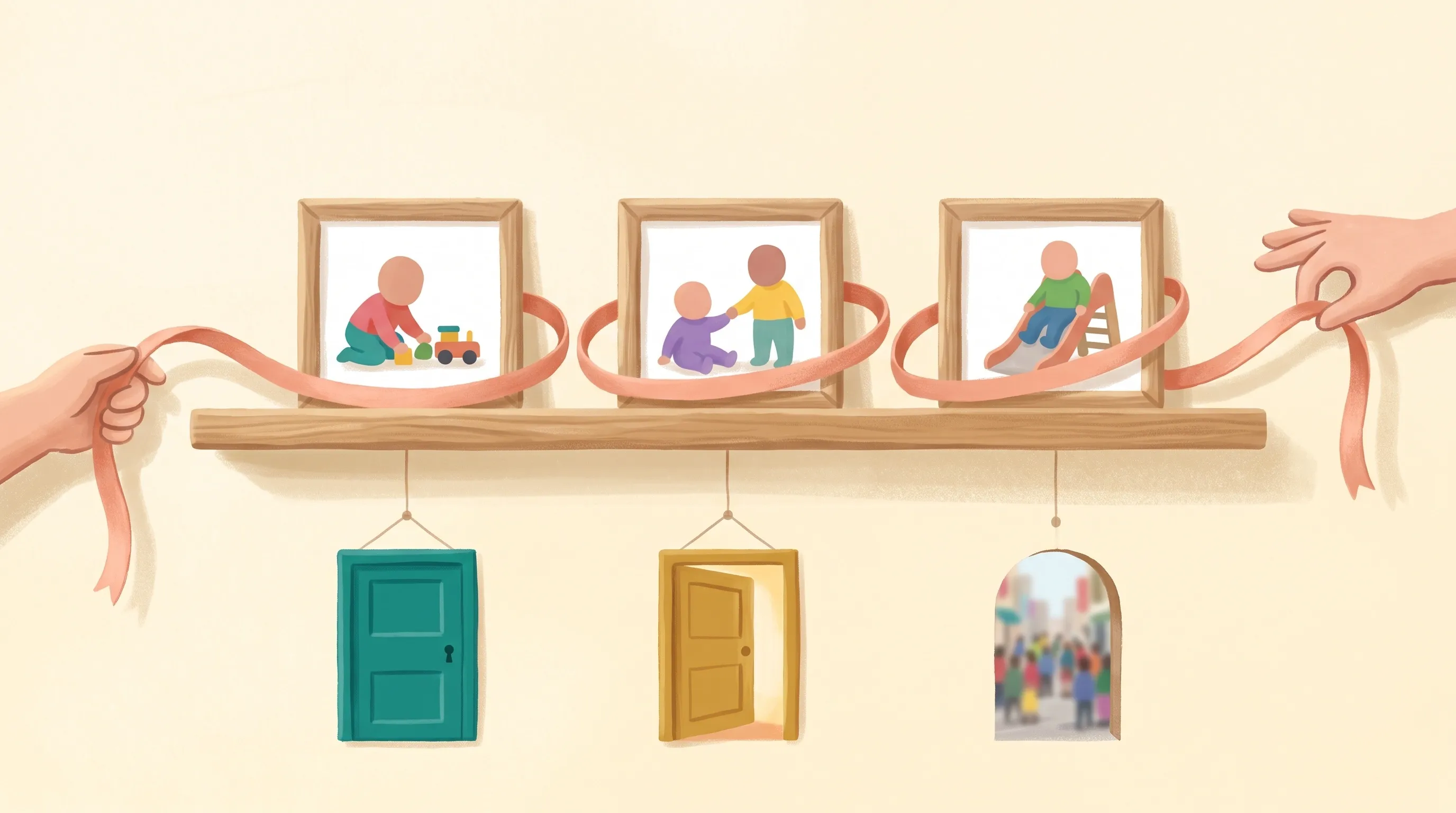
Yes, a crèche in France can share children’s photos with parents, but nursery photo consent under the RGPD has to be specific to each channel, provable, and as easy to withdraw as it was to give. That includes the Friday photo posted to the parents’ WhatsApp group. One “droit à l’image” tick-box on the enrollment form cannot cover a WhatsApp group, a printed cahier de vie, a parent app and an Instagram account at the same time. Since February 2024, French law also says both parents protect a child’s image right together, so record both parents’ agreement as the safe default.
Here is the short version, channel by channel. The detail and the reasoning follow.
| Channel | Who sees the photo | Consent you need | Can a parent withdraw cleanly? |
|---|---|---|---|
| WhatsApp group | Every member of the group, on their own phones | A separate consent line naming WhatsApp, for every child visible in the photo | Not for photos already saved on members’ phones |
| Printed cahier de vie | The child’s own family | A consent line for the cahier, plus consent for every other child shown in group photos | Yes, for future pages |
| Private parent app or secure messaging | Families the crèche authorizes | A consent line naming the app, and a processor contract with the app provider | Yes, if the app checks consent before a photo goes out |
| Website, social media, press | The public | Its own explicit consent per outlet; a refusal must not affect the child’s place | Hard: public copies can be re-shared |
This table is our analysis of how CNIL’s consent conditions apply to each channel, not a CNIL ruling. We found no CNIL guidance specific to WhatsApp groups in crèches.
RGPD and crèche photos: what valid consent means
A photo of an identifiable child is personal data, and publishing or sharing photos beyond the care itself is processing that, for a crèche, generally rests on consent. CNIL describes valid consent as «libre, spécifique, éclairée et univoque»: free, specific, informed and unambiguous (CNIL, consent guidance, 2018).
Four of CNIL’s requirements decide how a crèche’s photo form has to look:
- One consent per purpose. Separate purposes need separate consent; pre-ticked boxes and bundled consent do not count. A single “I accept the photo policy” box that covers the newsletter, the WhatsApp group and the Facebook page is bundled consent.
- Proof. The crèche must be able to show, at any time, that the parent consented (CNIL). A verbal “it’s fine” at pickup is hard to prove.
- Withdrawal. CNIL requires a withdrawal method «simple et équivalente» to the one used to collect consent. If the parent signed a paper form at enrollment, they should be able to withdraw just as easily, without a meeting with the director.
- The right controller. The data controller is the legal entity running the crèche (the commune, the association or the company) (Devergranne, donneespersonnelles.fr).
Consent covers the photos, not everything else. As GDPR practitioner Thiebaut Devergranne puts it, «Le consentement n’est pas une autorisation globale de gérer la crèche»: the crèche’s other processing runs on other legal bases. Keep the photo consent form about photos.
Droit à l’image for a child at crèche: why both parents matter
Law no. 2024-120 of 19 February 2024 amended article 372-1 of the French Civil Code and made parents’ protection of the child’s image right a joint matter: the AP-HP legal-affairs summary says the child’s image right now falls among the «actes non usuels de l’autorité parentale», which require both parents’ agreement under article 372-1 (Loi n° 2024-120, AP-HP legal affairs; official text on Légifrance). The same law asks parents to involve the child according to age and maturity, which matters little for a 15-month-old but will for older children in after-school settings. And when parents disagree, a judge can prohibit one parent from sharing content without the other’s authorization.
CNIL’s guidance to parents goes a step further: it says posting a child’s photos needs the agreement of both parents (CNIL, 2025). That guidance is addressed to parents, not to crèches, and no text we found states “two signatures” as an express crèche rule. But because the right is exercised jointly, collecting both parents’ agreement is the safe way to be able to prove consent if separated parents later disagree about a photo.
Concretely: a photo consent form with two signature blocks, one per holder of parental authority, and a line telling the crèche what to do if only one parent signs: no photos on that channel until the second signature arrives.
Autorisation parentale photo crèche: what the form must say
An autorisation parentale for photos works when a parent can read it and know exactly where their child’s face will end up. Built on the CNIL conditions above, a usable form has:
- The controller’s name and contact: the commune, association or company, not “the team”.
- One checkbox per channel, unticked by default: cahier de vie, private parent app, WhatsApp group (if you keep one), crèche website, social media, local press.
- The audience for each channel: “families of the Coccinelles section” is clear; “may be shared” is not.
- How long photos are kept on each channel.
- How to withdraw, by the same route used to consent, for example a reply in the parent app or a form at reception.
- A sentence stating that refusing does not affect the child’s place. In Devergranne’s words, «Le refus ne doit pas empêcher l’accueil.»
- Both parents’ signatures, dated.
- A line on group photos: photos with other children in them are only shared on a channel where every child visible has consent.
You don’t have to write this from scratch. Our parental consent form for photo and video use already has per-channel publication choices and a parental signature block, the CNIL consent form generator builds a version with the withdrawal clause included, and the general parent/guardian consent form covers a one-off occasion, such as photos at an end-of-year party. For the wider question of what every school consent form needs, see what school consent forms need now.
Picture a one-page form handed out at the adaptation period, with six unticked boxes and a line on group photos, filed in the child’s record and re-confirmed each September by a short message in the parent app asking families to check their choices.
WhatsApp crèche parents and RGPD: why a better caption doesn’t fix it
The argument here rests on consent, where the evidence is firm, not on where WhatsApp hosts data. A WhatsApp group fails the per-channel test for structural reasons that no wording change can repair.
- Everyone in the group sees every photo. A group shot of the Coccinelles at snack time is shown to every parent in the group. Applying CNIL’s one-consent-per-purpose principle, each child visible needs consent for that channel, not only the child whose parent asked for the picture.
- Withdrawal only works going forward. When a parent withdraws consent, the crèche can stop posting. Our own consent template notes that withdrawal does not apply to publications already carried out; in a group chat, that covers every photo already posted. CNIL’s «simple et équivalente» withdrawal becomes, in practice, a withdrawal for future photos only.
- The crèche has to prove consent elsewhere. A crèche that wants to show which families agreed to WhatsApp specifically, or when someone withdrew, would need to keep that record outside the chat.
- Photos carry metadata. CNIL warns that photo metadata can reveal where and when a photo was taken (CNIL, 2025).
A caption like “please do not share” asks members to behave well. It does not give the crèche proof, control over withdrawal or a limit on who sees the photo. That is why the fix is a different channel, not better wording. For the wider case against WhatsApp groups in schools, see why WhatsApp fails schools.
Take the Coccinelles’ Friday painting session: instead of one group shot posted to 14 families in WhatsApp, the educator sends each family the one or two pictures of their own child, through a channel that checks the child’s consent line first, and leaves out any child whose form isn’t back.
Which channel can carry crèche photos?
CNIL’s own advice to parents points toward the answer. It «déconseille fortement de partager des photos ou des vidéos de vos enfants» publicly and recommends a «messagerie privée instantanée sécurisée», email or MMS instead (CNIL, 2025). For a crèche, that means comparing options on the criteria the consent rules create, not on price alone.
| Option | Per-child audience | Records consent | Handles withdrawal | Processor contract | Cost to the crèche |
|---|---|---|---|---|---|
| WhatsApp group | No, the whole group | No | Future photos only | None signed by the crèche for group use | Free to use, but the consent gaps above remain |
| Email to each family | Yes, if sent one family at a time | Outside the tool | Yes, for future emails | Depends on the provider | Staff time per child |
| Printed cahier de vie | Yes | On paper | Yes, for future pages | Not needed | Printing and staff time |
| Private parent app | Yes, if photos go to a child’s own family | Depends on the app | Depends on the app | Required: the provider is a processor | Subscription |
The app row says “depends” on purpose. A parent app is the provider acting as a processor, which needs a contract under GDPR article 28(3), and as Devergranne notes, «Un hébergement européen ne résout pas à lui seul toutes ces questions.» When you evaluate one, ask three concrete questions: does it block a child’s photo when consent is missing, can each family see only their own child’s pictures, and can you export the consent record if CNIL or a parent asks?
In practice, switching looks like this: one email to families announcing the new channel and the date the WhatsApp group closes, the new consent form attached, a two-week overlap where photos go only to families whose forms are back, then a final message in the group before it is archived.
Your crèche photo consent checklist
Before the next photo goes out, check that:
- Each channel you use has its own unticked consent line.
- Both holders of parental authority have signed, or photos are held back on that channel until they do.
- Group photos are posted only where every child visible has consent for that channel.
- Parents can withdraw the same way they consented, and the form tells them how.
- The form states that refusing does not affect the child’s place.
- Every app or provider that stores photos has a processor contract with the crèche.
- You have a written date for closing the WhatsApp group, if you still run one.
The rules are clear on consent: the joint image right has been in the Civil Code since 2024 and the consent conditions predate it. What remains for a crèche is moving the daily photos to a channel where consent can be checked, proved and withdrawn. The step is the same whatever tool you pick: a channel that checks consent before a photo goes out.
Purpose-built parent communication platforms exist for this workflow, and BeeNet is one implementation path to test against the three questions above. Data is hosted in the EU (Microsoft Azure, West Europe), with a DPA for every school and encryption in transit and at rest, though hosting alone does not make a crèche compliant. Invitations go out by email, SMS or WhatsApp (falling back to SMS when a number can’t receive WhatsApp); messages then arrive in the free BeeNet Connect app, so the photos themselves stay out of WhatsApp. See how photo albums families can browse work, how BeeNet fits daycares, or book a demo before the next consent round.
References
- CNIL. (2025, November 28). Partage de photos et vidéos de votre enfant sur les réseaux sociaux : quels sont les risques ? https://www.cnil.fr/fr/partage-de-photos-et-videos-de-votre-enfant-sur-les-reseaux-sociaux-quels-sont-les-risques
- CNIL. (2018). Conformité RGPD : comment recueillir le consentement des personnes ? https://www.cnil.fr/fr/les-bases-legales/consentement
- Loi n° 2024-120 du 19 février 2024 visant à garantir le respect du droit à l’image des enfants. Journal officiel, 20 February 2024. https://www.legifrance.gouv.fr/jorf/id/JORFTEXT000049163317 (text consulted via AP-HP legal affairs: https://affairesjuridiques.aphp.fr/textes/loi-n-2024-120-du-19-fevrier-2024-visant-a-garantir-le-respect-du-droit-a-limage-des-enfants/)
- Devergranne, T. (2026, July 10; updated September 27). RGPD en crèche : dossiers, photos et applications. donneespersonnelles.fr. https://donneespersonnelles.fr/rgpd-creche



Ready to Transform Your School Communication?
Start saving time and increasing parent engagement with BeeNet.
Request Demo