Parent Involvement and Grades: What to Tell Families
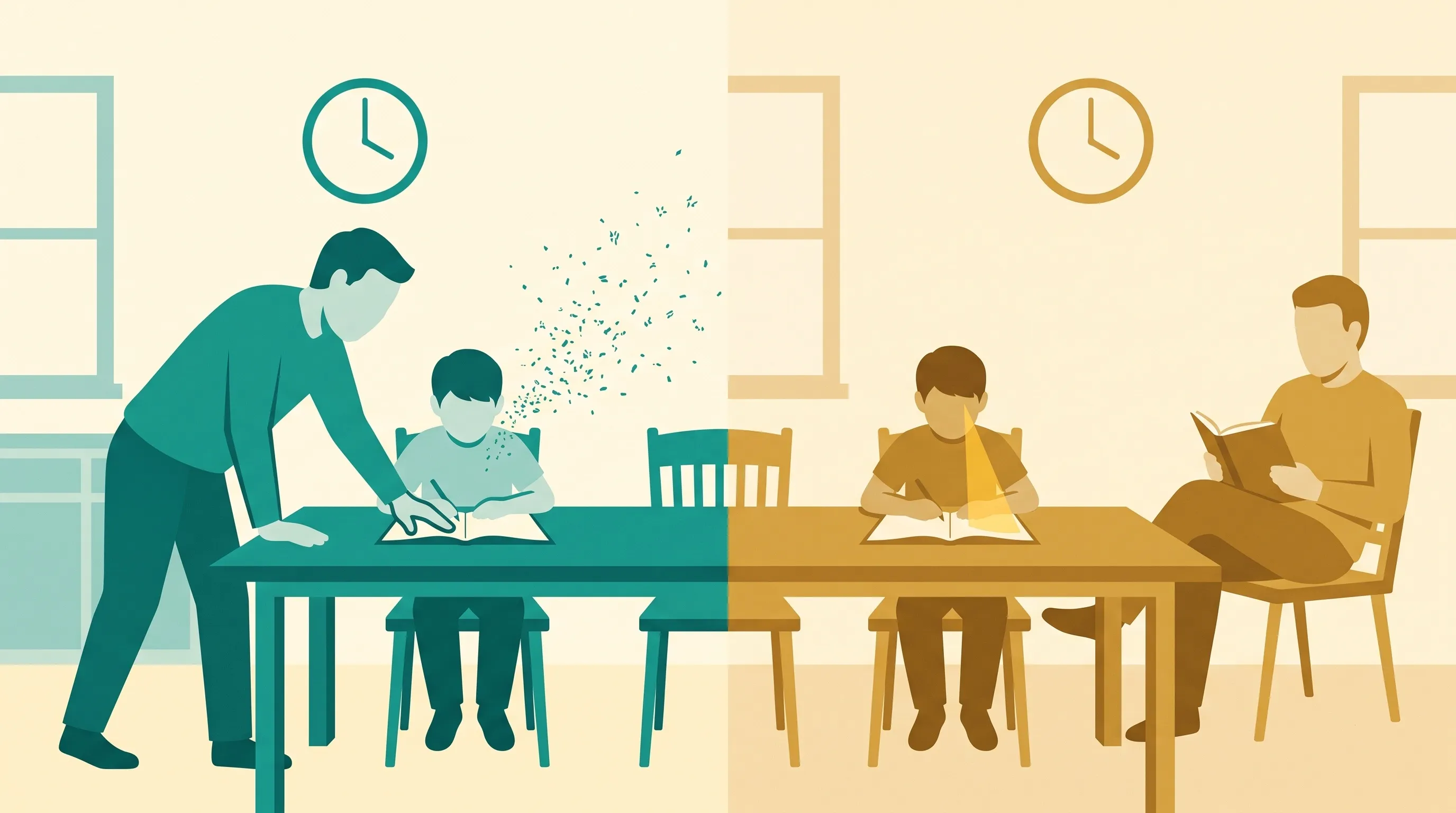
In a 2026 study of 871 elementary students, the parent involvement linked to better grades was the supportive kind: talking with a child and listening, or sitting quietly nearby while they read. Interfering involvement, such as nagging during play or abruptly stopping a game to demand homework, was linked to lower grades. The study was published in June 2026 in Child Psychiatry & Human Development, and children’s attention statistically accounted for part or all of those links.
For schools, that changes the message to families. “Be more involved” is too vague: it leaves parents to guess which kind of involvement counts. If you only need the deliverables, skip ahead to the do/don’t table and the coaching note further down. They translate the findings into what a parent can actually do tonight.
Parent involvement and grades: what the 2026 study measured
Researchers from South China Normal University and Capital Normal University ran two studies (Huo et al., 2026). The first was a questionnaire study of 871 elementary students in China, average age about 11.5. According to the preprint version of the paper, these were fifth and sixth graders from public schools in Guangzhou, and the children themselves rated their parents on a 21-item scale.
The scale ignored hours spent together and measured four kinds of what the authors call parental companionship (item examples from the preprint):
- Communication and interaction: a parent asking about school, praising good grades, comforting the child, sharing feelings.
- Accompanying: a parent being present while the child reads or plays.
- Neglect: a parent who is physically there but not paying attention.
- Interference: nagging or scolding during play, and suddenly interrupting a game to demand homework or chores.
Communication and accompanying were linked to higher school achievement, and interference to lower achievement. In the preprint, neglect showed no significant total effect on grades, and the published abstract reports no attention mediation for neglect. A child-reported measure of attention statistically accounted for part of the link for communication and interaction, and all of it for accompanying and interference.
Put plainly, children who described more supportive companionship also tended to report better attention, and better attention went with better grades. Children who described more interference showed the reverse pattern. The links are small: in the preprint, communication and interaction correlated with grades at r = .183, and interference at r = -.103.
What the attention-task study found, and what it did not
The second study compared 53 children with high companionship scores against 53 with low scores on the Attention Network Test, a computer task that separates three attention functions: alerting, orienting and executive control.
The low-companionship group had a significantly larger alerting effect, meaning a bigger response to a warning signal. The authors read this as a possible compensatory response, not a sign of stronger attention. Executive control showed no difference between the groups, so this does not show that supportive parents build “better attention networks.”
Quality, not quantity: why “spend more time” is the wrong message
On the narrower question of homework, recent work points the same way:
- A 2024 meta-analysis of 28 studies covering 378,222 participants found that overall parental homework involvement was weakly negatively related to achievement (r = -0.064). Autonomy support was the only form positively related to achievement (r = 0.164). Help with content, parental control and sheer frequency were largely unrelated to achievement.
- A 2023 math-only meta-analysis found a small positive link for supportive homework involvement (r = 0.076) and a negative link for intrusive involvement (r = -0.153). It is the older of the two and covers only mathematics, but it is the one meta-analysis we found that splits supportive from intrusive involvement directly.
- A 2025 study of 526 Russian high-school students found that students who recalled more parental autonomy support in childhood had higher grades and more productive homework habits, while controlling parenting was associated with lower persistence.
We covered the homework side in more depth in Parental Homework Help and Student Achievement. What the 2026 study adds is that the same supportive-versus-interfering split shows up outside homework, in everyday moments like a game or reading together.
One detail keeps this from tipping into a lecture for parents: quiet presence counts. In the preprint, the authors suggest that “when children are reading, parents can quietly accompany them without spending excessive time on electronic devices.” A parent does not need to teach the lesson to be part of the evening.
What this research cannot tell you
Every source here is correlational: the 2026 mediation result is a statistical pattern in one survey of children’s reports, not proof that changing parent behavior changes attention or grades. The arrow could also run the other way. A child who concentrates well and does well at school may simply draw calmer, less interfering parenting, because there is less to nag about. The 2026 study also captured children’s perception of their parents rather than observing parents, and the two primary studies come from China and Russia, not from France, Morocco or the Gulf. None of this cancels the finding. Several studies point the same direction, and that is enough to change what a school asks of families.
Do/don’t table: how parents can support learning
This table translates the measured behaviors into actions a school can pass on. The left column and the direction of each row come from the studies above. The specific suggestions in the middle column are the BeeNet team’s practical scripts, not items the researchers tested.
| Instead of this | Try this | Where it comes from |
|---|---|---|
| Nagging or scolding while a child plays | Agree on a homework time in advance, then let play run until then | Interference items, Huo et al. (preprint) |
| Stopping a game abruptly to demand homework or chores | Give a five-minute warning and let the child finish the round | Interference items, Huo et al. (preprint) |
| Listening while watching TV or scrolling a phone | Put the phone down for the few minutes the child is talking | Neglect item, Huo et al. (preprint); no significant link to grades in the preprint, so this is about connection |
| Correcting every mistake on the homework sheet | Ask “how did you work that out?” and let the child choose what to check | Applies the autonomy-support finding, Xu et al. 2024; Jiang et al. 2023 |
| Deciding the order and method of homework for the child | Offer a choice: “Math or reading first?” | Applies the autonomy-support finding, Xu et al. 2024; Gordeeva et al. 2025 |
| Hovering over every exercise | Sit nearby with a book while the child reads, no screen | Accompanying dimension and authors’ suggestion, Huo et al. (preprint) |
| Asking only “did you finish?” | Ask one open question about the day and listen to the answer | Communication and interaction, Huo et al. 2026 |
How to share this with families: a coaching note you can send
The practical move for a school is small and specific. Rather than a general appeal for involvement, send families one concrete message about the kind of involvement.
One option we suggest is the short message below, about 125 words, sent through the school’s usual parent channel in the second or third week of term, once homework routines have settled. Or a single slide at the first parent-teacher meeting of the year, followed by the same text in writing the next morning so absent parents get it too. Or a one-line reminder before the mid-term exam period: “Quiet company, not supervision, this week.”
Here is a coaching note you can adapt:
A small change that helps at homework time
A 2026 study of 871 elementary students in China found that children who described supportive time with their parents, such as a parent asking about their day or sitting quietly nearby while they read, tended to report better attention and better grades. Children who described being nagged or interrupted during play to be sent to homework or chores showed the opposite pattern.
Three things to try this week:
- Agree on homework time in advance, and give a five-minute warning instead of stopping a game.
- When your child talks about their day, put your phone down for those few minutes.
- You don’t have to help with every exercise. Sitting nearby with your own book counts.
For SMS or another short channel, a one-line version: “This week at homework time: a five-minute warning instead of stopping a game, phone down when your child talks, and quiet company nearby counts.”
Keep it in the families’ own language, and keep it short. A note that reads as a lecture will be skimmed; a note with three doable actions has a chance of changing one evening.
For schools with families who speak several languages at home, the same note can go out in each family’s language rather than a single version everyone half-reads.
The message to families should change this term
Recent research asks which involvement, not just whether parents are involved. In the 2026 study, supportive companionship went with better grades and interference with lower ones; in the largest of the homework meta-analyses cited here, autonomy support was the one form tied to higher achievement. Schools that keep sending generic “get involved” messages leave parents to guess which kind counts.
One well-timed, well-worded message per term, sent in the language each family reads, is enough; no program is needed. BeeNet is one way to run that through its announcements, with optional message translation into 130+ languages: the school switches it on, then each family chooses whether to use it and in which language. See how announcements work, and schedule this term’s coaching note for the second week of homework.
References
- Huo, X., Du, L., Wu, T., & Chen, C. (2026). Parental companionship shapes children’s attentional functions and academic achievement. Child Psychiatry & Human Development. https://doi.org/10.1007/s10578-026-02028-0 — https://link.springer.com/article/10.1007/s10578-026-02028-0
- Huo, X., Du, L., Wu, T., & Chen, C. (2025). Parental companionship shapes children’s attentional functions and academic achievement [Preprint, version 1]. Research Square. https://www.researchsquare.com/article/rs-6324909/latest.pdf
- Xu, J., Guo, S., Feng, Y., Ma, Y., Zhang, Y., Núñez, J. C., & Fan, H. (2024). Parental homework involvement and students’ achievement: A three-level meta-analysis. Psicothema, 36(1). https://www.psicothema.com/pdf/4826.pdf
- Gordeeva, T. O., Nechaeva, D. M., & Sychev, O. A. (2025). The role of parenting styles in schoolchildren’s homework motivation, homework behavior, and academic achievement. Psychology in Russia: State of the Art, 18(4). https://selfdeterminationtheory.org/wp-content/uploads/2026/01/2025_GordeevaEtAl_ParentingHomework.pdf
- Jiang, Q., Shi, L., Zheng, D., & Mao, W. (2023). Parental homework involvement and students’ mathematics achievement: A meta-analysis. Frontiers in Psychology, 14, 1218534. https://pmc.ncbi.nlm.nih.gov/articles/PMC10373934/



Ready to Transform Your School Communication?
Start saving time and increasing parent engagement with BeeNet.
Request Demo