ECEC Communication Gap: What OECD's 17-Country Data Shows About What Crèches and Kindergartens Are Missing
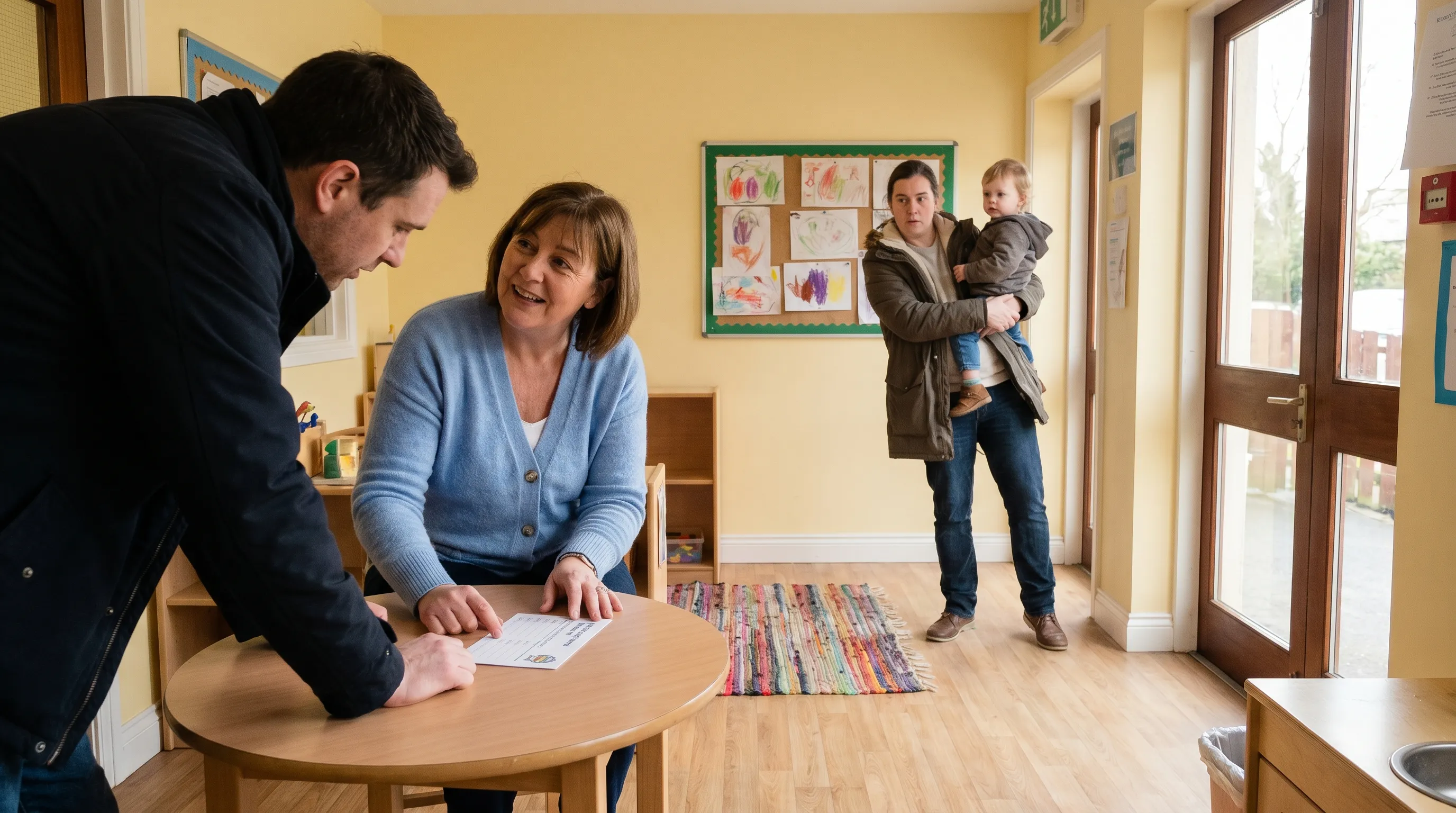
The equity gap in education is often discussed as a primary school problem. New OECD data shows it is already established before children reach Year 1.
In TALIS Starting Strong 2024, the OECD’s international survey of early childhood education and care (ECEC) workers across 17 countries and subnational entities, a striking pattern appears: in Finland, Israel, Japan and Sweden, fewer than 30% of crèche and kindergarten leaders report that parents have frequent opportunities to contribute to decisions. Not occasional involvement. Not consultation on major changes. Frequent participation — the baseline expectation of most modern family engagement frameworks.
That number is a policy problem. But what makes it an equity problem is what happens next: disadvantaged families are not receiving systematically stronger engagement to compensate.
The Decision-Making Gap Across Seventeen Countries
Andreas Schleicher, OECD Director for Education and Skills, summarises the TALIS Starting Strong 2024 data clearly: fewer than 30% of leaders in Finland, Israel, Japan and Sweden report that parents or guardians have frequent opportunities to contribute to decisions at the pre-primary level. Denmark, Norway and Türkiye sit at the other end — more than 60% of leaders in those countries report involving families frequently.
These numbers are descriptive and correlational; they tell us what exists, not why. But the cross-country variation is wide enough to indicate that the gap is a policy and practice choice, not an inevitable feature of early childhood settings.
You can measure this in your own setting with our free daycare family communication checker.
There is also a structural paradox buried in the same data. Home-learning encouragement tops 90% in many countries surveyed. Centres are communicating. They are sharing information. What they are not doing, in most systems, is inviting families into decisions: about the setting’s priorities, about curriculum emphasis, about what quality looks like for their child.
That distinction matters. Information-sharing and participation are not the same thing. A parent who receives a monthly newsletter is not the same as a parent who helped shape the month’s programme.
The Equity Inversion: Disadvantaged Families Are Not Getting More
The more troubling finding is what the OECD’s Education Policy Perspectives No. 110 describes as an absence of systematic compensatory effort. The report is careful: in some countries and in some centres, there are signs of stronger engagement where more disadvantaged children are enrolled. But across systems as a whole, there is “no clear pattern suggesting that there are systematic efforts to strengthen relationships between ECEC centres and families in situations of disadvantage.”
The TALIS data reinforces this. Less communication with families is associated with disadvantaged ECEC settings — not more. Staff initial education also underrepresents equity-related topics: working with children from diverse or disadvantaged backgrounds, and children whose home language differs from the setting’s language, are typically undertaught in initial ECEC training in most surveyed countries.
This creates an inversion. The children who stand to gain most from high-quality ECEC — those from disadvantaged households — are in settings where parental engagement is lower, and where staff are less prepared to bridge that gap.
Research from Wildmon, Anthony and Kamau (2024) at Mississippi State University adds granularity to the structural side: economically disadvantaged parents face the greatest barriers to ECEC involvement — unstable work schedules, transportation constraints, financial hardship — yet their children may benefit most from parental involvement. The implication is direct: the responsibility for closing this gap rests primarily with institutions, not families.
What High Engagement Looks Like in Practice
The OECD data does point to positive exceptions worth examining. Chile, Colombia and Türkiye stand out for the prevalence of home visits — a practice that shifts the engagement venue away from the centre and into the family’s context. The data also shows that in Israel (at the pre-primary level) and Norway (in centres for children under age 3), leaders are more likely to report active parental participation in settings where more than 10% of children come from disadvantaged homes, suggesting that some centres have developed effective equity-specific approaches.
A qualitative study by Demissie and Pearse (2025) in an economically disadvantaged UK community documents what structured engagement can look like at ground level: breakfast clubs, trusting staff relationships, and consistent access produced outcomes that parents described in concrete terms — reassurance about their child’s progress, emotional support, and connections to external services. Children reportedly moved from being “closed off and quiet” to “flourishing and seeking others’ company.” These are observational accounts from a qualitative study, not controlled measurements; but they illustrate the relational dimension of engagement that aggregate statistics tend to flatten.
The throughline is consistent: where engagement is structured, frequent, and adapted to the family’s context rather than the centre’s convenience, families experience it differently. Where it is sporadic, information-only, and one-directional, it functions as broadcast rather than relationship.
Communication Is Not the Only Variable
It would be misleading to treat the engagement gap as the sole explanation for inequitable ECEC outcomes.
A 2023 meta-analysis by von Suchodoletz et al. — covering 185 studies and 229,697 children — found that process quality (teacher-child interactions, instructional support) predicts child outcomes more consistently than structural characteristics, including qualification levels and staff ratios. Effect sizes are small across the board, and the majority of studies were US-based, which limits direct applicability to European or MENA contexts. Still, the finding is relevant: the quality of what happens inside the room matters, and engagement cannot substitute for it.
The Eurydice 2025 report on ECEC in Europe adds a further structural layer. Enrolment rates among disadvantaged children are lower across the continent. France illustrates the paradox: high overall childcare enrolment, yet one of the largest socio-economic participation gaps in Europe — disadvantaged children stand to benefit most from quality ECEC but participate least. Ireland’s Equal Start initiative (launched 2024) represents a targeted funding response to this gap; Malta faces documented equity challenges with limited policy response to date.
The point is this: fixing communication without addressing access, funding, and placement availability will not resolve the equity problem. But the OECD data also makes clear that where families do have access, communication quality and decision-making inclusion are not following. Both dimensions need attention simultaneously.
What ECEC Leaders Can Act on Now
The OECD frames family engagement in ECEC as “one of the most cost-effective policy levers available.” The question for centre leaders is what that means operationally, given that most of the change required is not expensive — it is structural.
Move from information-sharing to participation
The data distinguishes sharply between centres that inform parents and centres that involve them. Closing that gap means creating regular, predictable mechanisms for families to contribute to decisions — not just receive news.
In practice, this looks like a termly micro-survey of four questions sent via the parent app on the first Monday of each term: “What is going well for your child here?”, “What would you like us to prioritise this term?”, “Is there anything about your child’s home context we should know?”, “Are there barriers that make it hard for you to engage with us?” Responses are shared with staff at the term planning meeting. The survey takes under three minutes to complete and costs nothing to run.
Adapt engagement formats to the family, not the setting
The evidence on disadvantaged families is consistent: when barriers exist, communication that requires parents to come to the centre during centre hours will systematically exclude working parents, single parents, and families navigating multiple stressors.
In practice, this looks like a standing policy of sending a 60-second voice note in the parent’s preferred language when a key developmental update or concern needs to be shared — rather than a formal written letter requiring a response. The voice note is recorded by the key worker at end of day, released via the communication platform at 7:30 pm when a working parent is more likely to be available, and tagged for translation if the home language differs from the setting’s language. This shifts the burden of access from the family to the institution.
Prioritise disadvantaged families’ access to decision-making specifically
The OECD finding is not that disadvantaged families are disengaged — it is that centres are not making systematic extra effort to include them. The fix is intentional design, not increased volume.
In practice, this looks like identifying five to eight families each term who are least connected to centre decision-making (based on survey response rates and meeting attendance), and assigning a key worker to make one personal contact per month — a brief home visit, a phone call, or a doorstep conversation at pick-up. The goal is not compliance; it is to establish trust before a formal decision-making moment (a planning meeting, a curriculum review) so that participation feels accessible rather than institutional. A 60-second voice message via the parent communication platform is preferable to a phone call where possible: it requires no real-time availability from the parent, creates a logged record, and can be delivered at a time the parent has indicated they are available.
Close the home-learning loop with specific, low-effort asks
Most centres already communicate home-learning tips. The gap is between generic tips (“read with your child every day”) and specific, low-effort activities tied to what is actually happening in the setting.
In practice, this looks like a monthly message sent on the first day of each month with two activities of under ten minutes each, directly connected to that month’s curriculum themes — for example: “This month we’re exploring shapes. Activity 1: count corners on objects at home together (try a cereal box, a door, a coin). Activity 2: before bath time, ask your child to sort toys into ‘round’ and ‘not round’ piles.” No resources needed. No literacy required to participate. This format is accessible to parents across education levels and works in any home language. For mixed-age settings, the same structure applies — activities can be differentiated for under-3s and 4–5 year olds within the same monthly message.
Consistent Infrastructure, Not Individual Goodwill
What the OECD data describes is a communication architecture problem: most ECEC centres have no infrastructure for participatory, differentiated, family-adapted engagement at scale. Individual practitioners may do excellent relational work with specific families. But “one engaged teacher” is not a system. For disadvantaged families in particular, the consistency and accessibility of engagement matter more than its warmth, because consistency is what builds the trust required for participation to feel safe.
Purpose-built communication platforms exist that can operationalise exactly this infrastructure — persistent logs, multilingual delivery, scheduled messaging, participation-tracking, and family segmentation that allows staff to identify who is not being reached. BeeNet is one implementation path: a platform designed for early childhood and school settings that integrates these functions into a single environment, making it possible to track and adapt engagement by family rather than by message volume. Request a walkthrough to see how it handles multilingual delivery and family segmentation. What matters is that the infrastructure exists; the specific platform is less important than the decision to treat engagement as a structural function, not an individual pastoral one.
The Question Is Not Whether to Act
The OECD data shows that the current default — informing families about what the centre has decided — is not producing equitable participation. It does not prove that communication alone closes the outcome gap; other levers matter too. What it does show is that the centres and countries doing better are not doing something exotic. They are doing something consistent: building regular, accessible mechanisms for families to be involved in decisions, and making extra effort for the families with the greatest barriers.
The evidence is available. The practices are documented. The remaining question for every ECEC leader is which of them to start with this term.
References
- Schleicher, A. (2026). Why effective ECEC communicates with parents. OECD Education Today. https://oecdedutoday.com/why-effective-ecec-communicates-with-parents/
- OECD. (2024). Engaging Parents and Guardians in Early Childhood Education and Care Centres. OECD Education Policy Perspectives, No. 110. https://eric.ed.gov/?id=ED673296
- OECD. (2024). Results from TALIS Starting Strong 2024. https://www.oecd.org/en/publications/results-from-talis-starting-strong-2024_20af08c0-en.html
- Demissie, F. & Pearse, S. (2025). Parental engagement and transformation as a marker of quality in Early Childhood Education and Care. Journal of Early Childhood Research. https://journals.sagepub.com/doi/10.1177/1476718X241293899
- Wildmon, M., Anthony, K., & Kamau, Z. (2024). Identifying and Navigating the Barriers of Parental Involvement in Early Childhood Education. Current Issues in Education. https://cie.asu.edu/ojs/index.php/cieatasu/article/view/2146
- von Suchodoletz, A., Lee, D.S., Henry, J., Tamang, S., Premachandra, B., & Yoshikawa, H. (2023). Early childhood education and care quality and associations with child outcomes: A meta-analysis. PLoS One. https://pmc.ncbi.nlm.nih.gov/articles/PMC10212181/
- European Education and Culture Executive Agency (EACEA) / Eurydice. (2025). Key data on early childhood education and care in Europe — 2025. European Commission. https://eurydice.eacea.ec.europa.eu/publications/key-data-early-childhood-education-and-care-europe-2025



Ready to Transform Your School Communication?
Start saving time and increasing parent engagement with BeeNet.
Request Demo