How to Help Kids With Separation Anxiety at School
If you are working out how to help kids with separation anxiety at school, the most reliable answer is a short, predictable goodbye, said calmly, followed by a real exit, with the teacher ready to take over at the door. Long farewells, sneaking out and turning back at the last second tend to make the next morning harder, and the adults at both ends of the handover need to be doing the same thing. If the distress is severe, lasts, or starts to get in the way of school, friendships or sleep, that is a reason to involve a doctor, not just a better routine.
Is this normal separation anxiety or something more?
Most separation anxiety is a normal stage. The NHS says that from around 6 months to 3 years it is “very common” for young children to have it, and that it “should stop at around age 2 to 3”. Starting nursery or school is a big change, and a child who coped well before can find the first weeks of a new place hard.
It becomes a concern when it is severe or stays. The American Academy of Child and Adolescent Psychiatry (AACAP) lists “refusing to go to school or separate from their parents/caregivers” and “panic or tantrums at times of separation” among the signs of anxiety in children, and advises a professional evaluation when anxieties “become severe and begin to interfere with the child’s usual activities (for example separating from parents, attending school, and making friends)”.
The reassuring part is how common, and how time-limited, the milder form is. In the Great Smoky Mountains Study, which followed 1,420 children and young people from age 9 to 26 in the US, separation anxiety “was common in middle childhood, but became vanishingly rare by early- to midadolescence” (Copeland et al., 2014). About 5% met criteria for separation anxiety disorder at some point by age 26.
How to help kids with separation anxiety at school: the goodbye
The paediatric guidance on drop-off is written for babies and toddlers. Applying it to a school-age child is our extrapolation, but the logic holds: a short, predictable routine is easier to cope with than an open-ended one. The American Academy of Pediatrics (AAP) advice is to “create a short good-bye ritual, perhaps letting him hold a favorite stuffed animal”, to “say good-bye and then quietly leave”, and to be “consistent from day to day”. It also says not to reappear once you have left “unless you are prepared to stay or walk with your child to the door”.
In practice, this looks like the same 30-second sequence every morning: a hug, a high five, one sentence that says when you are coming back (“I’ll be at the gate after your last lesson”), and then you walk away without looking back through the window. The ritual matters more than its length.
Tell them the truth about where you are going
Slipping out while a child is distracted feels kind but tends to backfire, because the child learns that the grown-up can vanish at any moment. This is common practitioner advice rather than a trial result, and it matches the AAP line above: say goodbye, then leave.
Name the plan for the end of the day
Children cope better with a separation that has an end point they can picture. “After school we’ll walk to the park” gives a nervous child something to hold onto. Keep the promise exactly, including being on time. A parent who is late on a day the child was already anxious confirms the fear.
What teachers can do at the door
The handover is half the goodbye, so the school side matters as much as the home side.
- One named adult greets the child. The same teacher or assistant at the door each morning, using the child’s name, gives a nervous child someone to walk toward.
- A small job on arrival. Giving the child something to do straight away (handing out books, feeding the class fish) moves attention off the parent who is leaving.
- Take over, don’t negotiate. Once the parent has said goodbye, the teacher steps in warmly and the parent goes. A parent hovering at the window prolongs it for everyone.
- Agree what happens if the child asks to go home. The AAP advises parents to talk “with your child’s teachers and the guidance counselor about what to do if your child asks to go home from school early”. Having that answer ready in advance stops it being improvised at 9:05.
Most of this is established classroom practice rather than something tested in trials, so treat it as sensible routine, not proven method.
What parents can do away from the school gate
- Talk about it before the morning. The NHS advice is simple: “Talk to your child about their anxiety or worries. Listen to them carefully to understand their feelings.” Do this at a calm time, not in the car park.
- Explain why school matters, gently. The AAP suggests parents “gently but firmly tell your child why it’s important to go to school”, and to “reward your child’s brave behaviors at school”, adding that time doing fun activities with a parent is a powerful reward.
- Work with the school. The NHS suggests working with your child and the school “to identify the problem and find solutions together”, including a meeting with the class teacher or SENCO.
In practice, a short message to the teacher the evening before (“Maya is nervous about the assembly tomorrow, we’ve agreed she’ll hold her scarf”) means the person at the door knows what to expect.
Not every hard morning is a disorder, and not every rough week will pass alone
A tearful first fortnight of term is ordinary, and a child who is still distressed after weeks, or whose worry has spread to stomach aches, sleep, or fears that something will happen to a parent, needs more than a better routine. The research on short goodbyes at school age is thin: the AAP guidance is for younger children and the school-door tips come from practice, so neither should be read as a guarantee.
When to get professional help
The NHS says: “If your child’s anxiety is severe, persists and interferes with their everyday life, it’s a good idea to get some help. A visit to a GP is a good place to start.” The AAP says to contact your paediatrician if anxiety persists or worsens, or if it comes with new behavioural problems. In the UK, the Young Minds parents helpline is 0808 802 5544. Anywhere else, your child’s doctor or the school counsellor is the starting point.
Treatment works. A Cochrane review of cognitive behavioural therapy (CBT) for anxiety in children and young people found that 49.4% of children who received CBT no longer had their main anxiety diagnosis afterwards, against 17.8% of those on a waiting list or without treatment, across 39 studies with 2,697 participants in that comparison. This is for anxiety disorders in general, not separation anxiety alone, and a clinician decides what treatment fits a particular child. AACAP notes that treatment can include “consultation to the school”, and that early treatment “can prevent future difficulties, such as loss of friendships, failure to reach social and academic potential, and feelings of low self-esteem.”
Keeping home and school on the same script
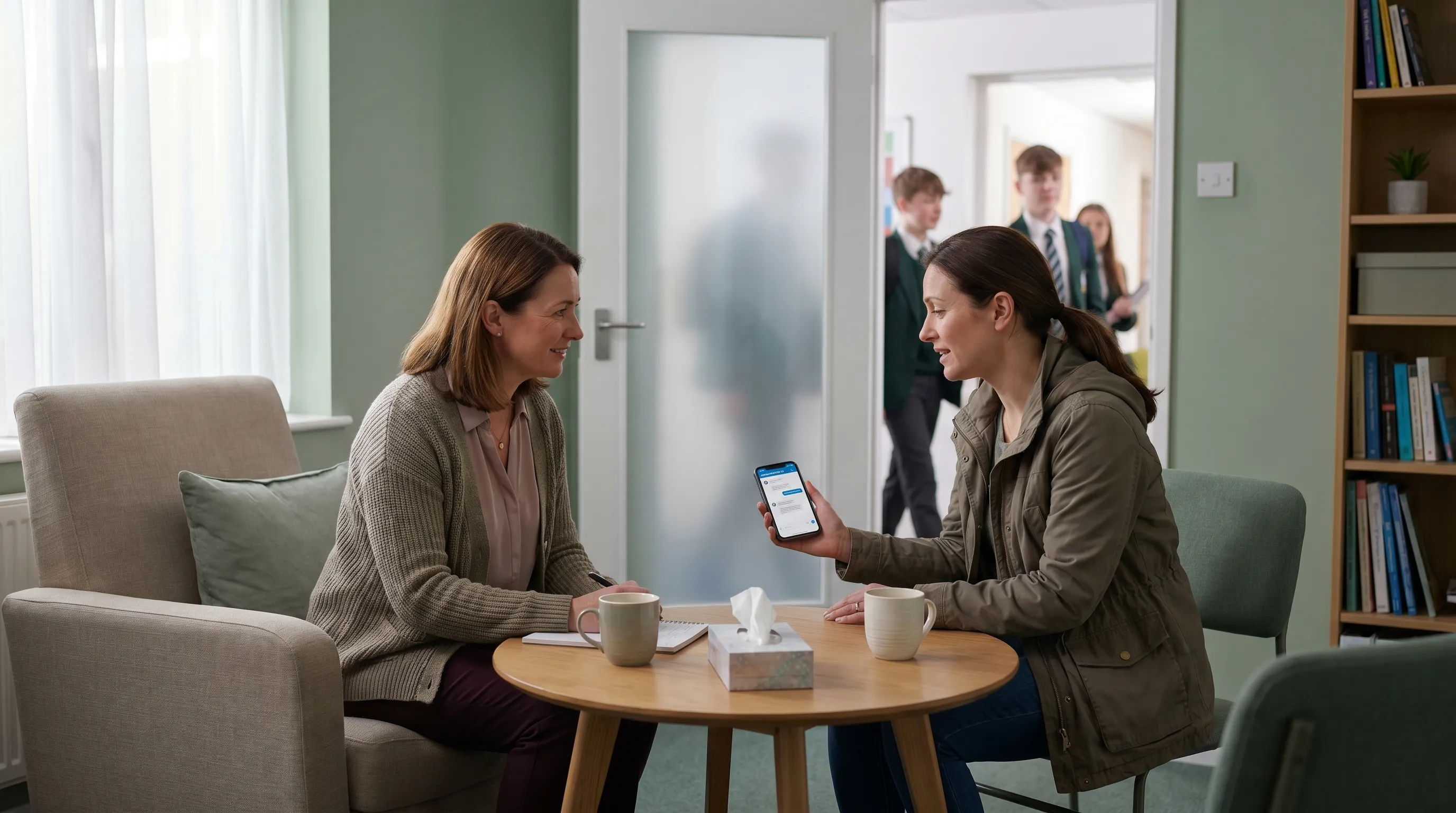
The child should hear one consistent message from two places, and that depends on the teacher and parent being able to talk quickly, without waiting for the next parents’ evening. A simple direct-message channel between the family and the class teacher is one way to do it: a two-line note about a bad night, a quick “she settled in five minutes” after drop-off. BeeNet’s direct and group messaging is one way schools set that up, and the schools overview shows how it fits with the rest of the school day.
References
- NHS, Anxiety in children.
- AAP HealthyChildren.org, Making baby’s drop-off at child care easier.
- AAP HealthyChildren.org, Help your child manage fears and anxieties.
- AACAP, Facts for Families: Anxiety and Children.
- Copeland, W. E. et al. (2014), JAMA Psychiatry, Great Smoky Mountains Study.
- James, A. C. et al. (2020), Cochrane Database of Systematic Reviews, CBT for anxiety in children and young people.
Ready to Transform Your School Communication?
Start saving time and increasing parent engagement with BeeNet.
Request Demo