Parallel Play: What It Is and When It Starts
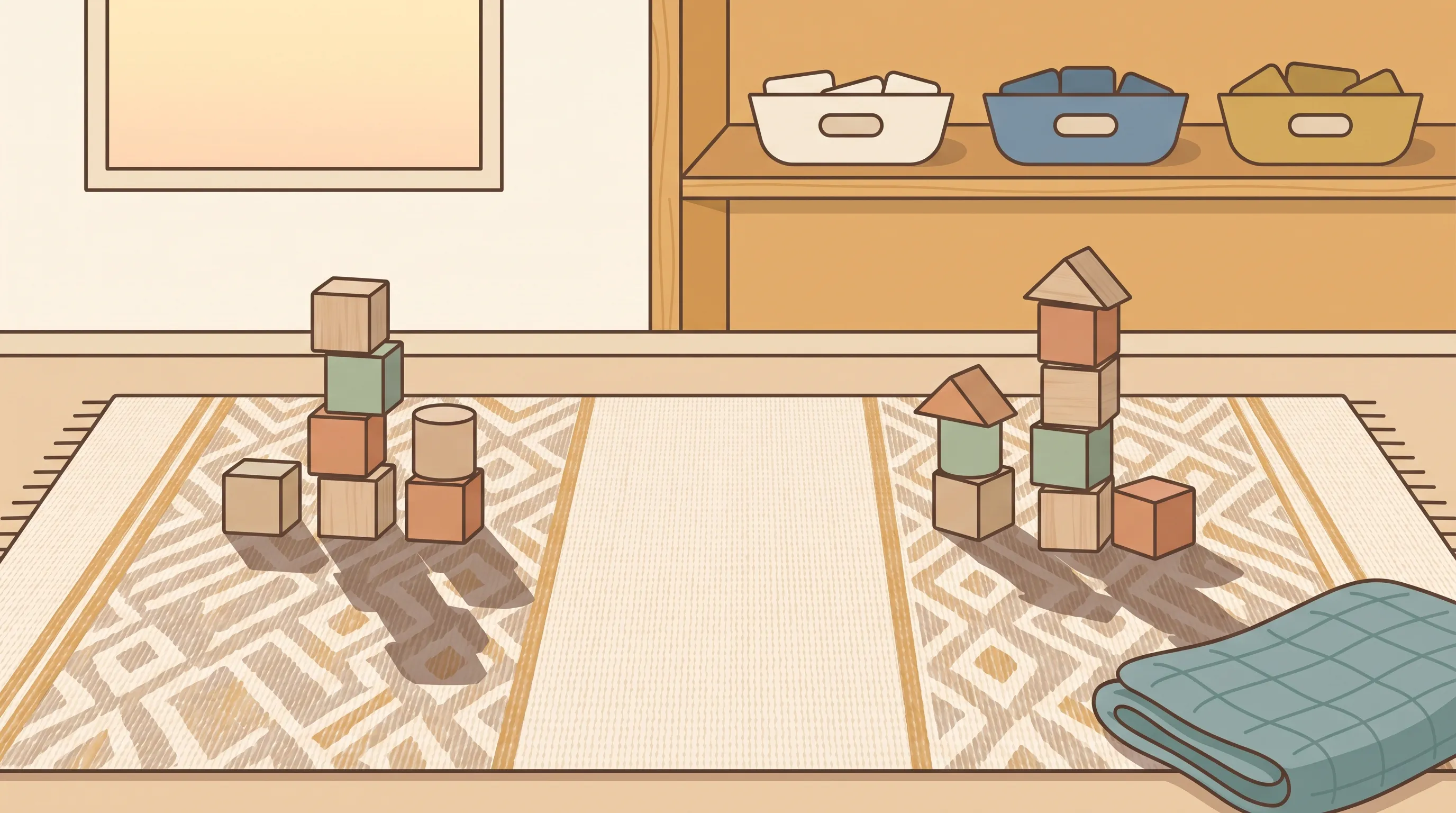
If your toddler sets up next to another child at the sandbox, both of them digging with their own shovels and barely trading a glance, that’s parallel play — children playing near each other, often with similar toys, without directly interacting. It’s not a sign your child is antisocial or behind. It’s one of the most well-documented, expected stages of early childhood, and it typically becomes the dominant way toddlers “play together” from around age 2.
What Is Parallel Play?
The term comes from researcher Mildred Parten, who observed preschoolers as part of her graduate research and, in a 1932 paper, sorted what she saw into six categories of increasing social complexity: unoccupied play, solitary play, onlooker play, parallel play, associative play, and cooperative play.1 Parallel play is the first of the social stages — the point where a child stops playing in total isolation and starts playing in the company of peers, even if not yet with them.
In parallel play, two children might sit at the same table with the same box of blocks, each building a separate tower, occasionally glancing at what the other is doing and copying a move — but not talking, sharing, or working toward anything together. They’re aware of each other. They’re just not yet collaborating.
When Does Parallel Play Start?
Most sources put the emergence of parallel play at around 2 years old, though the exact window varies depending on how narrowly a source draws the line between “parallel” and the stage before it (onlooker) and after it (associative). Some place its onset closer to 18 months and its tail end as late as 4 years, because different children — and different researchers — draw those boundaries slightly differently.2
The clearest anchor point comes from the CDC’s own developmental milestone checklist. Among the Social/Emotional milestones it lists for 2-year-olds: “Plays mainly beside other children, but is beginning to include other children, such as in chase games.”3 The same checklist tells parents plainly what to expect from a play date at this age: “children still play next to (not with) each other and don’t share well. For play dates, give the children lots of toys to play with. Watch the children closely and step in if they fight or argue.”
The American Academy of Pediatrics’ parent-facing guidance says much the same thing in blunter terms: two-year-olds “do not interact well with other children, even when playing side by side — that is, unless they want a toy or object from a playmate.”4
Is Parallel Play Normal, or Something to Worry About?
Normal. This is worth stating plainly, because it’s the single most common reason a parent searches for this term in the first place — watching a toddler ignore a same-age playmate for twenty straight minutes can feel like something is wrong.
It isn’t. It’s worth noting what the CDC’s own 2-year checklist does not flag as a concern: “doesn’t play with other children” is not on the list of reasons to talk to a doctor. The actual “act early” prompts for that age are about language (not yet using 2-word phrases), imitation (not copying actions or words), following instructions, walking steadily, or losing a skill the child previously had.3 Not playing cooperatively with peers at 2 isn’t one of them, because it isn’t unusual at 2 — it’s the expected behavior.
The CDC does note that the AAP recommends universal developmental and autism screening at the 24-month well-child visit — but that’s a routine part of every child’s checkup at that age, not a response triggered by parallel play specifically. If you have a concern about your child’s social development, the right move is the same one the CDC recommends for any milestone question: raise it with your child’s doctor, who has the fuller picture.
Why Parallel Play Matters
Parallel play isn’t a delay to work around — pediatric therapists describe it as doing real developmental work, just quietly. According to NAPA Center, a pediatric therapy provider, playing near peers (rather than directly with them) gives a toddler room to build several skills at once without the pressure of full social coordination:5
- Motor skills, by watching and copying what a peer does with a toy
- Comfort around other children, while the child still controls how much they engage
- Early empathy, through simply observing another child’s actions and reactions
- A sense of personal space and early sharing, from noticing “that’s their block, this is mine”
- Motivation to communicate, since wanting a peer’s attention (not just a caregiver’s) is a reason to start using words
That imitation piece shows up in AAP guidance too: despite a two-year-old’s apparent self-interest, “they’ll spend much of their playtime imitating other people’s mannerisms and activities,” which serves as “valuable rehearsals for future social encounters.”4 The child watching from six feet away isn’t checked out — they’re taking notes.
How to Support Parallel Play
You don’t need to engineer direct interaction, and pushing for it usually backfires. What actually helps is giving parallel play room to happen and trusting the child to move at their own pace.
In practice, that looks like:
- Duplicate materials, not shared ones. Two toddlers fight over one truck; they happily sit side by side with two trucks. NAPA Center’s tip here is straightforward: stock the play space with enough of the same toy that nobody has to negotiate yet.5
- Small, low-stakes playgroups. The AAP’s own advice is to start small — “at first it may be wise to limit the groups to two or three children” — rather than a big group, which raises the stakes for a toddler who isn’t ready to share attention across many peers at once.4
- Stepping back, not stepping in. The same AAP guidance is explicit that adults should “let the children guide themselves as much as possible. They need to learn how to play with one another, not with one another’s parents.” Narrate what you see (“You’re both building towers!”) rather than directing the children to play a specific way together.
- A quiet eye on conflict, without hovering. The CDC’s advice for this age pairs “give the children lots of toys” with “watch the children closely and step in if they fight or argue” — supervision, not orchestration.3
Parallel Play vs. the Other Types of Play
Parten’s six categories, in the order she observed them emerging, are useful less as a checklist to tick off and more as a map of what “playing together” looks like at different ages:12
| Stage | What it looks like |
|---|---|
| Unoccupied | No focused activity; wandering, watching, or random movement |
| Solitary | Playing alone, with little to no awareness of nearby children |
| Onlooker | Watching other children play, sometimes talking about it, without joining in |
| Parallel | Playing near other children, often with similar toys, without direct interaction |
| Associative | Interacting and sometimes trading materials, but without a shared goal or plan |
| Cooperative | Playing together toward a shared goal — building one thing together, or following the same game rules |
Play Stages Aren’t a Strict Ladder
It’s tempting to read that table as a staircase every child climbs once, in order, and never comes back down. The research doesn’t actually support treating it that way. A 2023 study in Clinical Child Psychology and Psychiatry found that more complex forms of play don’t simply replace simpler ones — children keep moving between solitary, parallel, and more interactive play well past the age any single category is supposed to have ended, and the line between “associative” and “cooperative” play in particular is genuinely hard to draw cleanly in practice.6 A three-year-old who spends part of a playdate in parallel play alongside more cooperative stretches isn’t regressing. That mix is normal too.
The Bottom Line
A toddler playing quietly next to another child, each absorbed in their own toy, is doing exactly what a two-year-old is supposed to be doing. The window for it is roughly the toddler and young-preschool years, it isn’t a red flag on its own, and it’s actively building the motor, empathy, and communication skills a child will use once they’re ready for more interactive play — usually sometime after age 3, and on their own timeline.
For families whose toddler is in daycare, a lot of that parallel-play stage happens somewhere the parent isn’t in the room. Some daycares now log a child’s day — activities, meals, naps, and mood — for parents to check once it’s posted, which is one way to get a window into how a toddler is playing when nobody’s watching from the sandbox. BeeNet’s daily recap feature is one option daycares use for this; it’s one part of a broader communication platform, not the only way a daycare might choose to keep parents in the loop.
References
Footnotes
-
Parten, M. B. (1932). “Social Participation among Preschool Children.” Journal of Abnormal and Social Psychology, 27(3), 243–269. Summarized in Parten’s stages of play, Wikipedia. ↩ ↩2
-
Parallel Play, EBSCO Research Starters. ↩ ↩2
-
Milestones by 2 Years, “Learn the Signs. Act Early.”, U.S. Centers for Disease Control and Prevention. ↩ ↩2 ↩3
-
Social Development: 2 Year Olds, HealthyChildren.org, American Academy of Pediatrics. ↩ ↩2 ↩3
-
What Is Parallel Play + 5 Ways It Benefits Your Child, NAPA Center. ↩ ↩2
-
Schuchert, S. A., Khattar, S., Tekkar, P., Rathour, A., Dawar, S., & Gupta, P. (2023). “Exploring social stages of play through eye to I© intervention model.” Clinical Child Psychology and Psychiatry, 29(3), 928–948. ↩
Ready to Transform Your School Communication?
Start saving time and increasing parent engagement with BeeNet.
Request Demo