Montessori Parenting: 7 Principles to Use at Home
Montessori parenting means bringing a handful of classroom ideas into your home: arrange things so your child can reach and use them, hand over real tasks, keep firm limits around other people’s needs, say less, and skip prizes and punishments. That list comes from Maria Montessori’s own writing, and it looks like a household where a small child is trusted to take part. One caveat up front: Montessori wrote about a school, and we found no study that tests a Montessori approach at home.
This guide covers seven principles that travel from her classroom to a kitchen, what the evidence behind them does and does not cover, and where popular “Montessori at home” advice drifts from the method. If you are choosing a school rather than a parenting style, start with our complete guide to Montessori education instead.
What Is Montessori Parenting?
Montessori parenting is a home-side adaptation of the method Maria Montessori developed for her Casa dei Bambini classrooms in Rome. The term is a later popularisation: her 1912 book, The Montessori Method, describes a school, with a teacher, specific materials and a group of children.1 Nobody inspects a living room for accreditation, so “Montessori parenting” has no official definition.
That is also why it pays to go back to the source. When we read the 1912 text, what survives the move home is a short list of practical ideas rather than a style of furniture. Marshall’s review in npj Science of Learning describes the classroom method in similar terms: hands-on materials, freedom to choose “what they work on, where they work, with whom they work, and for how long”, and “no system of extrinsic rewards or punishments”.2
Montessori Parenting Principles to Use at Home
1. Make the environment reachable
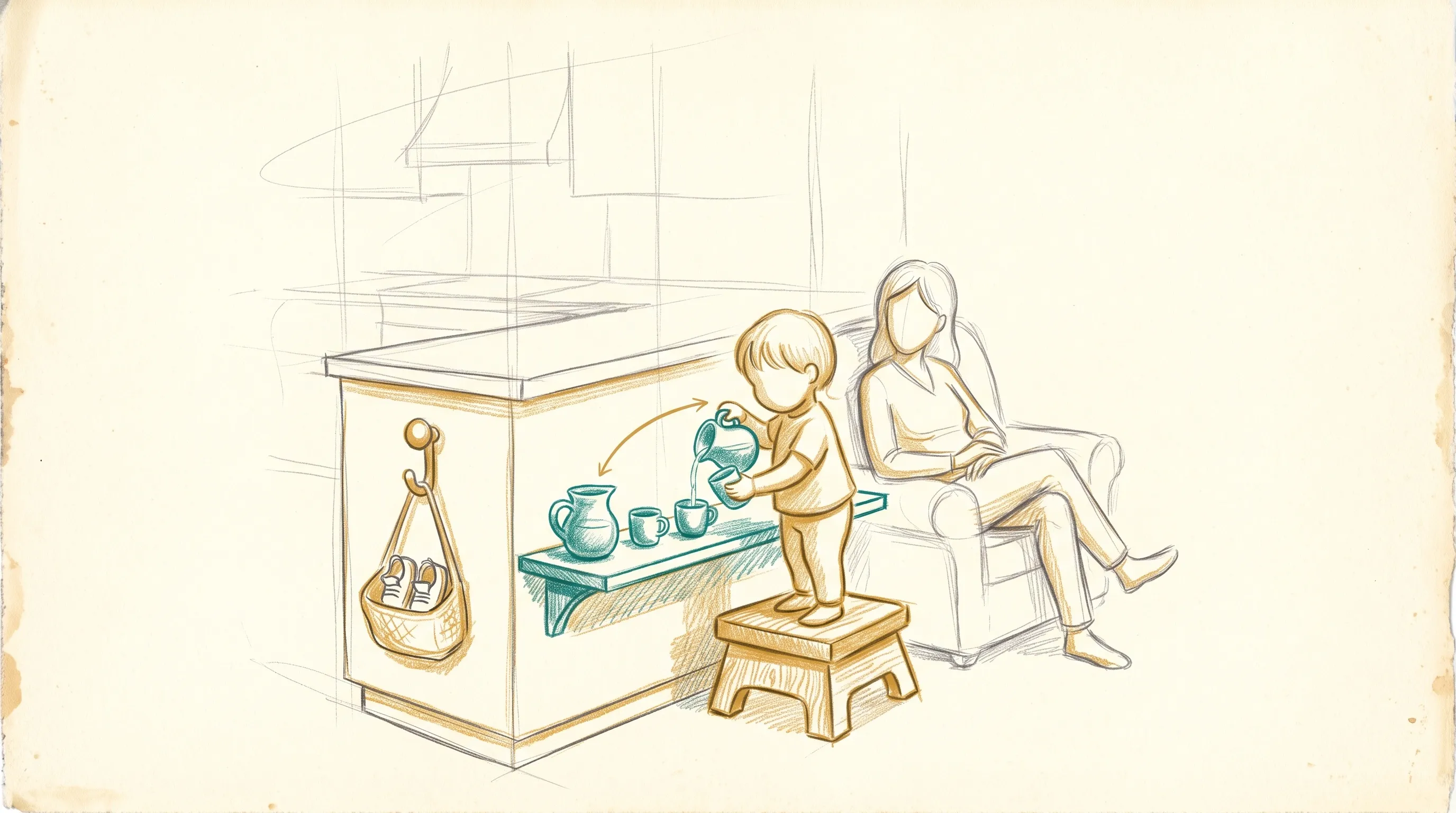
Montessori described a school where furniture was sized for children, including “a little washstand, so low that it can be used by even a three-year-old child.”1 The idea is that a child who can reach the cup, the coat hook and the cloth does not need an adult for each small job.
In practice, this looks like a low hook by the door for the coat, a stool at the sink, and one shelf of plates and cups the child is allowed to use. Or a small basket of the child’s own shoes by the door, so the morning routine begins with the child fetching them.
She also expected the objection that free-moving children “will overturn the little tables and chairs, producing noise and disorder” and called it “a prejudice which has long existed in the minds of those dealing with little children, and for which there is no real foundation.”1 Expect some noise and design for it.
2. Give real tasks, not pretend ones
Marshall lists the classroom’s practical-life work as pouring, using tools, cleaning and food preparation.2 At home, those are the jobs you already do. A child can wipe the table after a meal, pour water from a small jug, or wash vegetables for dinner.
Choose one daily job, such as wiping the table after breakfast, and keep it the same every day. Show it once, slowly, without speaking, then step back.
3. Keep freedom within limits
This is the principle most often lost in translation. Montessori’s own wording is firm: “The liberty of the child should have as its limit the collective interest; as its form, what we universally consider good breeding. We must, therefore, check in the child whatever offends or annoys others, or whatever tends toward rough or ill-bred acts.”1 She also wrote that “Discipline must come through liberty.”1
Read together, those lines describe choice inside boundaries, not permissiveness. A child can choose which of two cups to use and may not throw it at a sibling.
In practice, offer two acceptable options (“the red cup or the blue one?”) and hold the limit calmly when the answer is neither. The boundary is the other person’s comfort and safety, not your mood that day.
4. Show, then say less
Montessori wrote that lessons “are individual, and brevity must be one of their chief characteristics”, citing Dante: “Let thy words be counted.”1 For a parent, that argues for a short, slow demonstration over a stream of instruction.
When you teach a child to peel a banana or fasten a button, do it once at half speed with your hands visible, say nothing or one sentence, and let the child try. Resist stepping in when the first attempt is clumsy.
5. Skip prizes and punishments
Montessori had little patience for either: “Prizes and punishments are every-ready and efficient aids to the master who must force into a given attitude of mind and body those who are condemned to be his listeners.”1 Marshall confirms that classrooms using the method run without “extrinsic rewards or punishments”.2
At home, that means no sticker charts for chores and no removal of toys as a threat. It does not mean no consequences: the limit in principle 3 still applies, and the natural result of spilling juice is that you wipe it up together.
6. Let mistakes be visible
Montessori’s materials are designed so the child can see an error without an adult pointing it out. Marshall describes each piece as having “a ‘control of error’ which alerts the child to any mistakes, thereby allowing self-correction with minimal teacher support.”2
In practice, pick toys and tasks that show their own result: a puzzle whose last piece will not fit, a button that stays undone, a tower that falls. Hold back the correction for a moment and see whether your child spots it first.
7. Protect long stretches of concentration
In the classroom Marshall describes, children work through a three-hour “work cycle” in which they choose their own activities.2 No home can copy a classroom schedule, but the principle carries: when a child is absorbed in something harmless, do not interrupt it to move on.
Say your child is lining up spoons on the floor at 4:45 and dinner is at 5:00. A five-minute warning respects the work better than lifting the child out of it.
What the Research Shows About Montessori
The evidence base is real but narrow, and it concerns classrooms. A Campbell systematic review (Randolph and colleagues, 2023) included 32 studies, each required to show baseline equivalence between groups, and reported that Montessori education had “a meaningful and positive impact on child outcomes, both academic and nonacademic.”3 Effect sizes ranged from small to moderate: 0.26 for general academic ability, 0.22 for mathematics, 0.36 for executive function. The reviewers rated the evidence as high quality for general academic ability, mathematics and language, moderate for executive function and creativity, and low for social skills.3
A 2017 study of children admitted by randomized lottery to two public Montessori magnet schools in a high-poverty US city followed 141 children over three years. The Montessori group “fared better on measures of academic achievement, social understanding, and mastery orientation.”4
Both compare children in schools. Neither tests what a parent does in a kitchen.
Parenting Montessori Style: Where the Hype Outruns the Method
Any “Montessori at home” claim needs a few caveats beside it, and they matter more than the research summary.
The evidence is for schools. Writing in 2017, Marshall noted that “few studies are longitudinal in design” and that “there are no good quality randomised control trials.”2 Nothing in that literature says whether the same principles, practised by a busy parent, produce the same effects.
The same researcher appears again and again. Angeline Lillard is an author of the Campbell review, the 2017 lottery study and the 2013 essay cited below.345 Marshall, based at UCL, is not an author of those studies. None of that discredits the findings, but it is a reason to read them as encouraging rather than settled.
The label is loose. Marshall points out that “not all schools that call themselves ‘Montessori’ adhere strictly to Montessori principles, have trained Montessori teachers, or are accredited by a professional organisation.”2 The same looseness applies to products and parenting accounts. Our Montessori education guide explains how the name came to be unprotected.
Classical Montessori and play-based advice part ways on pretend play. Lillard’s 2013 essay notes that Maria Montessori “spoke negatively about a major component of playful learning—pretend play, or fantasy—for young children”, and reads the view against the Victorian fairy-tale culture of her day.5 You do not have to adopt that position, but it is part of the method you are borrowing from.
Aesthetics are not the method. Beige wooden toys and a low shelf can help, but nothing in the sources we read ties outcomes to how a room looks. In our reading, the reachable shelf matters because it lets a child act independently, not because it photographs well. That is our judgment, not a research finding.
If Your Child Attends a Montessori Setting
If your child is in a Montessori nursery or daycare, ask the teacher which tasks the child is working on and which of them you could share at home. Our guide to Montessori daycare cost, ratios and red flags covers what to ask before you enrol.
Many early-years settings share a daily summary with families: what a child did, ate, and how they seemed. BeeNet is one platform that does this; its daily recap lets educators log meals, naps, activities and mood for each child, so a parent can pick up the same threads at home. If you run or choose a setting and want to see how that works, the daycare overview is the place to start.
The Bottom Line
Pick two principles, not seven. Start with a reachable environment and one real daily task, and add the rest once those are habits. Keep the limits firm and the praise plain. Montessori gives a parent a way of looking: ask what your child could do for themselves if the house let them. The classroom evidence is encouraging, and a stool at the sink costs very little to try.
References
Footnotes
-
Maria Montessori, “The Montessori Method” (1912 English edition), Project Gutenberg #39863. ↩ ↩2 ↩3 ↩4 ↩5 ↩6 ↩7
-
Chloe Marshall, “Montessori education: a review of the evidence base”, npj Science of Learning 2, 11 (2017). ↩ ↩2 ↩3 ↩4 ↩5 ↩6 ↩7
-
Randolph et al., “Montessori education: a systematic review”, Campbell Systematic Reviews 19(3), e1330 (2023). Abstract. ↩ ↩2 ↩3
-
Lillard et al., “Montessori Preschool Elevates and Equalizes Child Outcomes: A Longitudinal Study”, Frontiers in Psychology (2017). ↩ ↩2
-
Angeline S. Lillard, “Playful Learning and Montessori Education”, American Journal of Play 5(2) (2013). ↩ ↩2
Ready to Transform Your School Communication?
Start saving time and increasing parent engagement with BeeNet.
Request Demo