Montessori Daycare Programs: Cost, Ratios, Red Flags
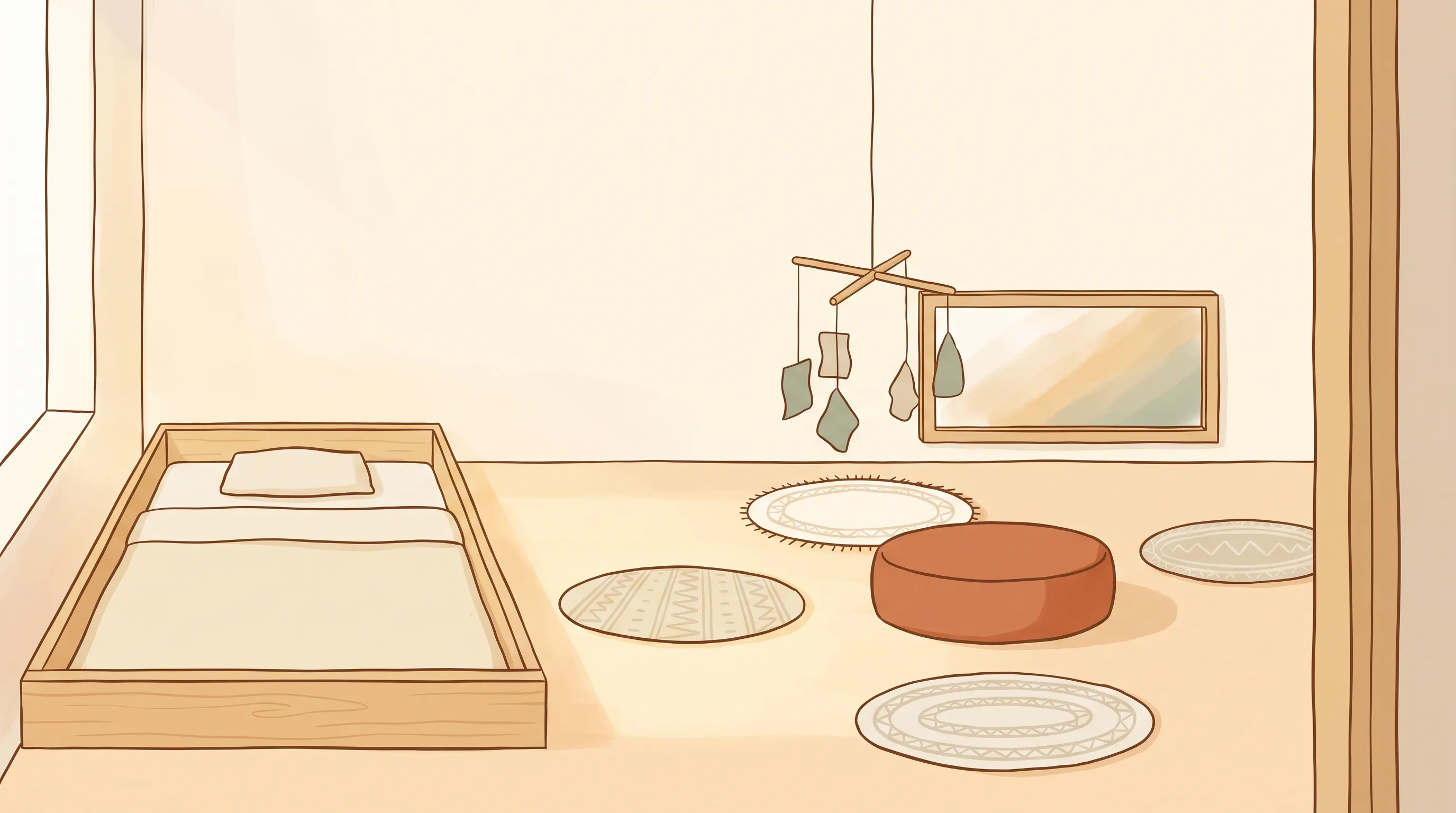
Search “montessori daycare programs” and most results assume you already know what you’re looking at. You probably don’t — and that’s not a knock on you. For children under three, Montessori isn’t one thing: it’s two distinct environments (Nido and Infant Community), staffed by whoever a center happened to hire, under a name nobody can legally control. Before you tour a single classroom, here’s what the label actually promises, what real programs charge and staff, and the specific questions that tell you whether “Montessori” on the sign means anything at all.
Nido and Infant Community: What “Montessori Daycare” Means Before Age Three
The Montessori classroom most people picture — child-sized furniture, a pink tower, sandpaper letters — is the Casa dei Bambini environment for ages 3 to 6, which BeeNet has already covered in full. Below age three, the Montessori world runs on different names and a separate training track entirely.
According to the Association Montessori Internationale (AMI), training for this age band splits into two environments. Nido (“nest,” in Italian) is built for children who aren’t walking yet — roughly from a couple of months old to somewhere around 14 to 18 months, though the exact cutoff reads more as a rule of thumb than a fixed boundary AMI publishes as law. Infant Community picks up from there and runs to around age three, when a child would typically move into a Casa dei Bambini. AMI’s own training arm describes its “Assistants to Infancy (0–3)” credential as covering “a Montessori Nido or Infant Community of children from birth to 3 years of age” — confirming the age scope, even if the precise month-by-month cutoff varies by program.
At both levels, the adult’s job is described less as teaching and more as guiding: providing a safe, engaging, nurturing environment, concentrating on sensory-motor and language development, and stepping back rather than instructing. If a daycare markets itself as “Montessori” for children under three, this — not the primary-level classroom you may already picture — is the actual reference point.
AMI, AMS, and MACTE: What “Accredited” Does — and Doesn’t — Cover
Two organizations dominate Montessori teacher training, and they read Dr. Montessori’s original method differently. Association Montessori Internationale (AMI) was founded by Maria Montessori herself, and its training stays close to her original sequence of lessons and materials — the more prescriptive of the two major pathways. The American Montessori Society (AMS), founded later to adapt the method for American schools, takes a broader, more flexible interpretation and is now the largest Montessori membership organization in the US.
A third name comes up constantly and gets misunderstood just as often: MACTE, the Montessori Accreditation Council for Teacher Education. MACTE doesn’t accredit daycares or schools — it accredits teacher-training programs. Most AMS training programs carry MACTE accreditation, and a number of AMI and independent programs do too, but AMI and AMS aren’t rivals to MACTE; both sit under it as recognized organizations whose graduates hold a MACTE-accredited credential.
The distinction that trips parents up: a daycare can tell you, honestly, that its lead teacher is “Montessori accredited” — meaning that teacher completed a MACTE-accredited training program — without the daycare itself being accredited by anyone. There’s no equivalent of a body that accredits Montessori daycares as a category the way, say, NAEYC accredits early-childhood programs generally. The accreditation, where it exists, lives with the person, not the building.
The Fact That Should Drive Every Tour: “Montessori” Isn’t a Protected Name
Here’s the fact that should organize everything else in this article: Maria Montessori never trademarked her own name, and in the 1960s a dispute between AMI and AMS led the US Patent Office to rule that “Montessori” is a generic term in the public domain — no single organization can claim exclusive rights to it. The practical result, as the nonprofit education-journalism outlet The Hechinger Report has put it, is that any school, anywhere, can call itself Montessori “with no training requirements, no inspections, no affiliation to any governing body, and no obligation to use any particular curriculum, materials, or teaching method.”
For an infant or toddler room, that matters more than it does at the primary level — not less. A four-year-old in a Casa dei Bambini is at least working with self-correcting materials that reveal their own mistakes as they go. A pre-walking infant in a “Montessori Nido” has no way to signal whether the room around them is genuinely prepared or is a standard nursery with a wooden shelf added and the word painted on the door — both are legally free to use the identical name. Verifying the difference is entirely on the adult doing the tour, not on the sign.
What Ratios and Cost Actually Look Like
There is no Montessori-specific ratio standard. Staff-to-child ratios for infant and toddler rooms are set by whatever childcare licensing authority governs that state or country — a Montessori label doesn’t change the legal minimum a center has to meet, and neither AMI nor AMS sets or enforces one of its own. One illustrative example, from Massachusetts childcare licensing: roughly one teacher per four toddlers, compared with about one per ten for preschool-age children. That’s a single US state’s rule, not a Montessori figure and not a number that transfers to another state, let alone another country — treat it as an illustration of why infant/toddler staffing is inherently more ratio-intensive, and costlier, than preschool, not as a benchmark to check a specific program against.
Cost follows the same logic: no central body sets Montessori tuition, so it varies by school, region, and age band. US consumer pricing guides commonly put general Montessori tuition at roughly $12,000–$18,000 a year, with infant and toddler programs running toward the higher end of that range — sometimes $13,000–$18,000 a year — specifically because of tighter staffing ratios and more intensive care needs. Expressed monthly, full-day Montessori infant care is often quoted around $1,500–$2,800, and toddler care around $1,300–$2,500. These are aggregated consumer-guide figures, not a government or Montessori-body dataset, and no equivalent numbers exist for BeeNet’s other markets — if you’re evaluating a program in France, Belgium, the Gulf, or elsewhere, ask the center directly rather than assuming a US range applies.
What to Look for on a Tour
Once you’re past the label, the room itself tells you more than any brochure. A few things worth checking in person, during active class time rather than an empty-room walkthrough (our questions to ask when a daycare says it has a learning program apply to any center, Montessori or not):
- Open, low shelves a child can reach. Materials should be organized, complete, and at a height where a child chooses and returns them without an adult’s help — not stacked in a closed cabinet “for later.”
- Real independence in daily routines. Watch whether toddlers are invited to feed themselves, use the toilet as part of what a genuine daycare potty-training program includes, wash their own hands, or put away their own materials — or whether staff quietly do these things for them out of habit or time pressure.
- A genuine mixed-age room. An authentic infant room typically groups a range of ages together — younger infants alongside a few who are already walking and talking — so children learn from each other, not only from adults. A room that’s really one narrow age band with Montessori-branded shelving added is a different thing.
- Ask specifically about the Assistants to Infancy credential. “Is your lead teacher AMI or AMS Assistants-to-Infancy trained, or from a MACTE-accredited program?” is the single most concrete, checkable question available, given that the name itself guarantees nothing (see above).
- Stay for at least 20–30 minutes, mid-morning. A five-minute walkthrough before drop-off or after pickup shows you an empty or transitioning room, not the environment in daily use.
- Trust the feel of the room — cautiously. Calm and purposeful versus loud and overstimulating is a real, if subjective, signal that experienced parents and providers both point to. Useful as a tiebreaker, not a substitute for the questions above.
If your child is still working through early sensory exploration, it’s also worth asking what materials are actually on the shelf day to day — BeeNet’s guide to sensory activities for toddlers covers what age-appropriate setups look like outside any Montessori-specific label, useful context for judging whether what you’re shown is developmentally real or staged for visitors.
Common Mistakes Parents Make When Evaluating “Montessori” Daycares
A few assumptions are worth dropping before you walk in:
- Assuming the name implies training. It doesn’t. “Montessori” on the sign confirms nothing about staff credentials, inspections, or curriculum fidelity — see above.
- Treating any quoted ratio as a Montessori standard. The binding number is whatever your local childcare licensing authority requires, not something AMI or AMS publishes.
- Confusing “Montessori accredited” with “this daycare is accredited.” MACTE accredits the teacher-training program an educator completed, not the building you’re touring. A center can employ zero MACTE-trained staff and still legally use the name.
- Expecting the same classroom you’ve read about for older children. The 0–3 Nido and Infant Community environment has its own age bands, materials, and training track — it isn’t a scaled-down version of the 3–6 classroom described in BeeNet’s full Montessori education guide, and a program genuinely following the infant-toddler track will look different, in specific and checkable ways, from a shrunk-down primary room.
None of this means Montessori daycares are worse than the alternative, or that the label is worthless — it means the label is a starting point for questions, not a substitute for them. A center that welcomes those questions, and can answer them specifically, is telling you something real. One that bristles at “which credential does your lead teacher hold?” is telling you something too.
For an educator who wants to see what genuine curriculum fidelity looks like on paper, our free Montessori method of teaching PDF lays out the five recognized curriculum areas week by week.
Once you’ve asked about training and watched the room, the last thing worth checking is more mundane but just as practical: how the center actually runs day to day, once you’re not there to see it. A program that can clearly show — not just promise — which staff are covering which room against the ratio their license requires, and that can tell you specifically what your toddler did that day rather than a generic “good day,” is usually the same program that took the training question seriously in the first place. Some daycares now handle both of those through software rather than a clipboard: tracking staff-to-child ratios per room against the rules that actually apply, and sending a daily recap home instead of a note stapled to a backpack. BeeNet’s ratio monitoring feature is one option built for exactly the first job, alongside daily updates for daycare and early-years programs more broadly — it has no Montessori-specific curriculum module and won’t tell you whether a lead teacher holds an AMI or AMS credential, but for the ordinary, daily accountability that separates a well-run program from a brochure, it’s one reasonable implementation path among several.
References
- Association Montessori Internationale (AMI). “Montessori 0–3.” https://montessori-ami.org/about-montessori/montessori-0-3
- Association Montessori Internationale (AMI). “AMI Classroom Assistants to Infancy (0–3) Certificate.” https://montessori-ami.org/training-programmes/qualifications/ami-classroom-assistants-certificate-assistants-infancy-0-3
- Montessori Northwest. “Assistants to Infancy.” https://montessori-nw.org/info-assistants-to-infancy
- Montessori Accreditation Council for Teacher Education (MACTE). https://www.macte.org/
- American Montessori Society (AMS). https://amshq.org/
- IMS Montessori. “Montessori in the Public Domain.” https://imsmontessori.org/news/montessori-community/montessori-in-the-public-domain/
- The Hechinger Report. “Will the Real Montessori Please Stand Up?” https://hechingerreport.org/will-the-real-montessori-please-stand-up/
- Beacon Montessori School. “Preschool Cost in Massachusetts.” https://beaconms.org/preschool-cost-massachusetts
- US infant/toddler tuition ranges are aggregated from multiple 2026 consumer childcare-pricing guides (including trustedcare.com, onespotapps.com, themontessorischools.org, firstquarterfinance.com, and daycarecostguide.com), cross-checked rather than drawn from a single source; treat as typical market ranges, not official statistics.



Ready to Transform Your School Communication?
Start saving time and increasing parent engagement with BeeNet.
Request Demo