Montessori Education: The Complete Guide
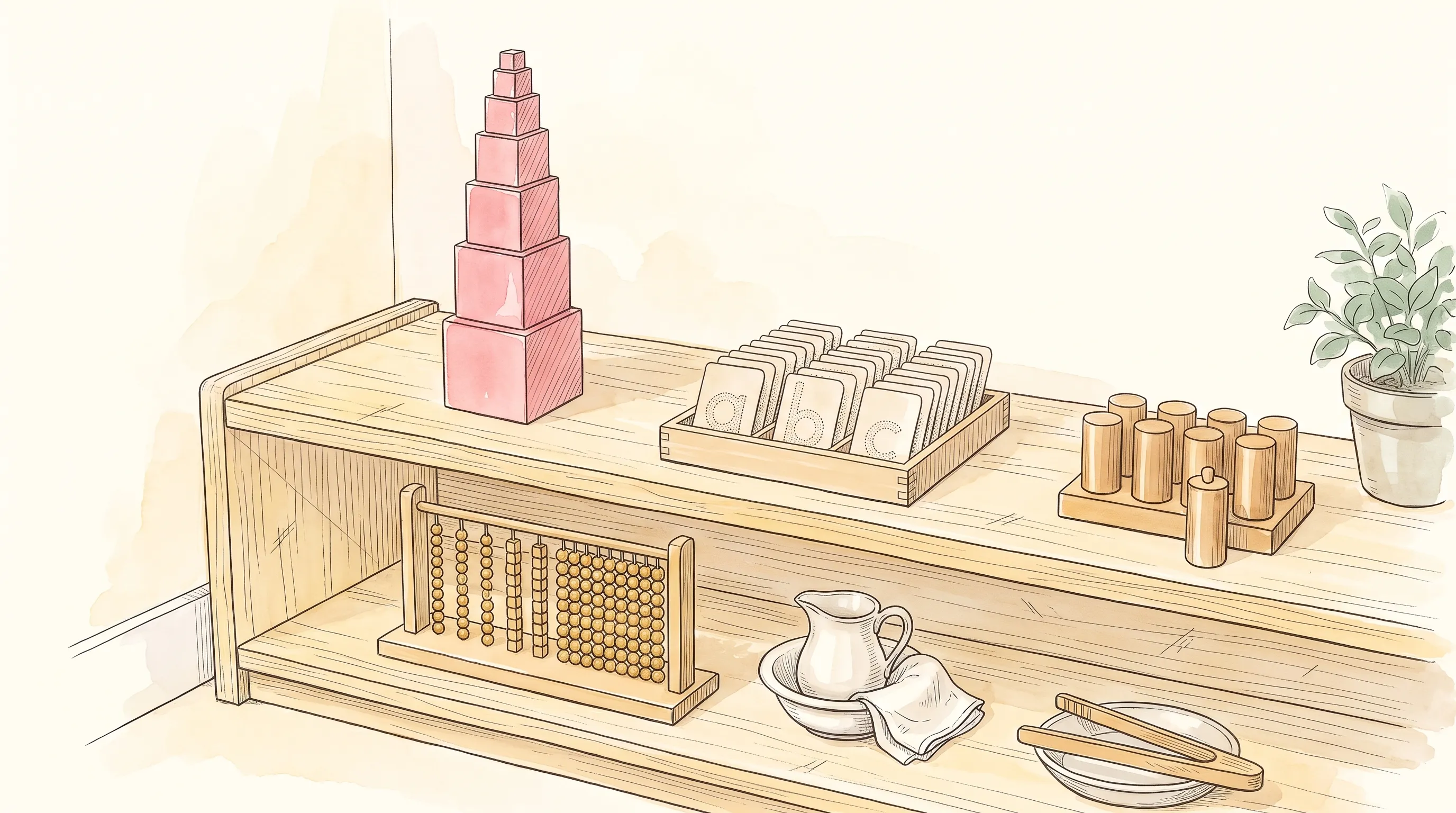
Montessori education is a teaching method built around a simple bet: children learn best when they choose their own work, move through it at their own pace, and are trusted to do real things with real materials — pouring water, buttoning a frame, tracing a sandpaper letter — instead of sitting through lessons pitched at a whole class at once. It is over a century old, used in an estimated 60,000 schools worldwide, and, legally, it is also an unregulated word: any school anywhere can put “Montessori” on its sign, whether or not a single teacher inside has ever been trained in the method. That single fact — more than the pink tower, the mixed-age classroom, or any research study — is the one thing every parent evaluating a Montessori program needs to understand before touching a single brochure.
This guide covers what Montessori education actually is, where it came from, what the two major accrediting bodies do and don’t guarantee, what the research says (and where it disagrees with itself), what it tends to cost, and the criticisms — historical and practical — that proponents don’t always volunteer.
What Is Montessori Education?
The American Montessori Society (AMS) describes it as “a holistic, experiential, child-directed system of education, developed by revolutionary educator Dr. Maria Montessori over a century ago.”1 Wikipedia’s working definition is more compact: “a type of educational method that encourages children’s natural interests and activities rather than formal teaching methods.”2 Both descriptions point at the same underlying design: hands-on learning, self-directed choice within a structured set of materials, and a deliberate move away from grades, tests, and lecture-format instruction.
It is not the absence of structure. A well-run Montessori classroom is arguably more structured than a conventional one — every material has one correct place on one specific shelf, every activity has a defined sequence, and a trained adult is always present, observing and redirecting. What’s different is where the structure sits: in the environment and the materials, not in a teacher standing at the front directing every child’s attention at the same time.
Who Was Maria Montessori?
Maria Montessori (1870–1952) was one of Italy’s first women to earn a medical degree, graduating from the University of Rome in 1896 in the face of significant gender discrimination.3 From 1896 to 1901 she worked with children with cognitive disabilities, drawing on the earlier pedagogical work of Jean Marc Gaspard Itard and Édouard Séguin — work that shaped the teaching materials she would later design.
The method as it’s known today began on 6 January 1907, when Montessori opened the first Casa dei Bambini (“Children’s House”) in Rome’s working-class San Lorenzo district, enrolling 50–60 children roughly aged 2 to 7. What she observed there — long stretches of deep concentration, a preference for repetition, and a strong sensitivity to order — became the empirical basis of the method. She published her first teacher-training course in 1909 and The Montessori Method in English in 1912, where it became a bestseller. In 1929 she co-founded the Association Montessori Internationale (AMI) with her son Mario, to protect and continue the work internationally.3
The Core Principles
Strip away the branding and Montessori programs share a common design, regardless of which organization certified them:
The Prepared Environment
Montessori classrooms are deliberately built for children, not adults: low, open shelves; child-sized furniture; natural materials over plastic; and a level of order and beauty that lets a child find, use, and return an activity without an adult’s help.2 The environment is treated as a teaching tool in its own right — a Montessori classroom without its prepared shelves isn’t really a Montessori classroom, even with a trained teacher standing in it. Parents who want to borrow some of these ideas for home can start with these Montessori parenting principles to use at home.
Mixed-Age Classrooms
Montessori classrooms are typically grouped into three-year spans — commonly ages 3–6 and 6–12 — matching what Montessori identified as distinct developmental “planes.”2 The rationale runs both directions: younger children learn by watching older peers and get an early look at what’s coming next, while older children reinforce their own mastery by teaching what they already know, building leadership and responsibility along the way. Children typically stay with the same teacher and peer group for the full three-year cycle, which both AMI- and AMS-aligned sources frame as building a stable, predictable relationship rather than a new classroom and new teacher every September.
Uninterrupted Work and Child-Led Choice
Rather than a bell-driven schedule of fixed periods, children choose their own work from the shelf and are given long, uninterrupted blocks of time to pursue it — commonly a few hours — with a trained adult observing rather than directing. The point isn’t unstructured free time; it’s depth. A child who is deeply absorbed in one activity is not interrupted to move on to the next thing on a schedule.
The Materials
Montessori materials are hands-on and self-correcting — designed so a child can see their own mistake without an adult pointing it out. Practical life materials (pouring, spooning, buttoning frames, food preparation) build independence and fine motor control, typically from around age 2.5. Sensorial materials — the pink tower, sound cylinders, color tablets — are built to isolate a single sensory variable at a time, a more structured cousin of open-ended sensory play. Language materials use tactile sandpaper letters and a moveable alphabet — a hands-on version of the same goal behind alphabet activities that pair letter names with sounds; math materials use concrete, countable representations like golden beads before ever moving to abstract numerals.
”Montessori” Is Not a Trademark — And That Changes Everything
Here is the fact that should shape how any parent reads a Montessori school’s marketing: in 1967, the US Patent and Trademark Office ruled that the word “Montessori” has “generic and/or descriptive significance” and denied it trademark protection.2 In practical terms, that means any school, anywhere in the US (and in most other countries), can legally call itself “Montessori” regardless of whether it follows a single principle of the method — no license required, no governing body’s permission needed.
The Philippines is a documented exception: a 1997 government order requires schools there to meet specific standards before using the name.2 Almost everywhere else, “Montessori” on a sign is a claim, not a credential.
This is precisely why accreditation bodies like AMI and AMS exist — not as a legal requirement, but as the only real quality signal available. As AMS puts it directly to families: “since ‘Montessori’ is in the public domain, it’s essential that schools and organizations are vetted to ensure they’re providing a quality experience.”1 A school’s affiliation or accreditation status is the closest thing to a warranty a parent is going to get.
AMI vs. AMS: What Accreditation Actually Means
Two organizations dominate Montessori accreditation, and they are not the same thing wearing two names.
Association Montessori Internationale (AMI) is the original body — the one Maria Montessori herself co-founded in 1929, and, per Wikipedia, “the sole Montessori organisation founded by Montessori herself.”4 It is Amsterdam-based, operates roughly 64 teacher-training centers across 32 countries, and counts over 5,200 members.4 Through its Scientific Pedagogy Group, AMI also has a hand in standardizing the physical materials themselves, maintaining contracts with authorized manufacturers.
American Montessori Society (AMS) started life as an AMI outpost. Mario Montessori appointed Nancy McCormick Rambusch as AMI’s US representative in 1958; in 1960 she founded AMS as a separate, independent organization rather than remaining a branch of AMI.4 AMS today offers three distinct services: AMS Affiliation (for schools and teacher-training programs committing to quality standards), AMS Accreditation (a more formal review for schools), and Credential & Transcript Services for individually trained teachers.1
Both organizations converge on the same essential elements when evaluating whether a program is genuinely Montessori: mixed-age classrooms, child choice of work, uninterrupted work blocks, a prepared environment, and trained teachers.2 Neither AMI nor AMS affiliation is legally required to use the Montessori name — which is exactly the point. It’s a voluntary quality signal in a category with no regulator.
Does Montessori Education Work? What the Research Actually Shows
The honest answer is: probably, for a lot of children, but not uniformly, and how faithfully a school implements the method appears to matter as much as whether it calls itself Montessori at all.
Several frequently cited studies point in a positive direction. Lillard and Else-Quest (2006), published in Science, reported that Montessori education fostered social and academic skills equal to or better than those seen in comparison schools. A 2007 study in the Journal of Research in Childhood Education found that Milwaukee students who attended Montessori public schools from ages 3 to 11 outperformed peers in high-school math and science. A 2017 study in Frontiers in Psychology used random lottery assignment — a methodologically stronger design than the usual observational comparison, because it sidesteps the problem of families who choose Montessori already differing from families who don’t — and found Montessori students scored higher on academic tests than peers randomly assigned to traditional public schools. More recently, a 2025 study in PNAS found Montessori kindergarteners showing better outcomes in reading, short-term memory, executive function, and social understanding.2
But the record is not unanimous. A 2017 study in npj Science of Learning found that positive effects were stronger in programs that adhered closely to the original method, and weaker in modern, adapted versions — fidelity, not the label, is what correlated with outcomes. A 2020 study in the Journal of School Choice found Montessori students scored lower in third-grade math but higher in English language arts than comparison students, with economically disadvantaged students showing the strongest gains — a genuinely mixed result, not a clean win. And a 2005 study of a Buffalo public Montessori magnet school, also in the Journal of Research in Childhood Education, found no evidence that Montessori enrollment improved academic achievement at all.2
Read honestly, that body of research supports a specific, more modest claim than “Montessori works”: several studies, including at least one randomized design, show Montessori students matching or outperforming peers on multiple measures — but results are not consistent across every subject or every implementation, and how closely a school actually practices the method appears to be a real moderating factor. Given that the name itself is unprotected, that last point is not a footnote — it is the whole ballgame.
The Real Criticisms of Montessori Education
Self-selection is the elephant in the room. Families who seek out and can afford (or win a lottery for) a Montessori program are, on average, different from families who don’t — more engaged, often better resourced. Controlling for that is genuinely hard, which is why the 2017 randomized-lottery study is treated as methodologically stronger than the older observational comparisons: it’s one of the few designs that actually isolates the method from who chooses it.
The name problem, again. Because “Montessori” carries no legal weight, a program can market itself as Montessori while running almost nothing like it — no trained staff, no prepared environment, materials bought once and never maintained. Some “Montessori-branded” programs have also folded in heavy digital-device use in ways that sit uneasily against the method’s core emphasis on tactile, hands-on materials — a tension worth asking about directly on a school tour, not assuming away because of the name on the door.
A more recent, and more serious, line of scholarship revisits Maria Montessori’s own historical views. A 2024 body of German academic scholarship, cited in Wikipedia’s overview of Montessori education, describes problematic thinking about racial hierarchy in her early-20th-century writing.2 That’s a real and documented critical reassessment — not a settled consensus with a single clean citation available here, but a reminder that a body of theory built more than a century ago carries the intellectual baggage of its era, even as the pedagogy itself has been revised continuously by practitioners since. A parent or educator taking Montessori seriously as a system should know that reassessment exists, not just the curriculum it produced.
What Does Montessori Education Cost?
There is no single answer, because there is no single Montessori — and that’s a direct consequence of the trademark point above. With no central licensing body setting fees, cost varies enormously by school, region, and whether the program is public or private.
Private Montessori programs are typically funded like other private schools: tuition-based, and often reflecting the cost of specialized teacher training and low child-to-material ratios. But Montessori is not exclusively a private-school phenomenon. Public and government-funded Montessori programs have existed since the 1950s, when some Montessori schools opened specifically to serve children from lower-income families — a trend that continues today.2 In the US specifically, a 2020 study identified 195 public Montessori schools across ten states,2 and Milwaukee’s public school system has run Montessori programs since at least the 1970s (it’s the same district behind the 2007 outcomes study cited above). Where a public or charter Montessori option exists and a family qualifies, the cost can be the same as any other public school place: free at the point of use.
The practical takeaway for a parent comparing options: don’t assume “Montessori” means “expensive private school.” Ask each specific program directly what it charges, whether it’s publicly funded, privately funded, or a hybrid — and whether that fee reflects AMI or AMS affiliation, or nothing more than the name on the sign.
How to Evaluate a Montessori School
Given that the name alone guarantees nothing, a short, concrete checklist does more good than any brand claim:
- Ask about AMI or AMS affiliation or accreditation directly, and ask what tier — affiliation is a lighter commitment than full accreditation. A program with neither may still be well run, but the absence is worth noting, not ignoring.
- Ask how teachers are trained, and by whom. A Montessori-certified lead teacher is a different thing from staff who attended a weekend workshop.
- Look at the room, not the brochure. Are shelves low, open, and organized by subject area? Are materials complete, or missing pieces? Is there a genuine mix of ages working independently, or is the room really running a single-age, teacher-led day with Montessori materials bolted on?
- Watch a work period, not just a tour. A prepared environment only proves the method if children are actually using it independently, for real stretches of time, with an adult observing rather than instructing.
- Ask what happens outside the classroom. How does the school communicate a child’s day — what they worked on, how they’re progressing through the curriculum, any incidents — back to families? A program that can’t answer that clearly is worth a second look regardless of how good the classroom itself looks.
For children under three specifically, Montessori splits into two distinct environments — Nido and Infant Community — where staffing ratios matter as much as any of the checklist items above. Our dedicated look at what a Montessori infant or toddler room actually costs and how it’s staffed covers real ratios and the specific questions worth asking on a tour at that age.
That last question isn’t incidental. Early-childhood programs — Montessori “Casa dei Bambini” classrooms very much included — increasingly run daily updates for parents through some kind of app rather than a paper note stapled inside a backpack: what a child ate, whether they napped, a photo or two, a short note on mood or a new material they tried. BeeNet’s daily recap feature covers exactly that gap for daycare and preschool-age programs, alongside developmental milestone tracking across the standard developmental domains. It has no Montessori-specific curriculum module — it isn’t a substitute for the pedagogy tools listed in our comparison of Montessori school management software — but for the ordinary, daily job of keeping families in the loop, it’s a reasonable option to have on the list.
The Bottom Line
Montessori is a coherent, century-old pedagogy with real developmental logic behind it — the prepared environment, the mixed-age classroom, the emphasis on hands-on materials and child-led work all trace back to careful observation, not marketing. The research leaning in its favor, including at least one randomized study, is genuinely encouraging. But none of that changes the one fact that should drive every actual decision: the word “Montessori” is unprotected, any school can use it, and fidelity to the method — not the sign out front — is what the evidence says actually matters. AMI and AMS affiliation are the closest thing to a quality signal this category has. Use it.
Related reading: Parallel Play: What It Is and When It Starts and Fine vs Gross Motor Skills: What’s the Difference? cover two developmental building blocks that show up constantly in Montessori’s own materials and mixed-age design.
Footnotes
-
American Montessori Society, “About Montessori” and “Why Choose Montessori”, seen 2026-08-20. ↩ ↩2 ↩3
-
Wikipedia, “Montessori education”, seen 2026-08-20. ↩ ↩2 ↩3 ↩4 ↩5 ↩6 ↩7 ↩8 ↩9 ↩10 ↩11
-
Wikipedia, “Maria Montessori”, seen 2026-08-20. ↩ ↩2
-
Wikipedia, “Association Montessori Internationale”, seen 2026-08-20. ↩ ↩2 ↩3
Ready to Transform Your School Communication?
Start saving time and increasing parent engagement with BeeNet.
Request Demo