Sensory Activities for Toddlers: Setup and Safety
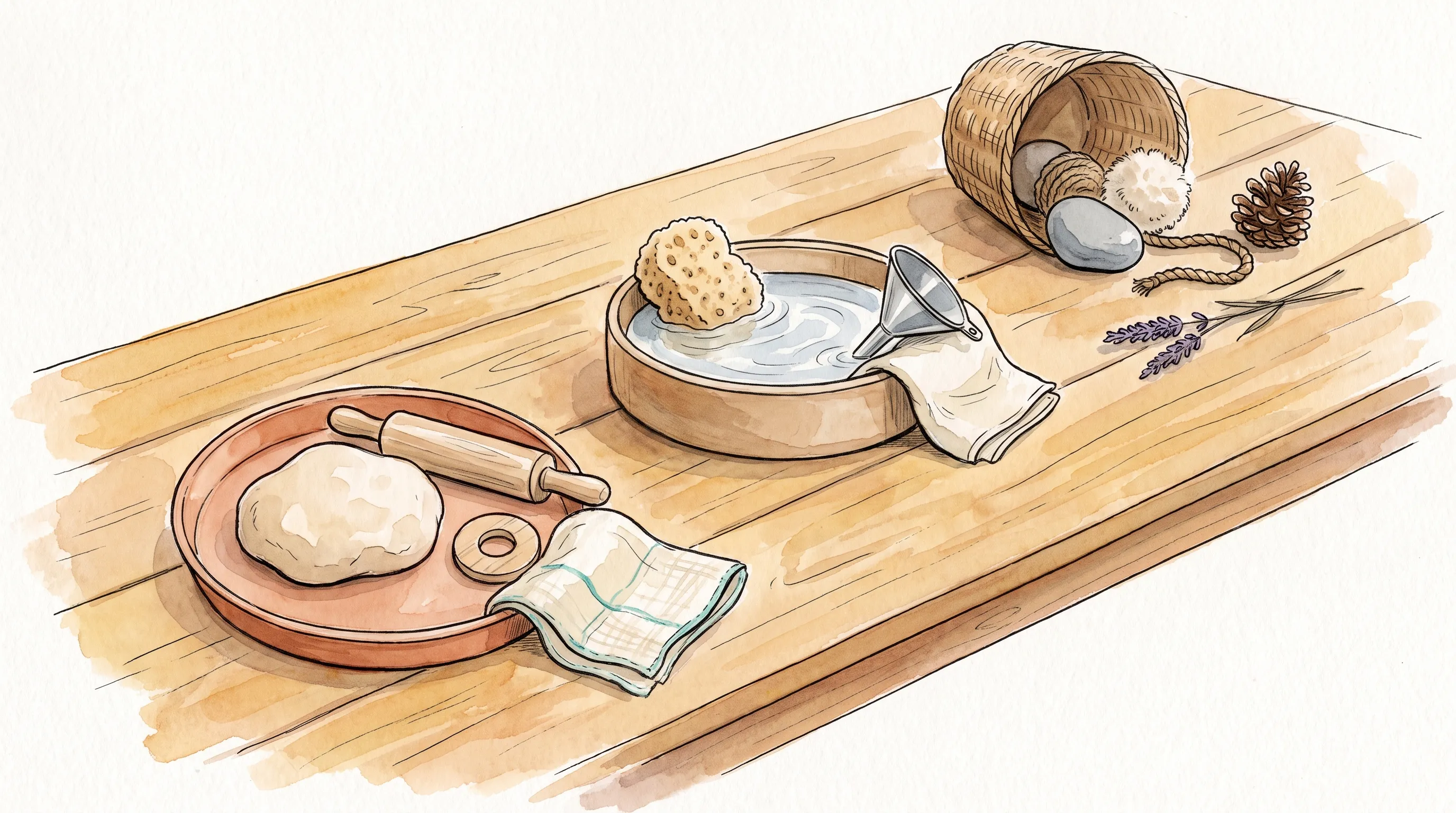
Sensory activities for toddlers are simple, hands-on setups — fill-and-dump bins, play dough, water play, texture baskets — that let a 1- to 3-year-old explore through touch, movement, and sound rather than through instruction. None of them need special equipment. What they need is the right materials for the child’s age, a realistic setup time, and a clear read on what can end up in a mouth. Below are ten toddler-tested activities, each with materials, setup time, mess level, what it develops, and a safety note specific to that activity — plus one section on the choking and allergen risks that apply across all of them. The same age-appropriateness filter applies to seasonal lists too — our breakdown of which Earth Day activities actually work for a 1- to 3-year-old, versus which ones are really a preschooler’s project, flags the same kind of mislabeled choking hazard that shows up in generic “toddler” roundups.
What Counts as a Sensory Activity for a Toddler
“Toddler” conventionally covers roughly 12 to 36 months. Zero to Three’s play guidance for this range groups useful activities into a handful of categories: repetitive fill-and-dump play, messy tactile play, water play, movement and musical games, and fine-motor manipulation — each tied to specific gains in language, hand-eye coordination, and confidence.[^1][^2]
The deeper theoretical case for sensory play — that structured tactile and movement input helps a child’s nervous system organize itself — comes from occupational therapist A. Jean Ayres’ sensory integration theory, developed from the 1950s onward. It’s a genuinely useful lens for planning activities, but it isn’t settled science: even researchers sympathetic to the theory describe the evidence base as limited, with methodological problems that newer studies are still working through.[^3] The honest version for a typically developing toddler: these activities are good, low-cost, engaging play with a plausible developmental rationale — not a clinical intervention, and not proof that skipping them holds a child back.
Fill, Dump, and Pour Play
Toddlers this age are drawn to actions they can repeat immediately and see the result of — full, then empty, then full again.
Fill-and-Dump Bin
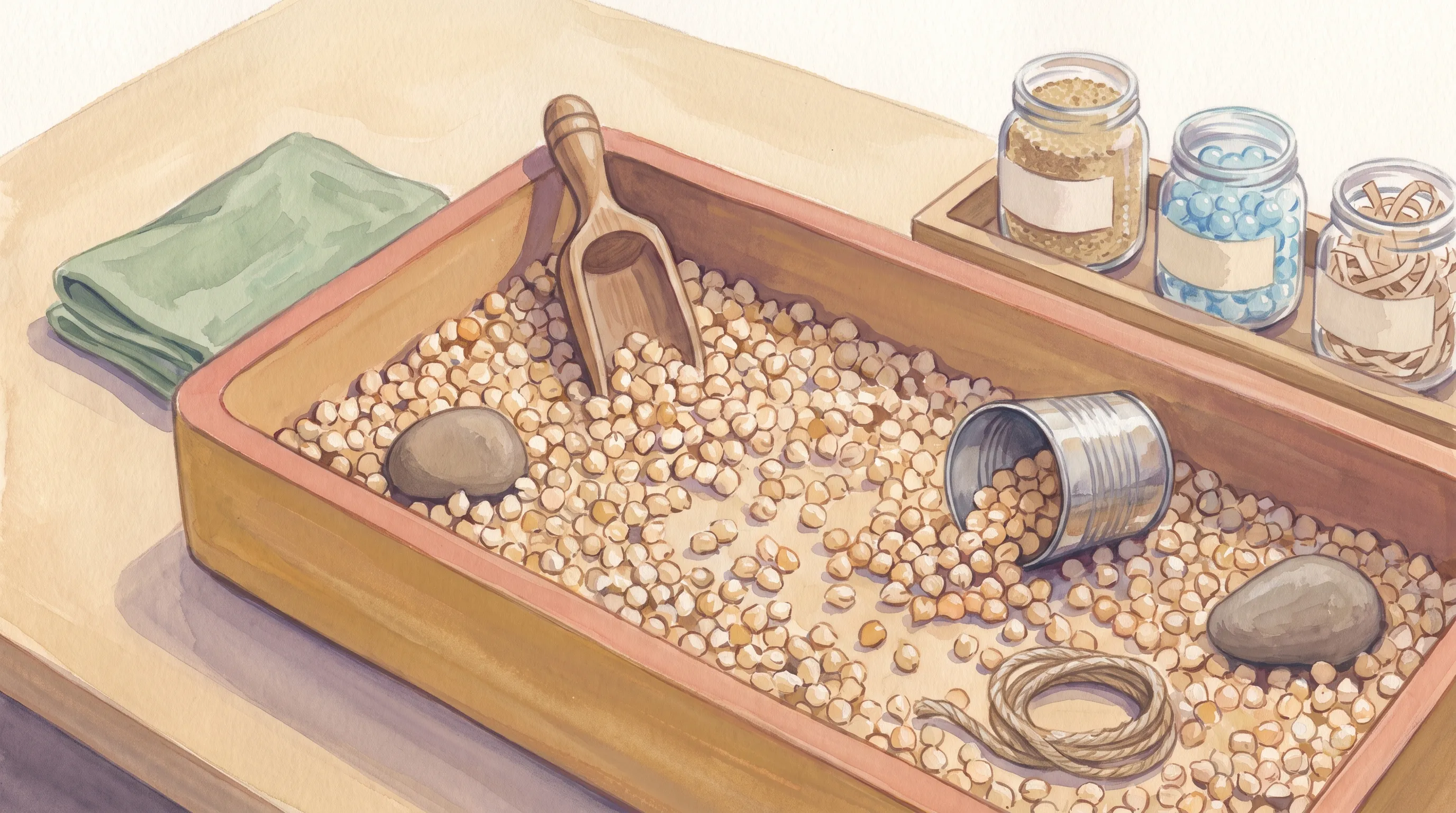
- Materials: a shallow bin or basin, a scoop or cup, and a filler — large dried pasta shells, dry oats, or water, depending on age (see the age-by-age filler rules in our sensory bin guide)
- Setup time: under 5 minutes
- Mess level: low to medium — contain it on a tray or towel
- Develops: the concept of full/empty and in/out, hand-eye coordination, early cause-and-effect reasoning[^1]
- Safety note: filler choice is the entire risk profile of this activity. Under 2, and for any toddler who still mouths objects, skip loose small fillers entirely and use water, cooked-and-cooled pasta, or oats instead — see the safety section below
Scoop-and-Pour Water Play
- Materials: a low basin with a few inches of water, plus sponges, funnels, and unbreakable cups
- Setup time: 5 minutes; do it outdoors or over a towel
- Mess level: high — wet floors are the main risk, not the water itself
- Develops: fine motor control (squeezing a sponge, aiming a funnel), early volume concepts, sustained attention[^1]
- Safety note: never leave a toddler alone with any standing water, even a few inches — active, in-the-room supervision the whole time, not just a check-in
Messy Tactile Play
Play Dough
- Materials: store-bought or homemade dough, plus a rolling pin and a couple of blunt cutters
- Setup time: 2 minutes with store-bought; 15 minutes if making it from flour, salt, oil, and water
- Mess level: low if kept on a tray; homemade dough tracks flour further than store-bought
- Develops: hand and finger strength that later supports pencil grip, plus basic shape and texture vocabulary
- Safety note: homemade dough is usually wheat-based — check for a gluten or wheat allergy on file before offering it to any child in a group setting, and have a non-wheat alternative (e.g., a taste-safe oat-based dough) ready
Cornflour Gloop (Oobleck)
- Materials: cornflour (cornstarch) and water, mixed roughly 2:1, in a shallow tray
- Setup time: 5 minutes
- Mess level: high — it’s a genuine two-hands-in activity and dries chalky on surfaces
- Develops: cause-and-effect (it acts solid under pressure, liquid at rest), sensory tolerance for an unusual texture, descriptive vocabulary
- Safety note: not for a toddler who still reliably mouths objects — a fistful of cornflour is not a choking hazard in the CPSC small-parts sense, but it isn’t meant to be eaten, and supervision needs to be close enough to intervene
Texture and Nature Play
Texture Basket
- Materials: 4-6 safe household items with contrasting textures — a soft cloth, a smooth stone, a bumpy ball, a cool metal spoon, a soft brush
- Setup time: under 5 minutes, using items already in the house
- Mess level: none
- Develops: descriptive vocabulary (“rough,” “cold,” “soft”), tactile discrimination
- Safety note: every item must clear a real choking check — nothing that fits entirely inside a standard toilet-paper tube, and nothing with small detachable parts
Nature Texture Tray
- Materials: pinecones, smooth leaves, large stones, and bark collected on a walk, laid out on a tray
- Setup time: the length of a short walk plus 5 minutes to arrange
- Mess level: low — mostly dirt on hands, easy to wash off
- Develops: visual and tactile contrast, outdoor vocabulary, fine motor pincer grip picking up small items
- Safety note: size-check every item for the child’s current mouthing stage; skip pinecones and small stones for a toddler who still explores objects by mouth, and rinse anything a dog or bird could have touched
Movement and Sound Play
Zero to Three’s guidance for this age band explicitly separates “circle games” — the movement-based cousin of circle time — active, movement-based group play — from the seated listening activities that come later in preschool. At 1-3, sensory play through the body is the norm, not an add-on.[^1][^2]
Shaker Bottles and a Kitchen-Spoon Band
- Materials: empty, well-sealed plastic bottles with rice or dried beans inside (hot-glue or tape the lid shut), or simply pots and wooden spoons
- Setup time: 5 minutes to assemble shakers; instant with pots and spoons
- Mess level: none, if bottles are properly sealed
- Develops: auditory discrimination, rhythm, turn-taking if played with an adult or sibling
- Safety note: a shaker bottle is only as safe as its seal — check it every time before handing it over, since a toddler who gets the lid off has direct access to a genuine choking hazard (dried beans and rice both fail the standard small-parts test)
Indoor Obstacle Course
- Materials: couch cushions, a low stool to climb over, a blanket “tunnel” between two chairs
- Setup time: 5-10 minutes
- Mess level: none
- Develops: gross motor skills, balance, vestibular input from climbing and crawling, following simple sequential instructions
- Safety note: anchor anything a toddler might pull down on themselves (unsecured furniture, lightweight stools); keep the course low enough that a fall lands on carpet or cushions, not a hard floor
Fine-Motor Manipulative Play
Shape Sorters and Simple Puzzles
- Materials: a shape sorter or 3-5 piece wooden puzzle
- Setup time: none — pull it off the shelf
- Mess level: none
- Develops: problem-solving, hand-eye coordination, spatial reasoning
- Safety note: buy sorter pieces sized for the toddler’s age band specifically — some shape-sorter sets aimed at 3+ include pieces small enough to fail the choking-hazard test for a 1- or 2-year-old sibling in the same room
Finger Painting
- Materials: non-toxic finger paint, a laminated sheet or tray, and a smock or old shirt
- Setup time: 5 minutes
- Mess level: high on hands and clothes; low on surfaces if using a tray
- Develops: fine motor control, color recognition, early mark-making that precedes drawing
- Safety note: confirm the paint is labeled non-toxic and taste-safe — toddlers this age routinely taste-test whatever is on their hands, and this is the one activity on this list where that’s expected, not a lapse in supervision
Safety Notes That Apply Across Every Activity
Two risks show up in some form in nearly every sensory activity on this list, and they deserve their own section rather than being buried in each entry.
Mouthing and choking. There’s no single age where a toddler reliably stops putting objects in their mouth — it’s individual, and for many toddlers it persists well past their first birthday. The U.S. Consumer Product Safety Commission’s small-parts test is the concrete standard to apply: anything that fits entirely inside a cylinder roughly 1.25 by 2.25 inches, in any orientation, is a choking hazard for a child under 3.[^4] The American Academy of Pediatrics adds a matching food-specific list — hot dogs, whole grapes, nuts, seeds, popcorn, hard candy, and thick peanut butter are kept away from children until at least age 4, and any round firm food is only safe chopped into pieces smaller than half an inch.[^4] None of this list of AAP guidance was written with sensory-bin fillers specifically in mind, but the same logic applies directly: dried beans, rice, and small pasta shapes all fail the same small-parts test, which is why the age-by-age filler breakdown in our sensory bin guide treats them as off-limits before age 2-3, not just “supervise closely.”
Allergens. No sensory activity involving flour, dairy, or nut products should go ahead in a group setting without checking each enrolled child’s allergy record first — wheat-based play dough, cloud dough made with baby oil and flour, and any “taste-safe” recipe built on a food base all carry the same risk as serving that food at snack time, because a toddler handling it will put their hands in their mouth. Keep a non-food alternative (kinetic sand, a store-bought hypoallergenic dough) ready rather than skipping sensory play for a child with a food allergy.
Nursery, Preschool, or Home: What Actually Changes
The activities themselves don’t change much by setting — a fill-and-dump bin works the same way at home as it does in a nursery room. What changes is supervision ratio and how the activity gets tracked. As children age out of this range and into the preschool years, the setting shifts again — from individual sensory stations toward the rotating group blocks covered in our guide to summer camp activities for preschoolers. A nursery or daycare room typically runs a higher adult-to-child ratio specifically for messy and water play, and many settings log which sensory activities a child did as part of ongoing developmental observation rather than as a one-off note. At home, the practical difference is mostly that one-to-one attention, not a different kind of play.
For toddler-room educators, that observation habit is worth taking seriously — sensory play is genuine, repeatable evidence of where a child sits on fine motor and language development, not just a way to fill twenty minutes. Some daycare platforms build a place for that directly: BeeNet, for example, lets educators log an activity like a texture basket or water play session in a child’s daily recap alongside meals and naps, and track it against developmental milestones across five domains with a report a parent can actually keep. It’s one way to turn “we did sensory play today” into a record that means something six months later — not the only way, and not the reason to run these activities in the first place, which remains simply that toddlers learn through their hands.
References
- Zero to Three. “Learning Through Play: 12 to 24 Months.” https://www.zerotothree.org/resource/learning-through-play-12-to-24-months/
- Zero to Three. “Learning Through Play: 24 to 36 Months.” https://www.zerotothree.org/resource/learning-through-play-24-to-36-months/
- Wikipedia. “Sensory integration therapy.” https://en.wikipedia.org/wiki/Sensory_integration_therapy
- HealthyChildren.org (American Academy of Pediatrics). “Choking Prevention.” https://www.healthychildren.org/English/health-issues/injuries-emergencies/Pages/Choking-Prevention.aspx
Ready to Transform Your School Communication?
Start saving time and increasing parent engagement with BeeNet.
Request Demo