Sensory Bin Guide: Fillers, Setup, Safety
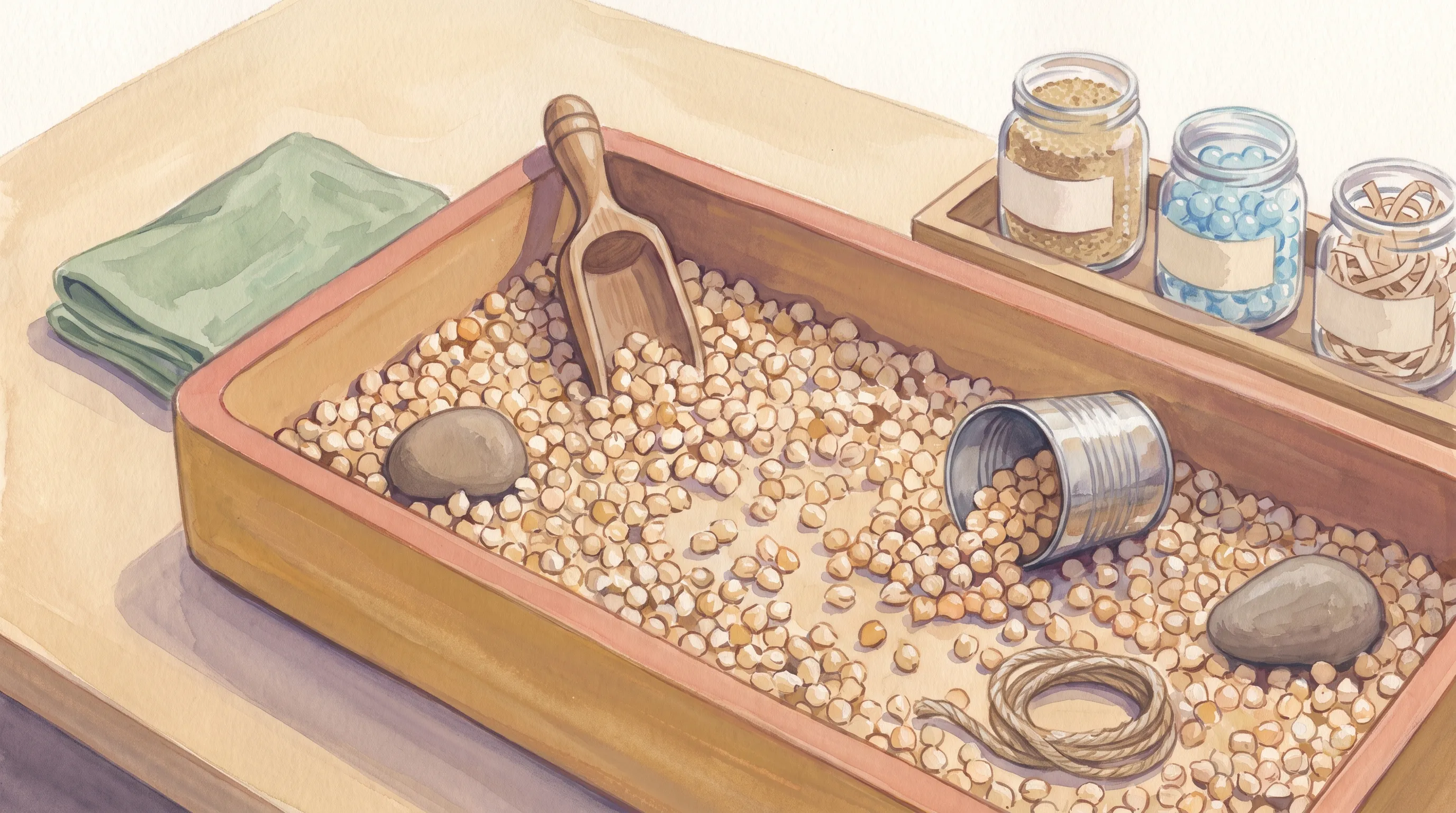
A sensory bin is a shallow container filled with a safe, texture-varied material — rice, dried pasta, water beads, sand, shredded paper — plus small tools and objects for a child to scoop, pour, sort, and dig through with their hands. It’s one of the simplest activities in early childhood education: five minutes to set up, no batteries, and it keeps a toddler or preschooler genuinely engaged for far longer than most toys manage. It’s also one of the easiest to get wrong on safety, because the most popular filler on Pinterest — water beads — has become a real enough hazard that the U.S. government wrote a new federal safety standard for it in 2025.
This guide covers what a sensory bin actually does for a child’s development, how to set one up in under ten minutes, which fillers are safe at which age (and which ones aren’t, no matter the age), and a set of theme ideas that don’t require a supply run.
Why Sensory Bins Matter for Development
Pediatric occupational and recreational therapists recommend sensory bins as a low-cost way to work several developmental skills at once, not because a specific clinical trial tested sensory bins directly, but because the underlying actions map onto well-established occupational therapy goals. Cleveland Clinic’s clinical team — recreational therapist Leah Young and occupational therapist Suzanne Messer — describe sensory play as supporting six overlapping areas: language (children build vocabulary narrating what they feel, see, and smell), fine motor skills (scooping, pinching, and pouring strengthen the same small-muscle coordination needed later for using a pencil or buttoning a coat), gross motor skills, cognitive growth through open-ended problem-solving, social skills when bins are shared, and self-regulation — as Messer puts it, “sensory play can be used to help regulate your overall arousal level,” meaning the same repetitive scooping motion can calm an overstimulated child or gently engage an understimulated one.
It’s worth being precise about what that evidence is and isn’t. A 2025 systematic review in Frontiers in Pediatrics, covering 21 studies and 675 children with autism, ADHD, or sensory processing differences, found strong trial-level evidence for only a couple of specific sensory interventions — deep-pressure input and caregiver training — and its included studies did not cover tactile bin-style play on its own. That doesn’t mean sensory bins don’t work; it means the case for them is professional practice consensus built on how fine motor and language development generally happen, not a clinical trial with a sensory bin as its intervention. Treat “supports development” as well-grounded, everyday-practice advice — not as a medical claim.
How to Set Up a Sensory Bin
The setup takes about the same time as pouring a bowl of cereal:
- Pick a container. A large plastic storage bin, an under-bed box, or even a baking sheet with raised edges works. Depth of 3-4 inches is enough — you want surface area for digging, not a bucket a toddler has to reach into.
- Choose one base filler (see the age-by-age list below) and fill it to about 2-3 inches deep. Less than that and there’s nothing to dig through; more and cleanup gets harder for no added play value.
- Add 2-4 tools. Measuring cups, a small shovel, tongs, a funnel, or a slotted spoon give the hands something structured to do beyond just touching — this is where most of the fine motor benefit comes from.
- Add 3-6 “find and sort” objects relevant to a theme — plastic animals, buttons, foam letters, pom-poms — sized appropriately for the child’s age (see below).
- Put it on a surface you don’t mind getting messy, or on a towel/shower curtain if you want easy cleanup. Outdoors or on tile beats carpet.
- Supervise actively, especially for children under 3. A sensory bin is not a “set it and walk away” activity at that age — see the safety section below for why.
Safe Sensory Bin Fillers by Age
The single most important sensory bin decision is the filler, because it’s the thing most likely to end up in a mouth. The U.S. Consumer Product Safety Commission has a precise legal test for this: the small-parts test cylinder is 1.25 inches wide and 2.25 inches long — “the approximate measure of a fully-expanded throat of a child under the age of three.” Anything that fits entirely inside that cylinder, in any orientation, without being squeezed, is a banned choking hazard on any product made for children under 3 (16 CFR Part 1501.4). That standard is the baseline for every age range below.
Under 12 months. Skip the traditional sensory bin. At this age, everything goes in the mouth, and no dry filler passes the small-parts test. Sensory exploration for babies means edible, single-ingredient options under direct supervision — cooked, cooled pasta shapes, mashed banana, or a water table with just water and a cup — not a bin of loose material.
12-24 months. Filler must be either edible or too large to swallow whole: large uncooked pasta shells, dry oats, shredded paper, cooked and cooled rice (not raw), or large cotton balls. No beads, no buttons, no small pom-poms, no dry rice or beans loose in a bin — all of those pass the CPSC’s small-parts test and are realistic choking risks at this age regardless of how often you’ve seen them in a Pinterest photo.
2-3 years. Most children have outgrown reflexive mouthing by now, but not all — individual variation is wide, and supervision still matters. Dry rice, dry beans, kinetic sand, and craft pom-poms become reasonable with active, in-the-room supervision. Small figurines and buttons are still a stretch; if you use them, pick pieces visibly larger than the CPSC cylinder.
3 years and up. The full range opens up: dry rice, beans, sand, small pasta, buttons, pom-poms, foam letters, small figurines, and water beads become age-appropriate — with one significant caveat on that last one, covered next.
The Water Bead Problem
Water beads — the small polymer balls that swell from pinhead-size to marble-size in water — are the single most popular sensory bin filler in online searches, and they’re also the filler responsible for a real, documented safety problem. Water beads are made from superabsorbent polymers that can expand 150 to 1,500 times their original size in water — and critically, they don’t stop absorbing fluid once swallowed. A 2024 case-series review in the Journal of Paediatrics and Child Health found only 12 published cases of water-bead ingestion causing intestinal obstruction worldwide (11 of them in children under 2), with roughly 30% involving complications and one fatal case, a 6-month-old who died of sepsis after a delayed diagnosis. Separately, the U.S. Consumer Product Safety Commission’s own emergency-room surveillance recorded around 7,000 water-bead-related ingestion injuries in the U.S. between 2018 and 2022, and has confirmed at least one additional infant death. Because water beads are also nearly invisible once dropped on a floor or carpet, they’re a real risk even to infants and toddlers who were never given the sensory bin at all but crawl through where an older sibling played with one. In August 2025, CPSC approved a new federal consumer product safety standard specifically for water bead toys, aimed at reducing exactly this injury pattern.
None of that means water beads are banned outright for older children. It means: use them only with children old enough to reliably not put things in their mouth, supervise the activity directly rather than from another room, do a floor check afterward, and store the container somewhere a younger sibling can’t reach it later. If there’s any child under 3 in the house — including one who just crawls through occasionally — water beads are not the filler to reach for.
Sensory Bin Theme Ideas
A theme gives the “find and sort” objects a reason to exist and keeps the same base filler feeling new. A few that need little more than what’s already in a craft drawer or kitchen:
- Ocean bin: blue-dyed rice or dry rice, plastic sea animals, seashells, a small net for scooping.
- Farm bin: dry oats or dried corn kernels (3+), plastic farm animals, small buckets.
- Construction bin: kinetic sand or dry beans, toy trucks, small rocks, a scoop.
- Alphabet bin: dry rice, foam or magnetic letters, tweezers for picking out a letter and naming it.
- Fall/autumn bin: dried leaves, pinecones, acorns (size-check for age), small pumpkins.
- Color-sorting bin: dry pasta dyed in 4-5 colors, matching cups for sorting by color.
Rotating the theme, not the base filler, is the efficient move — one bag of dry rice can become an ocean bin, then an alphabet bin, then a color-sort bin across a few weeks with different add-ins. If you’re mapping those themes onto a broader weekly schedule, our free preschool lesson plan template gives each day’s circle time, activity, and materials list one place to live.
Cleaning, Storage, and Reuse
Most dry fillers (rice, dried pasta, oats) can be reused for weeks if kept dry and covered between sessions — a lidded bin or a large zip bag works. Toss any filler that gets wet, sneezed on, or that a child has put in their mouth; dry grains and pasta mold quickly once damp, and there’s no practical way to fully sanitize loose grain filler. In a group setting — home daycare, preschool classroom — any tool or object a child mouths should come out of the bin immediately and either go through a dishwasher-safe wash or the trash if it’s not washable, and the whole bin should be emptied and wiped down between different groups of children, not just refilled on top of the old material.
For Daycares and Preschool Classrooms
Sensory bins are common enough in daycare and preschool programs that they’re worth thinking about as more than a one-off activity. If a child regularly practices scooping, pouring, and pinching in a sensory bin, that’s genuine fine-motor-skill repetition an educator may want to note somewhere a parent can actually see it — not just as a nice-to-know, but as part of tracking where a child sits against typical developmental milestones. Some daycare and preschool platforms build this in directly: BeeNet, for instance, lets educators log daily activities like sensory play in a child’s daily recap alongside meals, naps, and mood, and separately track progress against fine-motor and four other developmental domains with a PDF report a parent can keep. For centers doing this on paper instead, our free cognitive development observation sample gives that same dated, evidence-based note a consistent structure. It’s one way to connect an activity like this to the bigger picture of a child’s development — not the only way, and not the point of running a sensory bin in the first place, which remains simply: it’s cheap, it’s flexible, and kids genuinely like it.
References
- Cleveland Clinic. “What Is Sensory Play? The Benefits For Your Child and Sensory Play Ideas.” Published March 18, 2022. https://health.clevelandclinic.org/benefits-of-sensory-play-ideas
- Piller, A., McHugh Conlin, W., Glennon, T., Andelin, L., Auld-Wright, C., Teng, C., & Tarver, T. “Systematic review of sensory-based interventions for children and youth (2015-2024).” Frontiers in Pediatrics, published November 13, 2025. https://www.frontiersin.org/journals/pediatrics/articles/10.3389/fped.2025.1720179/full
- U.S. Consumer Product Safety Commission. Small parts / choking hazard standard, 16 CFR Part 1501.4 (test cylinder specification). Summarized via ComplianceGate. https://www.compliancegate.com/small-parts-regulations-warnings-united-states/
- Bollettini, T., et al. “Water beads: Expanding toy and ‘new’ problem for paediatric surgeons and community.” Journal of Paediatrics and Child Health, December 2024. https://pmc.ncbi.nlm.nih.gov/articles/PMC11834137/
- U.S. Consumer Product Safety Commission, water bead injury data and 2025 federal safety standard, reported via USA Today. Updated March 23, 2024. https://www.yahoo.com/news/water-beads-pose-huge-safety-203806111.html
Ready to Transform Your School Communication?
Start saving time and increasing parent engagement with BeeNet.
Request Demo