France's Lycée Phone Ban: What Collèges Learned the Hard Way

Because no lycée has run France’s national phone ban for even a single day — it takes effect September 1, 2026 — the best evidence available for what lycée administrators are about to face is what happened roughly two weeks into the equivalent collège rollout a year earlier. That record is the single best predictor anyone has for rentrée 2026, precisely because the honest answer to “what’s working one month into the lycée phone ban” is that nobody knows yet: it hasn’t started, and anyone publishing results before it has is guessing.
That distinction matters, because the temptation to treat the collège numbers as ancient history is strong, and wrong. Lycées are structurally different from collèges — bigger, older students, more legitimate reasons to carry a phone during the day. But the sources documenting the run-up to September 1 keep circling back to the same collège data point, because it’s the only real evidence anyone has about what happens when a French secondary school tries to enforce this rule at scale.
The Lycée Phone Ban Hasn’t Had Its One Month Yet
The circular that finalizes the lycée rules — MENE2617958C, published July 2, 2026 — sets out a vademecum requiring each lycée to consult its teaching teams and student council (CVL) before finalizing local rules, and to fold digital-citizenship education in alongside the ban itself, according to reporting on the circular’s contents Le Café pédagogique. Bruno Devauchelle, writing for the same outlet, is openly skeptical of the whole exercise, calling it “un constat d’échec” — a statement of failure — and arguing the school system isn’t driving the underlying digital-culture shift so much as retreating from it Le Café pédagogique.
That critique is worth sitting with, because it’s a July 2026 opinion about a rule that hadn’t been tried yet — not a report on results. Everything published about the lycée ban so far, including the ministry’s own circular, the Senate exchange about it, and the vendor guides selling storage pouches for it, predates September 1. A union representative quoted by L’Étudiant went so far as to estimate that full implementation “may take approximately one year” — effectively conceding that the September 2026 launch is a soft start, not a finished system L’Étudiant. Anyone publishing lycée-specific “here’s what’s working one month in” results before October 2026 is, at best, guessing.
What Two Weeks Into the Collège Ban Actually Looked Like
The collège version of this policy — “portable en pause” — was generalized across public collèges in September 2025. Two weeks later, the national principals’ union SNPDEN-UNSA presented survey results at a September 12, 2025 press conference, and they were blunt: only 8.5% of collèges had actually implemented a working system. In a separate question about intent to apply the rule, 67% of principals said they had no plan to apply it at all, while another 42.8% said they supported the goal but found the mechanics too complicated to pull off VousNousIls.
Staffing was the recurring explanation. SNPDEN-UNSA secretary general Bruno Bobkiewicz put it directly: “Il faut des moyens humains, des assistants d’éducation et du personnel pour récupérer les téléphones à l’entrée ou favoriser les retours autonomes” — you need human resources, education assistants, and staff to collect phones at the entrance or manage their return VousNousIls. Separate data cited in the same reporting found 73% of collèges were missing a complete educational team and 60% were short at least one teacher — a staffing gap that made adding a new daily collection-and-return duty close to impossible in many buildings. The equipment itself wasn’t free either: roughly €4,000 per 400-student collège, largely unfunded by the state and absorbed from budgets that would otherwise pay for field trips or classroom projects.
It’s worth being precise about what this data does and doesn’t show. It’s a self-reported union survey, not a controlled study, and it measures whether schools implemented the device-based system — not whether it worked once implemented. Bobkiewicz himself offered a genuinely useful counterpoint: the older, simpler 2018 rule (no confiscation device required, just a plain prohibition) had already pushed phone use to “close to 0%” in several schools, without any of the equipment cost or staffing burden. That’s a regulatory observation from the union’s own experience, not a causal finding — but it’s a strong hint that enforcement discipline, not hardware, may be the load-bearing variable.
Why the Collège Playbook Doesn’t Transfer Directly
Lycées aren’t just bigger collèges. A vendor guide aimed at proviseurs preparing for September lays out the structural gap clearly: lycées typically run 2–3 times the enrollment of a collège, serve students who are legally adults or close to it, many with authorized campus-exit privileges between classes, and rely on phones for more legitimate school business Montelsurpause. Pronote grade access and cafeteria payment are both explicitly preserved as exemptions in the July circular L’Étudiant. If those factors — larger scale, students who are legally adults or close to it, legitimate daily uses for a phone — hold across most lycées, a full-day, collect-at-the-door model calibrated for a much smaller collège population may not scale as cleanly to a bigger campus where many students can legally leave the building at lunch.
Funding runs through a different door too. Collège equipment is funded by départements; lycée equipment is funded by conseils régionaux — a separate budget authority with its own cycle. The vendor guide’s advice follows from that: start the funding conversation with the région early, rather than assuming the collège process or timeline applies Montelsurpause. The Senate record confirms the resource gap was real going into the rollout: while the ministry described pilot results as “très positifs,” with roughly 80% of participating collèges reporting favorable outcomes, Senator Agnès Canayer flagged that 70% of chefs d’établissement lacked adequate resources heading into the wider rollout — a figure worth reading with the caveat that “participating” pilot collèges are a self-selected group, not a representative sample Sénat.
Each lycée also writes its own zone and exemption rules into its règlement intérieur, rather than applying one national template. One administrator described the model to L’Étudiant this way: phones banned in hallways and buildings, but permitted in a defined courtyard zone — with discipline following a graduated ladder from warning to confiscation to, in repeat cases, a conseil de discipline referral L’Étudiant.
What’s Actually Working: The Lessons Lycée Admins Are Applying Early
None of this is “one month in” lycée evidence. But three specific responses to the collège shortfall show up repeatedly in the lead-up reporting, and they’re concrete enough to act on now.
Ask the regional council this week, not after rentrée
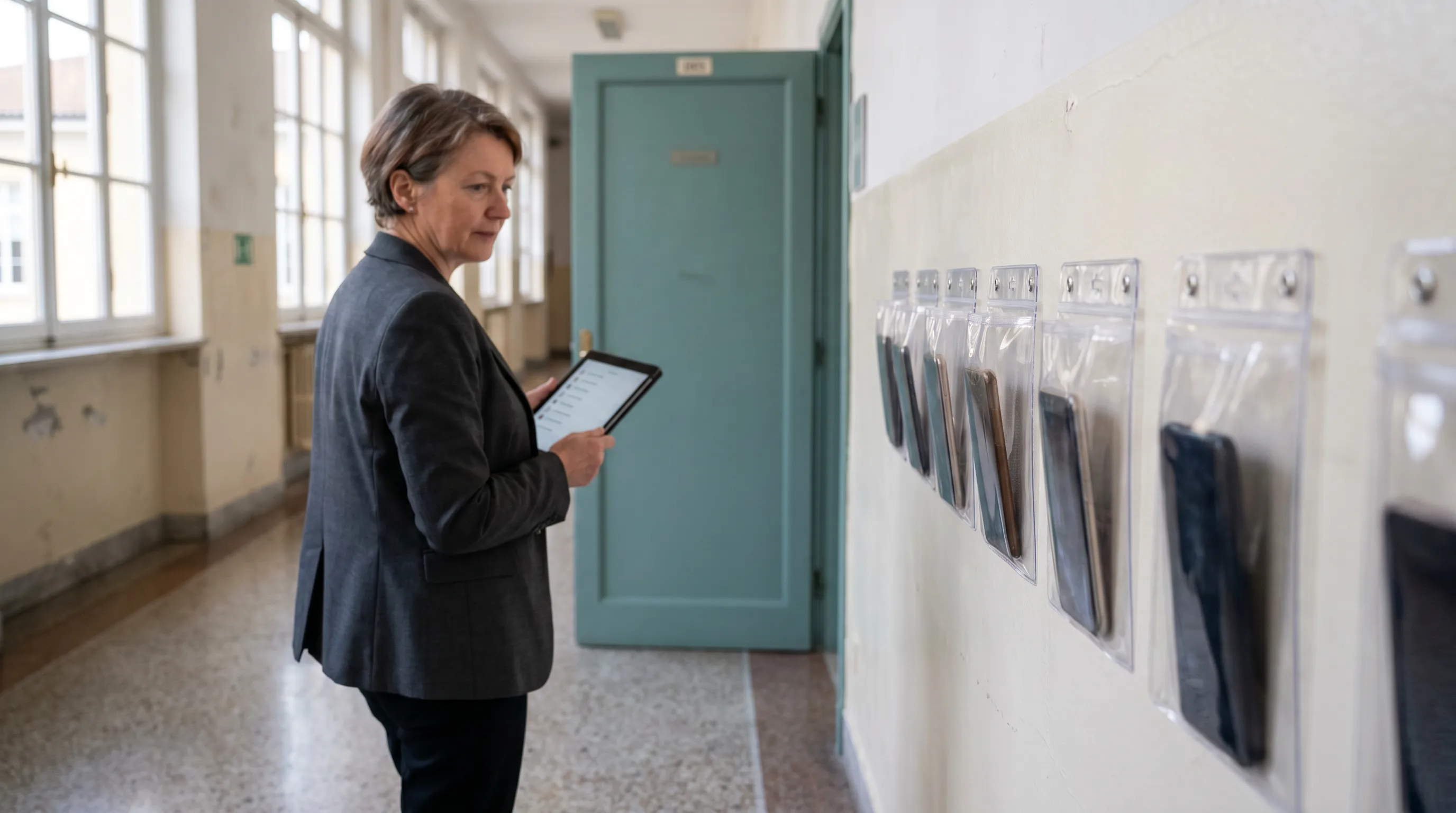
The vendor guide’s cost figures give administrators something to bring to that conversation: classroom-only pouch storage runs roughly €7–15 per student — for a 1,200-student lycée, that scales to an estimated €8,400–18,000 total, described as under 3% of an annual operational budget when amortized over two to four years. The guide lists a separate, more expensive full-day storage tier but doesn’t attach a specific cost to it Montelsurpause. A practical version of that outreach, with roughly four weeks left before rentrée: the lycée’s gestionnaire sends a two-paragraph funding request to the conseil régional now, flagged as urgent given the compressed timeline, citing those per-student figures and asking for a decision fast enough to order equipment before September 1 — rather than waiting on a routine budget cycle built for a longer runway.
Staff the door before day one, not after week two
Bobkiewicz’s core complaint about the collège rollout was that nobody had assigned actual people to actual collection points. A lycée applying that lesson might assign two surveillants specifically to phone collection at its two busiest entrances for the first two weeks of term, rather than leaving every teacher to enforce the rule solo at their own classroom door.
Consider whether the rule needs equipment at all
Given Bobkiewicz’s own observation that the plain 2018 prohibition — no pouches, no lockers — already drove usage near zero in some schools, a lycée with thin staffing might reasonably start with a zone-only, no-equipment model this September and add pouches later if enforcement gaps appear, rather than committing budget to hardware before knowing whether it’s needed.
The Sequencing Lesson: Set It Up Before Rentrée, Not After
The clearest answer from the collège experience isn’t about equipment — it’s about sequencing. Schools that struggled weren’t, by and large, opposed to the rule; SNPDEN-UNSA’s own survey found 42.8% supported the principle but found the logistics too complicated to execute in time. That’s a sequencing failure, not a buy-in failure.
The July circular’s consultation requirement — teaching teams and the CVL are consulted, with final approval resting with the conseil d’administration, before the règlement intérieur is finalized — is the mechanism built to prevent a repeat. In practice, for lycées that haven’t already convened it, that means scheduling a CVL meeting as a dedicated first-week-of-term agenda item — before locking the règlement intérieur for the year — rather than defaulting to a rule announced without consultation and revisited later. Once the rule is voted, a single message goes out to every parent the week before rentrée, on one channel: something like “Starting Sept. 1, phones are stored in [classroom pouches / the courtyard zone] from 8:05 a.m. to 4:30 p.m. Pronote and cafeteria payment stay accessible. Full rules: [link].” One message, sent once, from one platform beats a mix of photocopied notices and word-of-mouth relayed through students who, after September 1, won’t be checking their phones between classes to relay it.
Keeping Everyone Coordinated Once the Ban Is Live
The collège data points to staffing shortages and unfunded equipment as the main reasons the rollout stumbled; none of the six sources cited here quantify communication failures specifically. But the same reporting does establish that each lycée writes its own zone and exemption rules into its règlement intérieur rather than applying one national template — which means, by design, no two lycées will be communicating identical rules to their communities. However a lycée solves for people and pouches, someone still has to get its finalized règlement intérieur, its zone and exemption rules, and any later changes to them, in front of every student, parent, and staff member at once — and a school-specific rule set is harder to communicate informally, at lycée scale, than a single national policy would be.
Purpose-built school communication platforms exist specifically for this kind of coordination problem: one place to publish the finalized règlement intérieur, notify every parent when zone or exemption rules change, brief staff on the discipline ladder, and log confiscations without a shared paper notebook at the front office. BeeNet is one implementation path for that requirement — its announcements and messaging tools let a lycée push a single rule update to every parent and staff member at once, instead of relying on fragmented WhatsApp threads and hallway notices to carry rule changes to everyone who needs them. If you’re weighing how your school will handle a policy rollout like this one, see how BeeNet supports schools — or book a short demo.
References
- Sénat français. (2026, January 21). Réponse à la question écrite qSEQ25120857S [Ministry response to Senator François Bonhomme, delivered by Anne Le Hénanff; resource-gap flag by Senator Agnès Canayer]. https://www.senat.fr/questions/base/2025/qSEQ25120857S.html
- Devauchelle, B. (2026, July 6). Un BO avant une loi : interdire le téléphone portable au lycée. Le Café pédagogique. https://www.cafepedagogique.net/2026/07/06/un-bo-avant-une-loi-interdire-le-telephone-portable-au-lycee/
- Devauchelle, B. (2026, June 18). Le téléphone portable interdit aussi au lycée. Le Café pédagogique. https://www.cafepedagogique.net/2026/06/18/le-telephone-portable-interdit-aussi-au-lycee/
- L’Étudiant. (2026, July 22). Interdiction du portable au lycée : comment va-t-elle s’appliquer à la rentrée ? https://www.letudiant.fr/lycee/interdiction-du-portable-au-lycee-comment-va-t-elle-s-appliquer-a-la-rentree.html
- Montelsurpause. (2026). Interdiction du téléphone au lycée 2026 : guide proviseur. https://montelsurpause.fr/interdiction-du-telephone-au-lycee-2026/
- Courtois, A. (2025, September 15). Portable en pause : 9 collèges sur 10 n’appliquent pas le dispositif. VousNousIls. https://www.vousnousils.fr/2025/09/15/portable-en-pause-9-colleges-sur-10-nappliquent-pas-le-dispositif-695965

Ready to Transform Your School Communication?
Start saving time and increasing parent engagement with BeeNet.
Request Demo