Morocco Preschool Enrollment: 6 Questions to Ask
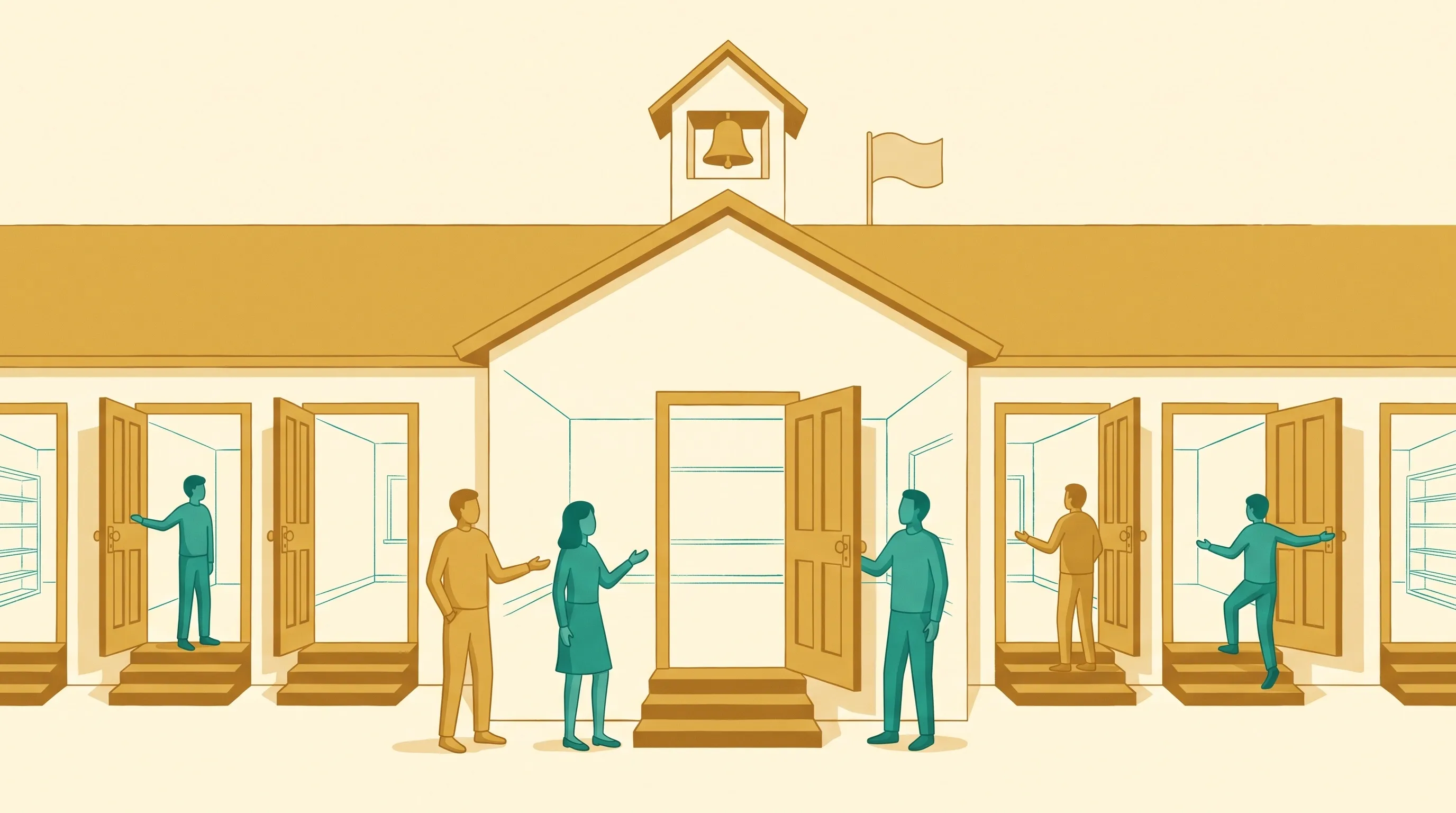
Morocco’s preschool enrollment rate for four- and five-year-olds reached 70.4% in 2025, up from 50.2% a decade earlier — and rural enrollment (75.6%) is now higher than urban, a crossover the same national evaluation traces back to 2022-2023 rather than to this year’s figures (Maroc.ma) (Aujourd’hui le Maroc). That’s the headline. The finding underneath it, from the same national evaluation, is less comfortable: access grew faster than quality did. The enrollment statistic tells a parent almost nothing about what a specific classroom will look like — and it tells an administrator even less about whether their own site would pass the same evaluation.
The Checklist: What Parents Ask — and What Your Site Should Already Be Answering
Morocco’s national preschool evaluation (CSEFRS, with UNICEF, published February 2026) surveyed 180 preschool units, 871 children, 180 educators, 180 administrators, and 624 parents across public, private, partnership, and informal sectors (Aujourd’hui le Maroc). These seven questions come straight out of what it measured — and every one of them is also a question a site director should be able to answer without checking:
- Is the educator formally trained in early-childhood development? Only 13% of children in the evaluation had a supervising educator with formal ECD training. Ask for it directly — don’t assume a diploma on the wall means what it implies.
- What curriculum does the site follow, and is it the national one? Morocco’s 2022-2026 roadmap calls for “unified curricula and pedagogical guides” across the network, plus a structured 950-hour initial training pipeline for educators (Ministere de l’Education nationale). Ask whether the site has adopted it or is still running something else.
- Which sector is it — public, private, partnership, or informal? The evaluation’s learning scores split by sector: private preschools averaged 71/100, informal settings 67, partnership programs 61, and public preschools 57 (Aujourd’hui le Maroc). Sector isn’t destiny, but it’s associated with a real gap in outcomes worth understanding before you sign.
- How, and how often, will the site communicate with you? Given the training and home-literacy gaps below, closing them takes a consistent way to reach parents — ask what that channel is and how often it’s actually used.
- Is there a book-lending or home-reading program? Nearly a third of children nationally owned no books at all — 53% in rural areas versus 16% in urban ones — and 58% had done no reading at home the previous week. A site that actively closes that gap should be able to say how.
- Is the provider part of a named partnership, and has it engaged with Morocco’s proposed quality label for early-childhood-development organizations? According to Le Brief, Morocco’s Ministry of Solidarity, Social Integration and Family announced plans for such a label in May 2024 (Le Brief); ask whether the site’s operator — a foundation, an NGO, or the school itself — has any update on where that stands.
- What does enrollment actually cost, and does it vary by sector? The national evaluation didn’t publish a cost breakdown alongside its learning scores, so this is one question no published figure will answer for you — ask the site directly, and ask whether the fee changes with the sector named in question 3.
Why Access Outran Quality
The CSEFRS evaluation’s core finding is that the national access gain and the national quality picture are two different things that happen to be moving in the same period, not one thing. Children in the sample averaged 62 points out of 100 on the evaluation’s learning assessment, with three-quarters clearing the 50-point intermediate threshold (Aujourd’hui le Maroc). Underneath that average sit three gaps that matter more than the topline score: an 8-point gap between urban and rural children, a roughly 12-point gap by household wealth, and the sector gap described in the checklist above. The educator-training figure — 13% of children supervised by a formally trained ECD educator — and the home-literacy figures — a third of children with no books at home, 58% with no reading in the past week — round out the picture of a system that built capacity faster than it built the training and home-support layers underneath it. None of this is causal evidence that any single factor produces a given learning score; it’s a correlational snapshot from one national evaluation.
What’s Actually Behind the Enrollment Gains
The growth itself is associated with a fairly well-documented set of contributing factors, worth naming so the access story doesn’t read as a mystery. Morocco’s Education Minister attributes rural expansion partly to easier land access for construction and to funding from the National Human Development Initiative (INDH) since 2018 (Morocco World News). The World Bank has lent $450 million specifically for rural early-childhood development, delivered partly through NGO operators — Fondation Marocaine du Préscolaire and Fondation Zakoura among them — that recruited and trained over 9,000 new educators, alongside a referral system that connected more than 500,000 mothers and children to health services (World Bank). INDH itself functions as a cross-ministry pilot incubator rather than a single program. These are plausible, documented contributors to the access numbers — financing, an NGO delivery model, and a specific governance structure — but the sources describing them are self-reported program narratives, not controlled comparisons, so treat them as one factor among several rather than the whole explanation.
Where the 70.4% Number Comes From
The 70.4% figure above comes from Morocco’s National Evaluation Authority (CSEFRS) and its Instance Nationale d’Evaluation, working with UNICEF — the same body behind the quality findings in this article, which makes it the most directly relevant number for a parent or administrator weighing quality against access. Public preschool units expanded from 6,185 to 23,182 over the same period (Maroc.ma).
Two other, differently-sourced figures circulate for the same general period. Morocco’s Education Minister told the House of Representatives that rural preschool enrollment rose from 35% in 2018 to 81% in 2025, with the national rate “expected to reach 85%” by year-end 2025 (Morocco World News). The World Bank’s own reporting puts national enrollment at 45% rising to 80%, and rural enrollment at 33% rising to 91% (World Bank). These shouldn’t be blended with the CSEFRS numbers above — they use different methodologies — but all three nonetheless point the same direction: sharp growth, rural outpacing urban. If you’re evaluating a specific site, the CSEFRS numbers are the ones tied to an actual quality assessment; the others describe the same expansion from a funding or policy vantage point.
Putting the Checklist Into Practice
For an administrator running a preschool or crèche — rather than a parent choosing one — every item above is also a to-do list, and each one has a concrete version rather than a vague one.
Educator training. In practice, this looks like listing each supervising educator’s ECD training and certification in the enrollment packet, and restating it on a one-page FAQ handed out at the first parent meeting of the year — not left for a parent to ask about.
Curriculum transparency. In practice, this looks like a short written summary of which curriculum guide the site follows, sent to every enrolling family before the first day, and pinned as a one-pager at the pickup point for the rest of the term.
Sector and partnership status. In practice, this looks like naming the site’s operator and any government or NGO partnership on the enrollment form itself, and — once the ministry’s quality label opens for applications — stating plainly whether the site holds it or has applied.
A real communication rhythm. In practice, this looks like a short weekly update — three or four bullet points, sent through the same channel every time — covering what the group covered that week, anything due from parents, and a note on any child-specific concern. For example: every Friday at 4 p.m., the toddler-room lead sends a four-bullet update to the “Petite Section A” group channel — this week’s theme, one item to bring Monday, and a one-line pickup-time note if a child seemed under the weather. A monthly newsletter cannot substitute for this; the evaluation’s home-literacy gap suggests parents need a steady, low-effort signal, not a long document a few times a year.
Home-literacy support. In practice, this looks like a rotating book-lending basket with a simple sign-out list, shared through the same channel parents already check for attendance and announcements, so borrowing a book requires no extra app or habit.
Named accountability. In practice, this looks like putting the operator’s name, its training pipeline, and its quality-label status on the same page a parent uses to enroll — not buried in a separate report only an administrator ever reads.
Cost transparency. In practice, this looks like stating the fee — and how it’s set — on the same enrollment form that names the sector and operator, rather than leaving families to ask or compare after the fact.
Parent Communication at a Moroccan Crèche Is the One Gap a Site Controls Directly
Funding, land access, and national curriculum rollout are largely outside any single administrator’s control. Communication with parents is not. Delivering the seven items above at any consistency — weekly, not occasionally; the same channel every time, not whichever one is convenient that day; in the family’s preferred language, not just the administrator’s — requires more than a WhatsApp group an assistant remembers to update. It requires a system that sends a message once and reaches every family’s channel and language, and keeps a record of what was actually sent when a parent asks — one that doesn’t depend on one staff member’s memory, the same kind of single point of failure that shows up nationally in figures like the 13% trained-educator rate the evaluation found.
Purpose-built communication platforms exist for exactly this workflow. BeeNet is one such option: it lets a preschool or daycare send organization-, group-, or class-level announcements in each family’s preferred language — French, Arabic, or English — through channels and messaging built for schools rather than adapted from a consumer chat app, with invitations by email, SMS, or WhatsApp so no parent is left off the list because they never installed an app. For a daycare or préscolaire specifically, that’s the difference between a communication plan that exists on paper and one that runs every week without anyone having to remember it — you can see how it fits a daycare’s day-to-day operations in more detail.
Morocco’s access numbers will keep climbing toward the 2028 universalization target regardless of any single site’s choices. Whether a given classroom closes the quality gap the evaluation just measured is a decision administrators are making this term, not a future one.
References
- Maroc.ma. “Le taux de préscolarisation des enfants est passé à plus de 70% en 2025.” 2026. https://www.maroc.ma/fr/actualites/le-taux-de-prescolarisation-des-enfants-est-passe-plus-de-70-en-2025
- Aujourd’hui le Maroc. “Les disparités territoriales et la qualité des apprentissages, principaux défis : Radioscopie du préscolaire au Maroc.” 2026. https://aujourdhui.ma/societe/les-disparites-territoriales-et-la-qualite-des-apprentissages-principaux-defis-radioscopie-du-prescolaire-au-maroc
- Morocco World News. “Morocco Rural Preschool Enrollment Jumps from 35% to 81% Since 2018.” 2025. https://www.moroccoworldnews.com/2025/12/273334/morocco-rural-preschool-enrollment-jumps-from-35-to-81-since-2018/
- Ministère de l’Éducation nationale, du Préscolaire et des Sports. “Programme national de généralisation et de développement de l’enseignement préscolaire.” 2026. https://www.men.gov.ma/fr/programme-national-de-g%C3%A9n%C3%A9ralisation-et-de-d%C3%A9veloppement-de-l%E2%80%99enseignement-pr%C3%A9scolaire%E2%80%AF
- World Bank. “Video: Morocco - Achieving Goals in Early Childhood Education.” 2025. https://www.worldbank.org/en/news/video/2025/09/24/video-morocco-achieving-goals-in-early-childhood-education
- World Bank (Arab Voices blog). “Morocco: An innovative approach to improving early childhood outcomes.” 2025. https://blogs.worldbank.org/en/arabvoices/morocco-an-innovative-approach-to-improving-early-childhood-outcomes
- Le Brief. “Fondation Zakoura : 27 ans de réalisations et de nouveaux horizons pour l’éducation.” 2024. https://www.lebrief.ma/fondation-zakoura-27-ans-de-realisations-et-de-nouveaux-horizons-pour-leducation-143040/
Ready to Transform Your School Communication?
Start saving time and increasing parent engagement with BeeNet.
Request Demo